Time-to-First-Commit as an Onboarding Health Indicator
Measure the four stages where new engineers stall to fix your onboarding system.

Time-to-first-commit is an engineering onboarding health indicator. It shows where access, environment setup, codebase comprehension, or workflow clarity keeps an engineer from contributing. Measuring those delays separately lets engineering leaders fix the onboarding system instead of blaming developers for being slow when the system fails them.
Why TTFC is a diagnostic signal, not a performance target
A useful TTFC measurement starts when access is granted and stops when the first PR merges to the main branch. Those boundaries make the measure auditable through a platform action and a Git event. Consistent boundaries matter because different definitions produce numbers that cannot be compared meaningfully.
The system-facing clock directs attention to how the organization receives a new engineer. Turning it into an individual target instead puts pressure on the person waiting for the system to work. A short interval can show that the path to contribution is clear, but the total alone cannot explain a long one. The diagnostic value of TTFC is in locating which stage broke.
The four layers TTFC can stall on — and what each delay signals
Access provisioning is the first layer to examine. Cycloid’s 2026 guide identifies the required access as SSO credentials, source control, CI/CD pipeline visibility, cloud account permissions, and monitoring dashboards. In a manual process, these can require separate tickets and one to two days of waiting. When access is first granted, some required permissions may still be missing, so incomplete provisioning can block work after the TTFC clock starts.
Environment setup is a separate layer, although it can overlap with access failures. The environment must mirror production configuration and support a local build and test before the engineer can make a meaningful contribution. A broken or non-reproducible environment can otherwise look like slow developer output. The distinction matters because a permission problem and a build problem require different fixes, even when they occur together.
Codebase orientation is the third layer and a major source of interruptions for experienced engineers. Without a software catalog or equivalent, new hires depend on colleagues to locate services, ownership information, dependencies, API documentation, architecture decision records, and coding standards. Tools such as Sourcebot, which index repositories across an organization and support natural-language search, give newcomers a way to find that context directly. The fourth layer is workflow clarity, including the branching strategy, PR process, and CI/CD pipeline. Cycloid’s 2026 guide describes the first task as validation that “environment, access, and workflow all function end-to-end”.
OneUptime’s onboarding tracking model combines milestone timestamps with blocker categories including ACCESS, DOCUMENTATION, TOOLING, ENVIRONMENT, and DEPENDENCIES. Those categories supply evidence about why progress stopped within a layer. They also avoid forcing every delay into a neat sequence when several problems are active at once.
What the benchmarks actually tell you about where most teams are failing
The performance spread is best read as a difference in platform preparation. Cycloid’s 2026 guide describes automated, self-service onboarding that compresses TTFC to under a day. It also reports an industry average time-to-productivity of two to four weeks. Those are different endpoints, so they should not be treated as a direct TTFC comparison. Their operational significance is the contrast between a prepared path to contribution and a prolonged ramp through manual processes.
CorrectContext’s 2026 guide reports that structured pre-boarding reduces time-to-first-commit by an average of five days. That gain comes from preparing access and environments before day one, rather than asking new hires to work faster afterward. A team should identify the layer consuming the most time and automate that layer first.
Preparation also includes the means to understand the codebase. Self-service architectural context and code search belong in the onboarding platform before day one. Providing that context through a catalog or a repository search tool such as Sourcebot reduces dependence on senior engineers for orientation. Otherwise, successful access automation can simply move the queue from permission tickets to unanswered architecture questions.
The hidden cost that makes a slow TTFC a leadership problem, not just a developer-experience problem
The cost of a slow start extends beyond the new hire’s salary. The Ramp Curve Lab puts the total first-90-days cost per engineer well into five figures when ramp salary, mentor time, tooling, and team velocity drag are included. Salary accounts for only a minority of that total. This makes onboarding delay a budget issue for engineering leadership and the CFO.
The mentor tax is particularly easy to miss because it appears as interruptions to existing work. A new engineer who cannot find architectural context independently must repeatedly ask someone who can. Access requests and workflow questions take up more of that time, and the cost grows with each new hire in a cohort. An automated, self-service process aims to bring avoidable interruptions of this kind close to zero so senior engineers no longer have to act as the default help desk.
TTFC also acts as a canary for the wider platform. Access-control gaps, brittle CI/CD pipelines, and under-documented architecture are obstacles to ongoing delivery that become especially visible when someone unfamiliar with the system tries to contribute. Fixing them cuts onboarding costs and makes work easier for the team already there.
How to instrument TTFC as a diagnostic tool rather than a vanity metric
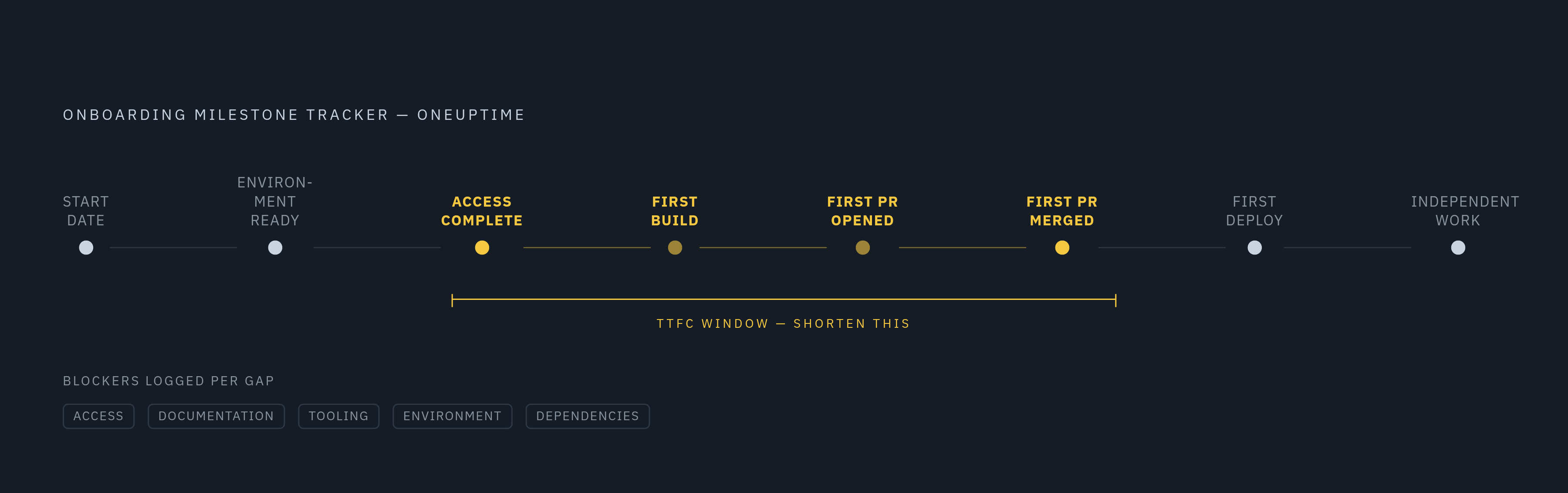
Instrumentation needs timestamps at layer boundaries. OneUptime’s onboarding tracking model defines milestones named START_DATE, ENVIRONMENT_READY, ACCESS_COMPLETE, FIRST_BUILD, FIRST_PR_OPENED, FIRST_PR_MERGED, FIRST_DEPLOY, and INDEPENDENT_WORK. The model combines automated events with manual checkpoints. It covers a broader journey than TTFC, which makes it useful for retaining context before and after the first merged PR. That broader record should still track the time from access granted to merge separately.
The gaps between milestones first show where delays are, and blocker records help explain why they happened. Logging ACCESS, DOCUMENTATION, TOOLING, ENVIRONMENT, and DEPENDENCIES makes recurring causes visible across hires. Because access and environment work can overlap, elapsed time alone is not enough to assign a cause. If FIRST_BUILD keeps taking longer than expected, its blocker records help show whether the cause is build tooling, missing documentation, or missing permissions.
Cycloid’s 2026 guide gives teams concrete reference points, including access provisioning within hours, codebase orientation within two to four hours, and a first PR merged by the end of day two. These reference points are thresholds for examining the performance of the onboarding system. The unit of analysis remains the duration of provisioning, orientation, or workflow blockage. Commit volume and PR count should not substitute for those measurements because neither explains whether the path to contribution works.
How can new engineers understand a large codebase faster — and where AI context tools help
Codebase comprehension resists process automation more than access provisioning or environment setup. Scripts and service catalogs can prepare accounts and environments, but understanding an unfamiliar system requires architectural context. Historically, that context came from extensive documentation or time with a senior engineer. The orientation bottleneck is therefore not simply finding a file. It is understanding how services, dependencies, and decisions connect across the codebase.
Cycloid’s 2026 guide identifies a software catalog as a structural answer to the question of “where everything lives”. A catalog can make ownership and architecture discoverable, but it must remain current and comprehensive. Repository-aware AI gives contributors another way to ask questions about the codebase directly. Its usefulness depends on the scope of the context it can reach.
An agent limited to files open in an editor cannot explain relationships that lie outside that context. Full-codebase access changes that boundary by making other repositories and relevant architecture documentation available for the answer. The Model Context Protocol, or MCP, is an open standard through which agents connect to external data sources and tools, including codebases.
Sourcebot deploys as a single Docker container, indexes configured repositories across an organization, and exposes that index through a built-in MCP server. Its natural-language interface also lets new hires and non-engineers ask questions about repositories directly. This makes it a self-hosted example of the same structural approach as a comprehensive catalog, with repository-aware search available to both people and agents. The relevant selection criteria are coverage, access to architectural context, and availability at the start of onboarding.
The data-sovereignty tradeoff engineering leaders must make before choosing an AI onboarding tool
For sensitive repositories, the question is not only whether AI can shorten orientation, but whether it does so without routing proprietary code through a third-party model provider. The boundary changes depending on whether a tool is cloud-hosted or deployed inside the organization. Engineering leaders must account for the exposure risk and the infrastructure work before committing to a toolchain.
The EU AI Act imposes data governance and logging obligations on high-risk AI systems, while explicit data residency requirements come from GDPR. HIPAA’s proposed 2025 Security Rule update, described in the brief as still unfinalized as of 2026, expects AI tools to be included in organizational risk analysis. These requirements make the flow of code and context relevant to tool selection.
Self-hosting allows the code intelligence layer to remain inside the organization’s infrastructure while still providing full-codebase context to agents. However, that deployment boundary must be considered together with the model provider receiving the context. Sourcebot’s single-container deployment and bring-your-own-model flexibility give teams control over both the hosted index and their choice of LLM provider. Keeping code internal and preventing third-party training depends on using that control consistently. Self-hosting resolves the structural residency problem only when the model path respects the same boundary.
Using TTFC data to close the feedback loop and improve the onboarding system over time
An individual onboarding record helps explain one delayed contribution, but cohort trends reveal the system’s health. Comparing milestone durations over time shows whether a fix removed a bottleneck or whether the same blocker continues to recur. Increasing environment setup time, for example, can signal growing complexity without corresponding automation investment. The value of the measurement compounds when it changes platform decisions.
CorrectContext’s 2026 guide describes a 30-60-90 plan with clear goals and performance expectations at each phase. Those boundaries provide review points for the wider ramp beyond TTFC. Before day one, the focus is access and environment preparation. The first build and merged PR then test the path to a first contribution, while later checkpoints show how close the engineer is to working independently. Aggregated blocker categories can become a platform backlog ranked by how often each category caused delays.
A typo fix or documentation update may produce a reassuring number without exercising the path that meaningful engineering work requires. TTFC is a gate metric, and it should be paired with a scoped task that passes through actual code review and CI/CD. Cycloid’s 2026 guide specifies a real customer-affecting bug or small feature.
That distinction completes the feedback loop. TTFC should therefore remain a recurring health measurement. Engineering teams that use it this way improve the platform for everyone who depends on it.