The Hidden Onboarding Cost in Engineering Team Productivity Budgets
Senior mentor time and productivity loss during ramp-up dwarf traditional recruiting costs.
Engineering onboarding costs far more than recruiting spend because the full bill includes senior mentor time and months of reduced output while a new hire learns the codebase. Reducing that cost depends on making architecture, dependencies, and implementation patterns easier to discover. A complete budget makes those hidden costs visible and shows where documentation, structured plans, and searchable code can shorten the ramp.
Why engineering onboarding costs far more than HR budgets show
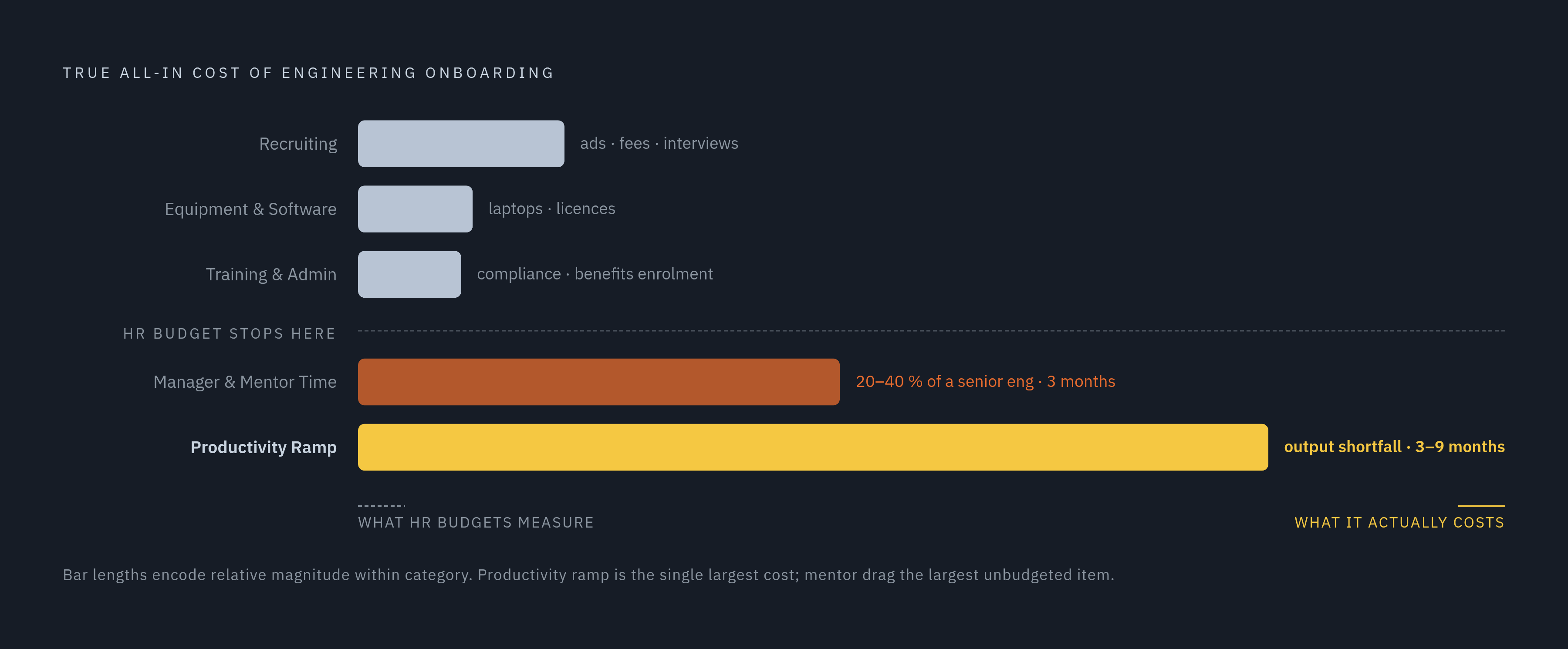
SHRM’s direct cost-per-hire figure counts what is spent on recruiting. It does not measure the full cost of making an engineer productive. Once equipment, training, mentor time, and the productivity ramp enter the calculation, the all-in cost reaches a substantial share of annual salary.
The largest omissions sit inside engineering. Senior engineers can spend 20–40% of their working hours supporting a new hire during the first three months, while the new hire remains below full output. Those costs appear as salaries already committed. As a result, a budget can accurately record recruiting expenditure while understating the capacity needed to absorb the hire.
The five cost categories that make up the real number
The full model contains five categories, namely recruiting, equipment and software, training and admin, manager and mentor time, and the productivity ramp. Recruiting covers job ads, recruiter time or agency fees, and the interview process. Equipment and software cover laptops, monitors, and tool licences, which can run to several thousand dollars for engineering roles. Training and admin include compliance courses, product training, and benefits enrolment, with costs that vary by role complexity.
Manager and mentor time counts the work that employees already on the team set aside to help someone else get up to speed. The productivity ramp measures the new hire’s shortfall from full output while they learn the system. These are distinct costs because an hour spent explaining architecture consumes the mentor’s capacity even while it helps the new hire recover theirs. Counting both keeps the model from treating knowledge transfer as free just because both people are already on payroll.
Senior mentor drag: the cost no onboarding calculator models
Senior mentor drag is the largest unbudgeted line item in engineering onboarding. A senior engineer usually spends 20–40% of their working hours in the first three months answering questions, reviewing pull requests, explaining architecture decisions, and debugging problems the new hire cannot yet spot. Standard onboarding calculators leave this work outside the model. The time still has to come from somewhere, usually the engineering work that the mentor would otherwise have completed.
That trade-off matters when the same engineer has to meet a quarterly roadmap milestone. The cost includes the value of the hours spent mentoring and the output those hours would have produced, an opportunity cost. An engineering leader planning a budget needs to track both the salary already committed and how much work the team has time to deliver.
Mentorship is also necessary, so eliminating it would be the wrong objective. Some questions need human judgment, while others need access to information that is already there. Tools such as Sourcebot, a self-hosted code intelligence platform with full-codebase indexing and natural-language search, can help new hires discover architecture, APIs, and implementation patterns independently. Even a modest reduction in mentor drag per hire can compound across a hiring cohort, leaving more mentor time for context that only people can transfer.
The productivity ramp and what codebase opacity does to it
The productivity ramp is the biggest single cost category, even when mentor drag is the largest unbudgeted one. A software engineer usually takes three to nine months to reach full output, and a senior engineer’s ramp can take longer. The decisive constraint is often codebase navigability. A legacy monolith can impose a meaningfully longer ramp than a well-documented codebase because experience alone does not reveal its local assumptions.
Consider a staff engineer joining a system they do not know. Seniority does not supply knowledge of its architecture, deployment pipelines, or business context. The engineer still needs to understand how the code behaves and which design decisions constrain a change. Until that context becomes discoverable, hiring someone more experienced does not remove the underlying bottleneck.
Documentation helps only to the extent that it remains useful for the current system. When it is out of date, the new hire must return to code exploration or questions to senior engineers. Searchable code across every repository provides another route to those answers. The ramp therefore depends not simply on how much information exists, but on whether a new hire can find the information needed to make a safe contribution.
Early attrition: when the ramp never completes
If an engineer resigns after eight weeks, the organisation has paid for recruiting, equipment, training, and a partial ramp without completing the intended knowledge transfer. Senior engineers have also spent time supporting someone whose departure restarts the process. The next hire needs someone to explain things, review their work, and help with debugging all over again.
Brandon Hall Group research finds that organisations with a strong or well-defined onboarding process retain new hires at a markedly higher rate than those using ad-hoc programmes. That makes onboarding quality relevant to whether the investment reaches completion and how quickly it pays back. The cost to replace a departing engineer can run from half to twice annual salary when re-recruiting, lost institutional knowledge, and team-morale drag are included. A cost model that assumes every new hire finishes the ramp leaves out the time the team spends helping each replacement.
Non-engineers face the same codebase barrier with no onboarding programme at all
Product managers, support staff, and security reviewers need answers about system behaviour, dependencies, and design decisions. Yet these roles often receive no structured onboarding to the codebase. In many organisations, their route to an answer is another interruption to a senior engineer.
Unlike new-hire mentor drag, this stream of questions has no natural completion date. Each new product question, compliance review, or support escalation means someone has to search for context again. The mechanism is the same, namely senior engineering time diverted from output-producing work, but no onboarding budget owns it. Documentation and searchable code can make that context accessible without requiring each question to pass through an engineer. This broadens the value of codebase navigability beyond the cost of any individual hire.
How AI coding agents hit the same retrieval cliff on day one
AI coding agents encounter a similar limit when they can see only local code. They cannot reliably answer cross-repository questions about which services call an RPC, which fields are consumed downstream, or which design decisions constrain a change without access to that context. The missing information is organisational. Even when agents generate code faster, they still need to know how the wider system fits together.
Without that knowledge, an agent can make a change that breaks an undocumented dependency. This resembles a new hire making a production change without understanding the deploy process. In both cases, things go wrong before implementation because the needed context is missing. Agents can repeat the failure across queries, while new hires face it during the human ramp period.
The emerging division of labour separates discovery from reasoning. Static analysis discovers structure across repositories, AI reasons over that structure, and MCP, or Model Context Protocol, delivers relevant context at query time. Teams also build a context layer that holds architecture decision records, design patterns, and guardrails. Surfacing that accumulated knowledge to each agent avoids treating every run as another first day.
Where the real leverage is: what actually compresses the ramp
The strongest interventions reduce the amount of codebase knowledge that must be transferred through interruption. Living runbooks and architecture documentation move basic questions from a senior engineer to a durable reference. Their value is practical rather than ceremonial, measured in questions answered and mentor hours recovered. They also leave people more time to talk through judgment, trade-offs, and business context.
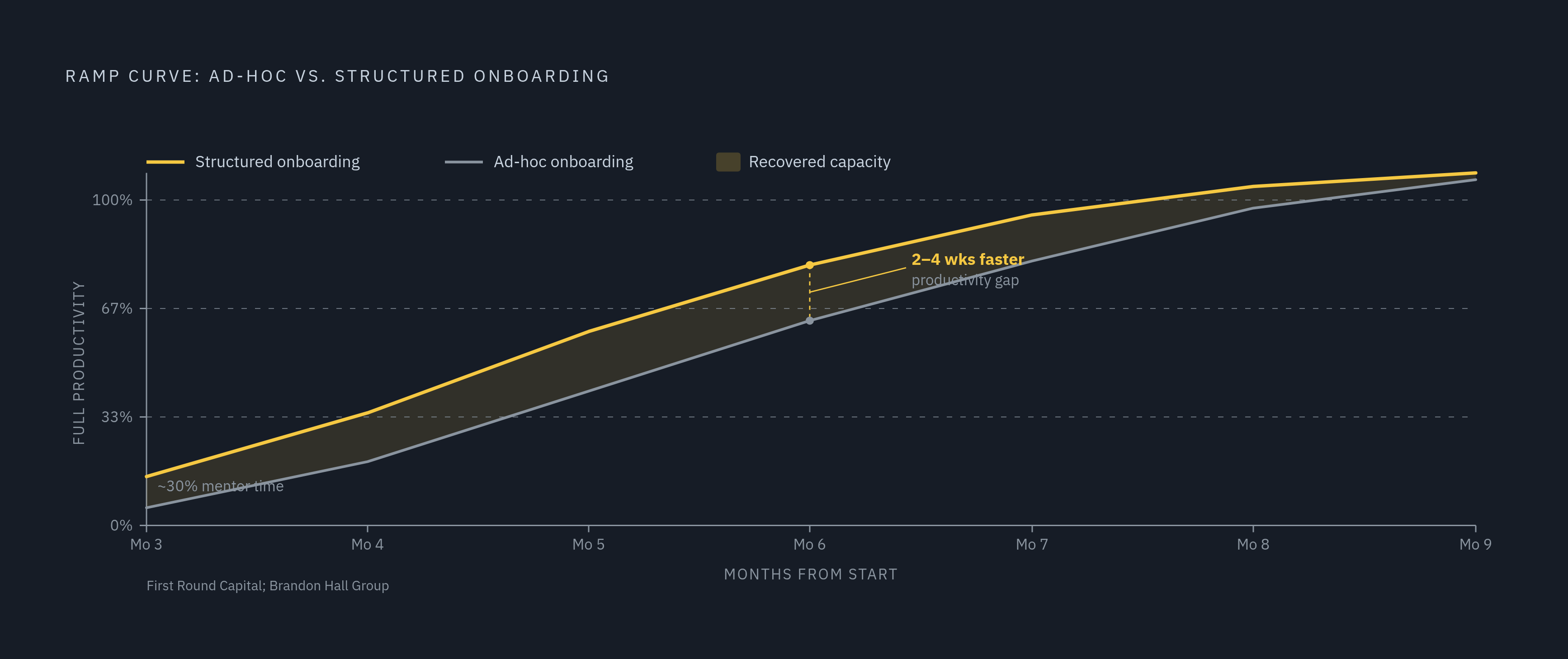
Structured onboarding plans then put that information in an order that new hires can follow. First Round Capital ramp research finds that structured plans move the ramp curve left by two to four weeks compared with ad-hoc programmes. A dedicated onboarding buddy, separate from the hiring manager, concentrates support and reduces interruptions across the team. During the first three months, this structure addresses both the new hire’s progress and the mentor capacity consumed along the way. Across the longer three-to-nine-month ramp, the goal is to reach full output, which takes more than finishing administrative tasks.
Code search and navigation address the questions that survive documentation. Sourcebot indexes the full codebase and provides natural-language search, making it one option for giving engineers and AI agents access to context across repositories. The relevant criteria are company-wide coverage, useful navigation, and access to the information needed to understand a change. The same infrastructure can also help non-engineers answer questions about the system without interrupting someone.
The governance cost that most onboarding budgets still do not model
Mature MCP and agent infrastructure need least-privilege access controls, audit trails of agent calls, and a way to roll back agent actions. These controls take dedicated attention. A budget that counts only the productivity benefit of a context layer repeats the original mistake by leaving its operating cost invisible.
The comparison with Kubernetes is instructive. Containerisation solved a real problem and also gave rise to platform engineering as a field of work. AI context infrastructure is following a similar path, with AI enablement specialists beginning to own what agents can and cannot touch. That ownership belongs in the cost model.
Data handling is part of the same calculation. Cloud-hosted AI coding tools with opt-out rather than opt-in privacy settings can require individual developers to act to prevent code from being used in model training, although enterprise-tier plans are typically exempt by default. Self-hosted deployments can keep code and audit trails inside the organisation’s infrastructure, but teams still need to control access and what agents can do. Tooling may indeed replace the work of onboarding with the work of governance. Governance can be scoped, staffed, and budgeted.
What an honest onboarding cost model looks like in practice
An honest model presents SHRM’s recruiting benchmark as one line. It then adds equipment and software, training and admin, manager and mentor time, and the productivity ramp. For a software engineer at a mid-market US company, those categories produce a substantial all-in cost, with a higher total for a senior engineer. Early attrition adds the risk that the organisation will incur much of that cost again before the investment reaches full output.
A two-week reduction in ramp time reduces the productivity shortfall for every hire. Reducing mentor support from 30% of working time to a meaningfully lower level recovers part of the established team’s capacity. Documentation, structured plans, and code search can then be assessed against the categories they affect, with governance costs included.
The model also needs to distinguish per-hire savings from ongoing reductions in interruptions. Non-engineers and AI agents continue to need codebase context after a new engineer completes onboarding. A self-hosted option such as Sourcebot meets that shared need by giving engineers, non-engineers, and agents a natural-language interface they can use to query code across repositories. The practical decision is whether the infrastructure and programme costs are justified by lower mentor drag, a shorter ramp, and fewer repeated demands on senior engineers. Engineering onboarding becomes a manageable investment when the budget measures the capacity required to make someone productive.