Standardizing the Local Development Environment Across a Distributed Engineering Team
Environment drift ruins distributed teams when AI agents join the workflow.
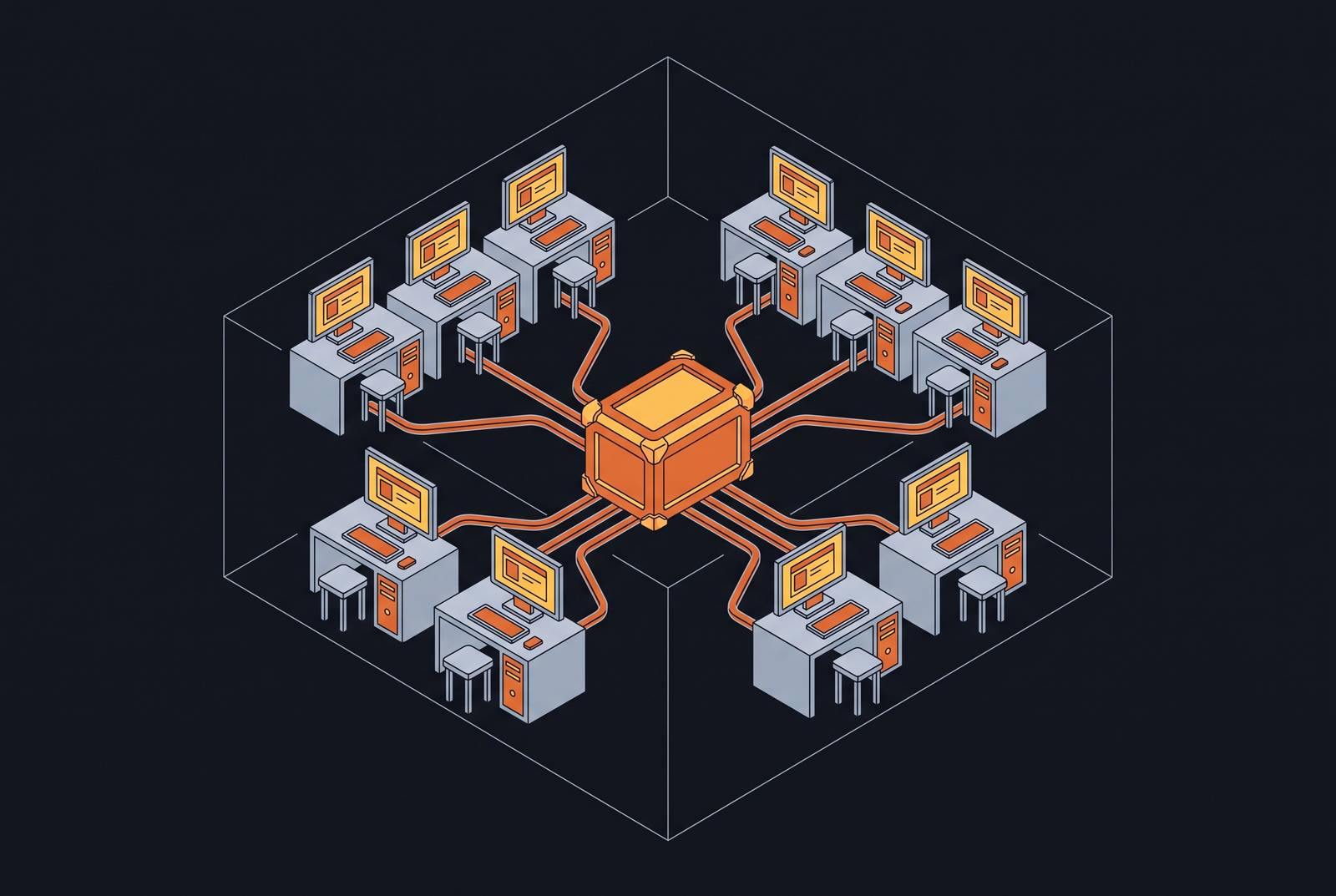
Standardizing the local development environment across a distributed team is not primarily a matter of picking the right tools.
"Works on my machine" is still a real problem in 2026
The phrase just changed shape. It just changed shape.
Distributed teams make the problem worse by construction, not by accident. Engineers spread across continents carry different hardware, different OS defaults, different locally stored secrets, and, critically, no shared party responsible for keeping any of it aligned. Everyone has an opinion about which linter to run or which Node version is best, but few teams have an enforced contract governing how environments get configured, versioned, or checked before code ships. That gap, between opinion and enforcement, is the discipline gap, and it is where drift lives.
The stakes changed again with the arrival of AI coding agents as a daily tool rather than a novelty. A recent benchmark of more than 50 engineering leaders found that nearly 90% report their teams actively using AI in some form. That number matters here because once agents are embedded in the workflow, environment inconsistency becomes an agent-behavior problem in addition to a builds problem, since an agent's output depends on the context it can see, and that context is itself part of the environment.
What a standardized local environment contains
Five layers need to line up before anyone can call an environment "standardized. Runtime and language versions, Node, Python, Go, the JVM, need to be pinned to exact numbers rather than left at "latest". Secrets and credentials need a defined storage and injection path rather than a scattering of local .env files. Service dependencies, databases, queues, third-party stubs, need to run locally rather than pointing at a shared staging environment that everyone quietly depends on and nobody owns. Code and CI/CD tooling, formatters, linters, pre-commit hooks, pipeline definitions, need to be identical across machines.
Where things live across repos, which service owns which piece of functionality, how the codebase is actually structured. That knowledge usually sits in the heads of senior engineers, and new hires acquire it by interrupting those same engineers, over and over, which is a slow and expensive way to onboard anyone.
Everyone running the same tools is not the same as everyone running the same configured tools. Configuration parity, both engineers running the same linter rules, the same pre-commit hooks, the same formatter settings, is what actually prevents drift, and most teams skip it.
AI agents add a new wrinkle to this list rather than sitting outside it. An agent needs the same structured context a good manager would hand a junior engineer on day one: what the service does, what it must not touch, which conventions apply. Skip that step, and two engineers working the same codebase with differently configured agents will get meaningfully different output, a new and more subtle version of the old problem.
Containers as the baseline contract for runtime consistency
Version managers alone don't close the gap. An .nvmrc file or a pyenv configuration still depends on whatever else lives on the host machine, the OS, the system libraries, and whatever else is installed globally. A container removes that surface entirely, because the runtime is defined once, in a file, and travels with the code rather than living on the state of somebody's laptop.
Docker Compose has become the default local orchestration primitive for a reason: one file can declare every service dependency, its version, its environment variables, and the order in which things need to start, and that file lives in the repository rather than on one engineer's machine where nobody else can see it. This sounds like a small distinction. It is not. A Compose file checked into source control is auditable, reviewable, and reproducible; a setup script passed around in a Slack thread is none of those things.
There's a useful rule of thumb for internal tooling here: if a developer tool can't be stood up with a single container image or a short Compose file, expect some engineers to skip it entirely, since friction at setup time correlates almost perfectly with which tools actually get adopted across a team and which quietly die on a wiki page. That is not a hypothetical, it's a predictive signal. Friction at setup time correlates almost perfectly with which tools actually get adopted across a team and which quietly die on a wiki page.
Dev containers, the VS Code and devcontainer.json specification, push this a step further by making the container the editor's runtime, not just the application's. That closes off an entire category of drift: mismatched IDE plugins, inconsistent language server versions, extensions that behave differently across machines. Once the editor itself runs inside the same defined environment as the application, most of the classic "it works for me" bugs simply stop occurring, because there is no longer a meaningful difference between "me" and anyone else on the team.
Configuration-as-code: what to version-control
Certain files belong in the repository without exception: Compose files, devcontainer configs, linter and formatter configuration such as .eslintrc, .prettierrc, or pyproject.toml, pre-commit hook definitions, CI pipeline definitions, and AI agent context files like AGENTS.md or .cursor/rules. These are the team's working agreement, expressed in a form that code review can actually enforce, not personal preferences. They are the team's working agreement, expressed in a form that code review can actually enforce.
Certain things must never go in the repository, no matter how convenient it seems in the moment: actual secrets, personal access tokens, and one-off local overrides that only a single engineer needs. Those require a separate path entirely, and treating them as a repo problem is how leaks happen.
Secrets management deserves to be treated as a discipline problem in its own right, not an afterthought bolted on after the tooling decisions are made. The pattern that causes the most damage is familiar: secrets sitting in gitignored .env files, copied over Slack when someone joins a project, rotated inconsistently or not at all.
None of that matters if enforcement depends on good intentions. Secrets injection needs to happen automatically at container startup, through the secrets manager itself, rather than through a line in a README that some engineers read and others skip. The same logic applies to formatter and linter configuration: the moment those settings live in individual home directories instead of the repo, code review loses its ability to enforce a shared standard, because there is no longer a single standard to point to. Sources note Infisical as a serious self-hosted alternative to Doppler for secret management, alongside Vaultwarden for credential storage with end-to-end encryption and offline resilience.
CI/CD as the enforcement layer that validates local discipline
If something passes locally and fails in CI, the local environment is what's wrong, not the pipeline. CI is the ground truth. The developer's machine is not, no matter how senior the developer or how confident they are that "it works fine" on their end.
Adoption of CI/CD is broad but far from universal. Roughly 55% of developers report using CI/CD tools regularly, with GitHub Actions leading organizational adoption at 33%, Jenkins at 28%, and GitLab CI at 19% https://blog.jetbrains.com/teamcity/2026/03/best-ci-tools/.
Parity is the requirement that makes CI meaningful as a validator in the first place. CI has to run the same container image and the same environment variable injection path as local development; if the pipeline builds from a different base image than the one developers use locally, it cannot actually catch the drift it exists to catch. A CI system that diverges from local setup isn't validating local discipline, it's validating its own separate reality.
For teams that can't or won't send code to a SaaS runner, self-hosted CI has matured considerably. Forgejo Actions offers a GitHub Actions-familiar experience, migrating workflows with minimal changes, and imported GitHub repositories can run their pipelines unmodified if no .forgejo/workflows/ directory exists. Woodpecker CI has reportedly eclipsed Drone among indie teams since its 3.0 release shipped a cleaner YAML syntax. TeamCity, meanwhile, is built for polyglot, enterprise-scale organizations that need complex build chains, snapshot dependencies, test history, and hybrid cloud and on-premises deployment all at once.
Internal developer portals as the surface that makes standards visible and self-serve
Standards that exist only in a README, a Confluence page, and one engineer's memory mean new hires and non-engineers cannot find the canonical version. New hires can't tell which one is canonical, and neither can anyone outside the immediate team. A portal solves this by making the standard the only visible path, rather than one option among several conflicting ones.
A portal is the UI, a platform is the engine. A portal without an execution layer behind it can surface a standard beautifully and still have zero power to enforce it. Teams evaluating this space need to know, going in, which one they're actually buying, because the two solve different problems and get pitched as though they're interchangeable.
Backstage, originally built at Spotify and now under the CNCF, is the clearest example of the portal category done well, combining a service catalog, a documentation system called TechDocs, and software templates for scaffolding new services. It requires real, sustained engineering effort to deploy and maintain, and it is explicitly a portal, not an execution layer, so it will not run enforcement on its own.
What a portal contributes specifically to environment standardization is concrete rather than abstract. Software templates can scaffold a new service with the correct Compose file, devcontainer configuration, linter setup, and AGENTS.md file already in place, so a new service starts compliant instead of getting retrofitted later. Service catalog entries document which repos exist, what each one owns, and how to run it locally, which is exactly the tribal knowledge that otherwise lives in one person's head. TechDocs or an equivalent system turns the onboarding contract into living documentation, versioned alongside the code it describes rather than drifting away from it over time.
Onboarding contracts: the written agreement that makes standards stick
An onboarding contract is a documented, version-controlled checklist with exit criteria, something every new engineer, and every returning engineer after a long absence, has to complete before writing production code, not a wiki page. It's a documented, version-controlled checklist with exit criteria, something every new engineer, and every returning engineer after a long absence, has to complete before writing production code.
It needs to cover how to clone and start the local stack with a single documented command that's actually tested against the current container image. It needs to specify how to get secrets, naming the specific tool and the specific path, rather than defaulting to "ask someone on Slack". It needs to show how to run the test suite locally and define what a passing result actually looks like. It needs to spell out how AI coding agents are configured for that particular codebase: which AGENTS.md files exist, which MCP servers are available, what the team's model rules say. And it needs to explain what the pre-commit hooks check for and how to run them by hand when needed.
Seniority is where this tends to fall apart. Junior engineers follow the onboarding contract because they have no alternative. Senior engineers skip it constantly, because they can reconstruct a working environment from memory faster than they can read the checklist, and that shortcut is exactly where drift originates. It is also the hardest constraint to fix, since the people most capable of bypassing the standard are usually the people with the least incentive to follow it.
This is the practical version of the "truck factor" argument. When environment knowledge lives entirely in one senior engineer's head, the team is one resignation away from a genuinely painful reconstruction effort. A written onboarding contract turns that knowledge from one person's property into something the organization actually owns.
AI coding agents as a new dimension of environment consistency
Agents are no longer a side experiment that a few engineers run for fun. As of mid-2026, roughly 90% of professional developers were using AI coding agents at work at least weekly, and 68% were using them daily https://blog.jetbrains.com/research/2026/08/ai-coding-agent-adoption-2026/. At that level of penetration, an agent is part of the environment in the same sense that a compiler or a test runner is part of the environment, not an optional add-on layered on top of it.
That creates a genuinely new consistency problem. Two engineers working the same codebase, with different AGENTS.md files, different MCP server connections, and different model rules configured, will produce substantively different output from the same prompt. That is "works on my machine" wearing a new outfit, and it is arguably harder to catch than the old version, because the failure doesn't appear as a broken build, but rather as subtly inconsistent code that still compiles.
AGENTS.md has emerged as the answer to at least part of this. By early 2026 it had become the cross-agent standard read natively by Codex, Cursor, Aider, Copilot, and Windsurf, among others, though Claude Code requires a CLAUDE.md bridge and Gemini CLI uses its own GEMINI.md file natively. It belongs in the repository next to the Compose file and the devcontainer configuration, as a shared team asset.
MCP, the Model Context Protocol, plays the equivalent role for connecting agents to internal tools and data. Anthropic introduced it in November 2024, and it has since been adopted by OpenAI, Google DeepMind, Microsoft, and thousands of development teams, with both companies donating their respective standards to the Linux Foundation's Agentic AI Foundation in December 2025. The scale of adoption is not marginal: the Python and TypeScript SDKs together see roughly 97 million monthly downloads, which puts this well past the experimental stage https://workos.com/blog/everything-your-team-needs-to-know-about-mcp-in-2026. For local development specifically, MCP typically runs over STDIO transport, where the AI host launches the MCP server as a local subprocess. That approach is fast and secure, and it's what powers local workspace indexing inside tools like Cursor and Claude Code. The practical implication for standardization is straightforward: MCP server configuration, files like .cursor/mcp.json, belongs in the repository and in the onboarding contract, exactly like any other piece of shared environment configuration. It was donated by OpenAI to the Agentic AI Foundation, alongside Anthropic's MCP, in December 2025, making it a vendor-neutral standard.
Full codebase context: why local-only agent access is a structural limitation
Even a perfectly standardized local setup runs into a ceiling that no amount of configuration-as-code can fix on its own. An engineer's machine can only ever hold a fraction of an enterprise codebase, and an agent restricted to what's checked out locally can't reason about cross-service dependencies, who consumes a given API, or the blast radius of a change reaching outside the repo it's sitting in.
That's a structural limitation, not a configuration problem, and no local Compose file or devcontainer spec resolves it. To reason well about a change, agents need a representation that spans further than any single checkout, connecting code to the services that run it, the APIs those services expose, the fields those APIs return, the consumers depending on them, and the sensitive dataflows and third-party integrations touching all of it. Local standardization gets a team most of the way there. It gets every engineer, and every agent, working from the same starting point. But the reasoning an agent needs to do about the consequences of a change downstream requires visibility that a local machine, however consistently configured, was never built to hold on its own. Claude Code adoption was at 18% among professional developers in January 2026 https://blog.jetbrains.com/research/2026/08/ai-coding-agent-adoption-2026/. Vaultwarden maintains idle resource consumption under 30 MB of RAM https://dev.to/roberts_jakuko_fbc04cb38/top-5-open-source-self-hosted-developer-tools-for-2026-infrastructure-3doj. Uptime Kuma dispatches incident alerts across more than 90 notification providers https://dev.to/roberts_jakuko_fbc04cb38/top-5-open-source-self-hosted-developer-tools-for-2026-infrastructure-3doj. 18% of respondents report not using any CI/CD tool at all https://blog.jetbrains.com/teamcity/2026/03/best-ci-tools/.