Self-Hosted Developer Tooling Strategy for Enterprise Engineering Platforms
Enterprise platforms now require self-hosted tooling for compliance, cost control, and speed.

What a self-hosted developer tooling stack looks like in 2026
Self-hosted developer tooling has stopped being a cost-saving side project. It's now an infrastructure decision with direct consequences for compliance, engineering headcount, and how fast a company can ship. The forces pushing enterprises toward it aren't abstract: subscription costs on SaaS dev tools keep climbing, API quotas shift without warning, and regulators are getting specific about where code and prompts can legally live. Gartner expects 80% of large software organizations to have dedicated platform teams by 2026. Tooling decisions now sit with people whose job is the platform itself, not with individual developers picking favorites.
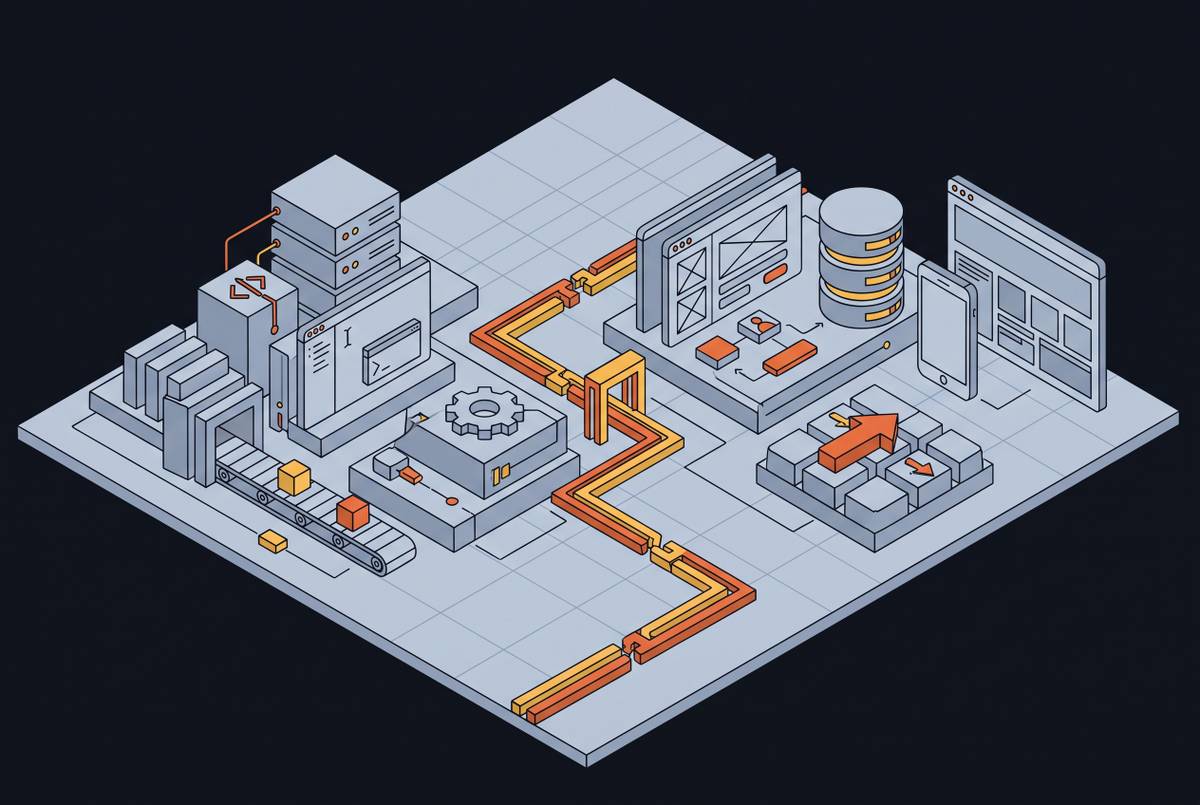
Most teams get the layering wrong before they get anything else wrong. At the top sits the developer-facing layer: portals, service catalogs, scorecards, self-service actions, the things a developer actually clicks on. The platform backbone, usually Kubernetes plus GitOps plus infrastructure-as-code, provisions and runs anything, and that function is what that layer supplies. Below that come guardrails (policy-as-code, secrets management, supply-chain controls), feedback loops (observability, reliability data, cost data), and an automation layer for workflow engines and AI or ops agents.
A developer portal is not a developer platform. That distinction sounds pedantic until a team buys a slick portal, points it at nothing, and discovers there's no execution engine underneath to provision infrastructure, deploy a service, or roll back a bad release. A portal is the UI. A platform is what actually does the work. Plenty of teams learn the difference after signing the contract, not before, which is exactly backwards.
A workable starter IDP needs one tool each from platform orchestration, infrastructure-as-code, container orchestration, and a delivery layer. The portal should be the last decision made, not the first, because it carries the least leverage over whether anything it depends on actually works. Most organizations end up assembling a stack from several tools rather than buying one finished product from a single vendor, and the real question is which combination produces a coherent stack rather than integration debt someone has to pay down in year two. It's whether the combination produces a coherent stack or produces integration debt that someone has to pay down in year two.
The real total cost of "free and open-source" at enterprise scale
Organizations that went self-hosted with Backstage found out that "free and open-source" translates to a standing team of 3 to 12 dedicated engineers, indefinitely. Organizations that bought a proprietary platform instead found themselves locked into a data model they can't migrate out of without a rebuild. Neither path is free. They're just charged differently, and the mistake is assuming the sticker price on either one reflects the real bill.
Self-hosted Backstage installations run up a substantial sum in annual operational overhead once staffing, infrastructure, and maintenance get counted honestly. Part of that is what practitioners call the TypeScript tax: Backstage's frontend runs on a component-based frontend framework, and maintaining that frontend infrastructure doesn't stop being work once the initial rollout wraps. It's a recurring line item, not a one-time cost. The commonly cited figure of $2 million and a year of engineering time for a full portal buildout represents a real outcome for under-resourced self-hosted IDP projects, and teams that budget for less almost always end up paying the difference in overtime and delay.
The decision actually breaks into three categories, and most vendors only want to talk about two of them. Build, meaning self-hosted open source, gives maximum flexibility, but the operational overhead is the real cost, not the license fee a team thinks it's avoiding. Buy, meaning proprietary SaaS, gets a polished interface fast but comes with permanent vendor lock-in and a data model that's often difficult or impossible to export cleanly. Hybrid, meaning managed open source, gets the portability of the open-source ecosystem without carrying the full engineering tax in-house. For organizations in the 50 to 150 developer range, the size where a dedicated platform team isn't yet justified but ad hoc tooling has already started to hurt, hybrid is the right default, and teams that skip straight to build or buy at that size are usually solving for a headcount they don't have yet.
Data sovereignty and code privacy as non-negotiable constraints, not preferences
62% of enterprises report having experienced an AI-related data exposure incident, and most of those trace back to weak input controls or data handling policies nobody had actually written down. Treating sovereignty as a compliance checkbox rather than an architecture constraint is how organizations end up on the wrong side of that number.
The exposure vector has shifted. It used to be about data sitting at rest in some misconfigured bucket. Now it's code and prompts in transit, headed to a third-party API that most security teams have never actually audited. AI coding assistants that ship code out to an external model create a new egress channel, and in a lot of organizations, nobody is watching it. The vulnerabilities aren't hypothetical, either. CVE-2025-53773 describes a hidden prompt injection buried in repository files, things as ordinary as a documentation file or a config file, that enabled remote code execution. Separately, EchoLeak, affecting Microsoft 365 Copilot, was a zero-click prompt injection capable of quietly exfiltrating enterprise data without a user doing anything wrong.
Three forces are turning self-hosting from a nice-to-have into a requirement, and platform teams that still treat it as optional are misreading the direction of travel. Regulated industries face data residency mandates that rule out sending source code to an undisclosed processing region. There's genuine IP risk in the fact that code sent to a third-party model may inform that model's training or get retained somewhere outside the sender's control. And audit requirements are catching up: enterprises increasingly need a log of what code went where, and most SaaS tools simply don't produce that log in a form anyone can hand to an auditor. A growing share of enterprises are moving to private AI setups specifically to keep that control in-house, addressing sovereignty, latency, and IP risk all at once, by keeping processing physically close to where the data already lives.
Strengths of the open-source self-hosted ecosystem in 2026
The technical case for self-hosting has changed. Single-binary architectures, containerized deployment, automatic TLS renewal, and configuration a team can write down in a file instead of a shell script have replaced the fragile, hand-maintained setups that used to make self-hosting a liability. Five tools hold up as production-ready anchors, and each one exists to kill a specific SaaS dependency rather than to compete on features across the board.
Caddy is a Go-native reverse proxy with automatic ACME certificate management built directly into the binary, native HTTP/3 (QUIC) support, and a configuration format, the Caddyfile, that a human can actually read. Its ingress API is dynamic, reconfigurable at runtime without dropping active connections.
Forgejo is a community-governed Git forge, a fork of Gitea now stewarded under the Codeberg non-profit, shipping as a single Go binary that stays under 150 MB of RAM under moderate load. Its CI/CD system, forgejo-runner, borrows syntax familiar to anyone who's used GitHub Actions, though it's not a guaranteed drop-in replacement. It bundles OCI, npm, PyPI, Maven, and Cargo package registries out of the box, and it has been shown capable of running hundreds of repositories on an entry-level VPS.
Vaultwarden is a Rust reimplementation of the Bitwarden Client API server, running under 30 MB of idle RAM, with a zero-knowledge architecture, so the host only ever stores ciphertext. It's fully compatible with existing Bitwarden clients, supports encrypted client-side caching for emergency offline access, and handles team credential vaults with access controls suited to injecting secrets into CI/CD pipelines.
Uptime Kuma is a Node.js and SQLite monitoring engine that checks HTTP(S), TCP, ping, DNS, and Docker container health, plus push-based cron heartbeats. It integrates with more than 90 notification providers and can produce public or private status pages with SLA metrics attached.
MinIO rounds this out as a high-performance, statically-compiled distributed object store with an S3-compatible API, built for teams whose applications already assume S3 semantics but who don't want a dependency on any actual cloud provider.
The pattern across all five matters more than any one of them individually. Each replaces one specific external SaaS bill (TLS certificates, artifact hosting, secrets management, uptime monitoring, object storage), and none of them requires a full Kubernetes deployment to operate. That tells a platform team exactly where to spend engineering effort and where not to. The foundational layer, ingress, secrets, source control, observability, is genuinely well-served by open source right now. Save the SaaS budget for the layers where a vendor's actual product differentiation changes the outcome, and don't waste it re-buying what Caddy or Forgejo already does for free.
Why MCP's rise to production infrastructure changes the tooling calculus
MCP, the Model Context Protocol, is an open standard Anthropic introduced in November 2024. In December 2025 it was donated to the Linux Foundation's Agentic AI Foundation, and at the time of that donation, Anthropic reported more than 10,000 active public MCP servers and over 97 million monthly SDK downloads, infrastructure with real adoption behind it. That's infrastructure with real adoption behind it, and platform teams still treating it as experimental are already behind the curve. That's infrastructure with real adoption behind it, and platform teams still treating it as experimental are already behind the curve.
The protocol went from curiosity to expectation in roughly a year. What MCP actually does is simple to describe: it lets an AI application discover what tools are available to it at runtime and call them through a shared message format, rather than every integration being a one-off build. The "USB-C for AI applications" comparison, overused as it is, happens to be accurate here.
The architecture matters for platform teams because it defines where the operational responsibility sits. There's the MCP host, the AI agent that needs a service. There's the MCP client, a dedicated connection to one specific server, usually running right alongside the host. And there's the MCP server itself, which can run locally or remotely and exposes actual tools or resources, such as a database, a code repository, or a calculator function. Once an organization has agents calling into internal systems through MCP servers, those servers become part of the production surface area, with the same expectations around uptime, logging, and access control as anything else in the stack. Skipping that step means the agent layer inherits none of the discipline the rest of the platform already enforces.
AI coding agents at enterprise scale: what Cursor, Claude Code, and Copilot require from platform infrastructure
GitHub Copilot and Cursor have both reached broad enterprise adoption, with usage spreading across entire engineering organizations. These are production dependencies now, not developer conveniences, and platform teams have to support them the same way they support a CI system or an artifact registry.
That support runs into a hard technical wall pretty quickly. Cursor's indexer has documented limits on very large repositories, and teams working with large monorepos need to tune it carefully, for example with a.cursorignore file, to avoid performance degradation relative to standard editors. GitHub Copilot's local indexing has practical limits that cover most individual projects fine but fall well short of an enterprise monorepo with tens of thousands of files in it. Neither of these is a rare edge case. For any organization running a multi-year, multi-team codebase, this is the default reality the platform team has to design around, not an exception to plan for later.
Claude Code deserves particular attention from teams thinking about running agents autonomously rather than as autocomplete. It has grown from a command-line tool into a multi-agent platform capable of coordinating multiple instances working in parallel across a codebase. In Q1 2026, 78% of Claude Code sessions involved multi-file edits, up from 34% just a year earlier in Q1 2025. That shift moved the typical workload from single-line completion to autonomous, multi-file refactoring, and an agent operating across an entire codebase needs full-repo context infrastructure as a safety requirement.
Cursor's own product direction tracks the same trend. Cursor 3.0 introduced an Agents Window and a Design Mode, while earlier versions added agentic capabilities including background agents and automated issue handling. The interface itself has stopped being built around completion and is now built around agents operating semi-independently. Platform teams that ignore this in their context and indexing infrastructure will find their AI tooling investment capped by the same file-count ceilings that already limit Copilot and Cursor today.
Self-hosted AI coding tools for teams with strict code privacy requirements
For organizations bound by the sovereignty and audit requirements laid out above, sending code or prompts to a third-party API is often simply disqualifying. It's often simply disqualifying, and treating it as a negotiable convenience is a category error. The practical response has been the emergence of self-hosted AI coding infrastructure: open-weight or self-deployable models paired with retrieval and indexing systems that run entirely inside an organization's own network boundary, with no code or prompt data ever leaving it.
This is where the rest of the argument converges. A self-hosted coding assistant needs an indexing layer capable of handling monorepos at the scale where Copilot and Cursor already show strain, and that file-count ceiling is an architectural problem any self-hosted alternative has to solve too. It's an architectural problem any self-hosted alternative has to solve too, or it inherits the exact same wall. It needs an interface compatible with the standard tool-calling protocol if it's going to plug into the ecosystem the rest of the industry is standardizing on around MCP. And it needs the same audit logging that regulated enterprises are demanding of every other layer in the stack: a record of what was sent, to which model, and when.
None of this comes free, in engineering time or in infrastructure spend, and the same total cost of ownership framework that applies to developer portals applies here too. Running a capable code model in-house means owning specialized compute capacity, model updates, and the operational burden of keeping an indexing pipeline current against a codebase that changes daily. But for a team that has already priced in a couple million dollars for a self-hosted IDP, or that's legally barred from sending code to an external API in the first place, the cost of self-hosted AI tooling isn't the question that matters. A cloud-only coding agent with no visibility into where prompts go was never really on the table to begin with.