Structured Mentorship Programs That Do Not Burn Out Senior Engineers
Routing codebase questions away from senior engineers preserves their time for judgment.
Engineering onboarding works best when new hires can find codebase context without making senior engineers their default search interface. Structured mentorship programs protect senior engineers by routing repetitive questions to maintained knowledge and repository-aware tools, while reserving bounded human exchanges for judgment, architecture, and career development. The commitment to mentorship remains intact. What changes is how knowledge reaches the people who need it.
Why senior engineers become the default answer to every question
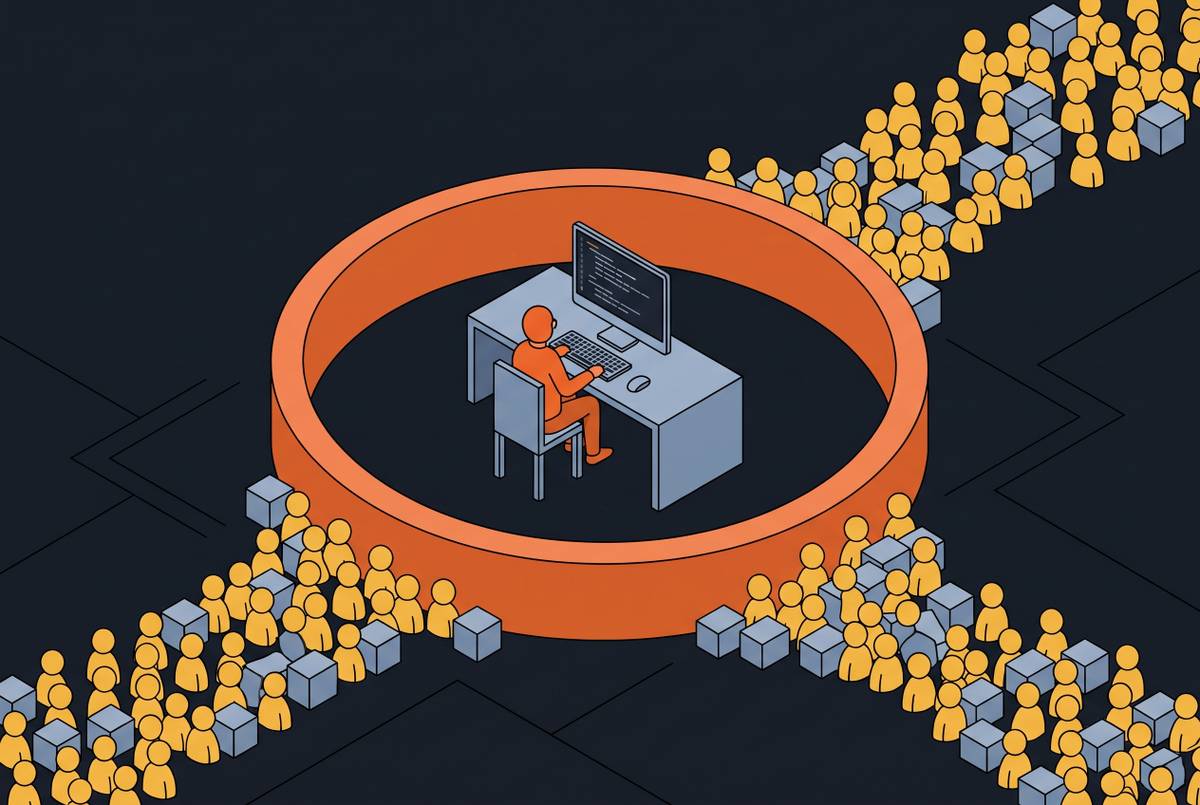
By the end of the week, a senior engineer has answered the same three questions twelve different ways. Each answer helped someone move forward, but the next question would still go to the same person. Without a deliberate knowledge-transfer system, junior engineers ask the person who holds the context because there is nowhere else to get a reliable answer. Informal mentorship makes that dependency permanent.
The onboarding cost therefore extends beyond the new developer’s ramp-up time to the senior developer’s repeatedly interrupted focus. Knowledge stays tacit and personal, available only when its holder is available. Both sides lose. Inadequate mentorship harms professional development and retention, while unlimited availability pulls experienced engineers away from deep work. As seniors increasingly orchestrate coding agents, evaluate their output, and set architectural direction, interruptions also compete with the judgment-intensive work that less experienced engineers most need them to perform.
What structured mentorship actually restructures
Structure changes the direction and timing of knowledge transfer. It separates mentorship from synchronous, on-demand availability through prepared, scheduled, and bounded exchanges. A well-formed question in a defined window asks something different of a senior engineer than an open-ended request to explain the codebase midway through another task.
A prospective cohort study at a Veterans Affairs tertiary care system found that mentors in a structured committee program reported improved work satisfaction and reduced burnout. Mentors met roughly twice a year with each mentee. That medical setting supports the principle that sustained mentorship can work through periodic meetings. When people prepare for an exchange, they have room to share institutional knowledge and culture as well as help someone get past what is blocking them.
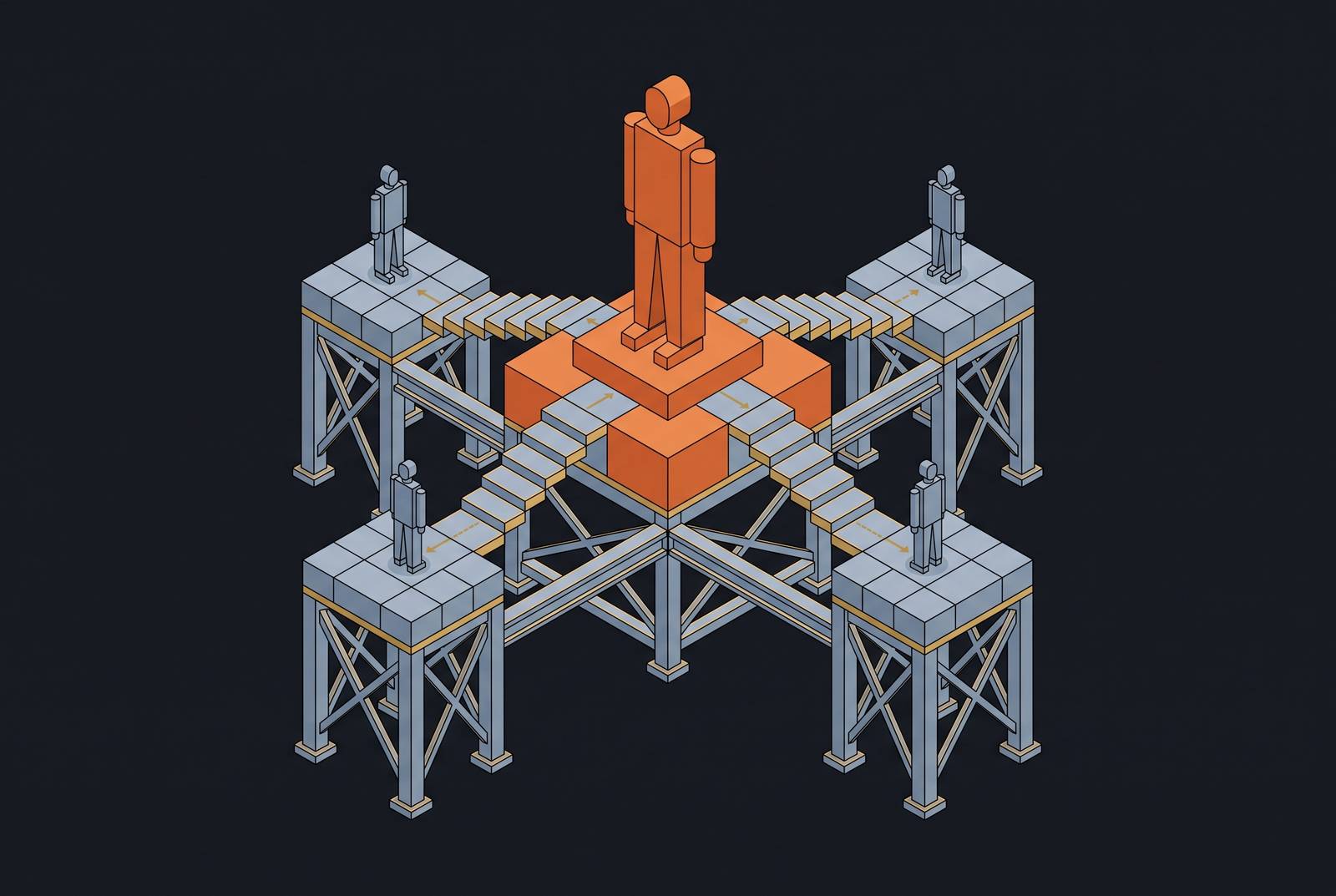
A scalable program separates questions by the expertise they require. Senior engineers set direction and take on the really hard questions, and mid-level engineers help with day-to-day technical work. People look elsewhere for answers to routine questions before asking someone. This tier separation protects access to senior judgment without treating every need for information as a need for that judgment.
Tiered mentorship hierarchies and the micro-exchange model
In a tiered model, senior engineers oversee development, meet periodically with individuals, and enter technical discussions when the other tiers cannot resolve them. Mid-level engineers help with the day-to-day work that junior engineers are responsible for. A structured peer-mentorship study in a medical setting found that pairing juniors with participants one level above them significantly reduced anxiety and improved prioritization skills. Mid-level mentors gave neutral-to-agreeable responses, and the study concluded that the program could augment their professional development.
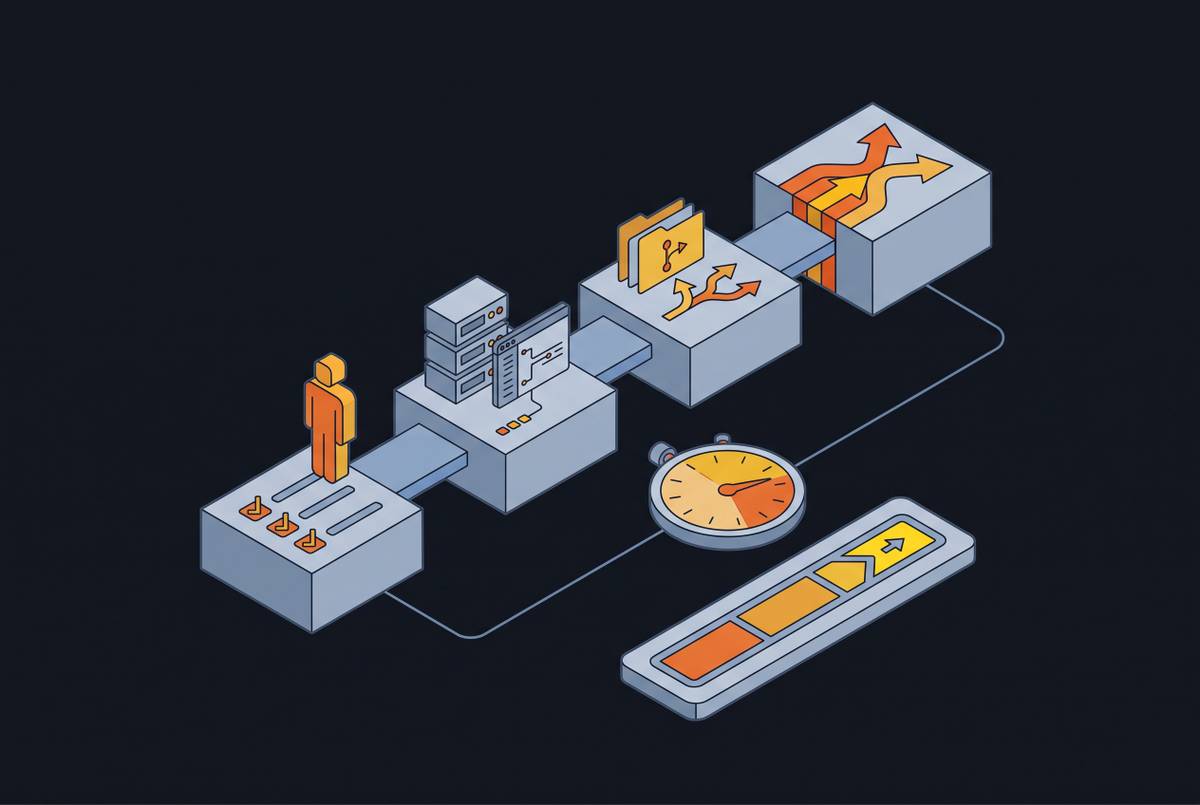
Short, task-scoped micro-exchanges make this hierarchy less expensive to operate. The mentee formulates a bounded question before requesting help, so the mentor receives a specific problem. Pull-based does not have to mean immediately interruptible. A daily request cap, enforced by the system rather than the mentor’s willpower, prevents short exchanges from becoming an unlimited stream of interruptions.
The routing system is as important as the hierarchy. A searchable repository of past exchanges lets later mentees use answers that are already there, so each repeated question costs less to answer. That repository also gives mid-level engineers access to explanations previously supplied by seniors. Without this reusable record, tiering can merely move the bottleneck down one level.
How codebase knowledge becomes the highest-volume interrupt source
Codebase understanding accounts for much of the repetitive mentorship load in engineering. New hires need to locate callers, understand dependency relationships, identify service ownership, and reconstruct architectural decisions. These questions recur during team transfers and incident response. The answers usually draw on context built up over time without needing a new judgment from a senior engineer, so it makes sense to keep a record of them.
In the past, new engineers spent weeks building this mental model by reading documentation, tracing dependencies, and talking with others. When the missing context lives only in a senior engineer’s head, every new hire repeats part of the same inquiry. The tenth explanation costs another human exchange. The expense is especially frustrating because the question may be new to its asker without being new to the organization.
The distinction between retrieving a decision and evaluating it is essential. Explaining why a decision was made calls for the information in its record, while deciding whether it still fits may take architectural judgment. Maintained architecture documents, annotated decision records, and code-linked explanations make the first task independently answerable. They cannot recover reasoning that nobody recorded. Capturing that reasoning in queryable form is therefore a precondition for reducing this class of interruption.
Repository-aware AI agents as a first-line answer layer
Repository-aware AI agents give new contributors a way to explore codebase context without waiting for a mentor. With live access to the relevant repositories and architectural documentation, an agent can generate guided summaries and answer implementation questions on demand. Access must extend beyond the local checkout. An agent confined to one developer’s machine cannot reliably explain relationships across repositories it cannot see.
A well-maintained architecture document, including an agent instruction file used for that purpose, provides a concrete starting point. An agent can query the recorded explanation. Shared prompt libraries add another reusable resource by preserving ways of asking questions that fit the team’s codebase. During incident response, the same retrieval approach can help find callers and show who owns a service, with engineers still deciding what to change.
Sourcebot is one option for this first-line layer, giving humans and agents search and code understanding across company repositories through a self-hosted platform. New hires can ask natural-language questions instead of requesting a synchronous module walkthrough. That capability does not remove the need for foundational skills. Heavy agent reliance before a junior engineer understands the basics can leave that engineer unable to proceed when an answer is wrong. Structured mentorship must teach those basics before engineers turn to an agent as their first source of help.
Why the context layer matters more than the agent itself
The same model can help or confuse a new engineer depending on the information it receives. A copied snippet or cached snapshot may ground an explanation in the wrong version of the codebase. A senior engineer may then have to correct both the original misunderstanding and the assumptions built on the agent’s answer.
Live repository access, code search, dependency mapping, and cross-references between code and documentation give an agent the context it needs to explain things well. MCP-based workflows can extend that context beyond source files. An agent investigating a bug can read relevant code from a repository server and related issues from a project-management server within one workflow, without custom integration code for each exchange. Block’s use of MCP-based internal tooling provides an enterprise example of this approach beyond experimentation.
For a self-hosted implementation, Sourcebot connects repository context and project tools through MCP-based connectors. Its role here is the context layer. The relevant selection criteria are repository coverage, freshness, search and navigation, and access to related project information. Model choice alone cannot compensate for missing architectural context or stale code.
Self-hosting as a prerequisite for safe AI-assisted mentorship in regulated and sensitive codebases
The requirement for broad codebase access makes deployment architecture a governing constraint. An answer layer may need details of proprietary code to be useful, but compliance rules may bar those details from leaving the organization’s environment. In that setting, self-hosting is a prerequisite. The permissible data boundary determines which tooling is deployable before its convenience can be assessed.
Cloud-hosted AI introduces questions about where inputs, outputs, code snippets, and retrieved context are processed and retained. Training-data use and opt-out arrangements depend on the service, settings, and business tier. Teams should therefore judge cloud deployment by how well its architecture meets their needs, without assuming it is a worse choice.
Self-hosting the context layer does not by itself determine where the chosen model processes the code it retrieves. The model route must respect the same boundary. Bring-your-own-model flexibility lets teams choose an LLM provider and control where code is sent rather than depend on a single provider’s privacy posture. Sourcebot’s single-container deployment places the code intelligence layer inside the customer’s infrastructure, with MCP-based connections to tools such as Jira, Linear, and Confluence. For sensitive deployments, both that local layer and the way the chosen model is set up must meet the same security requirements.
What structured mentorship programs must cover that tooling cannot replace
AI-assisted retrieval does not turn mentorship into a software service. Architectural reasoning, career direction, judgment under ambiguity, and the unspoken rules of decision-making remain human work. Mentors explain how stakeholders relate to each other, how decisions get made informally, and where the team’s way of working differs from its documented processes.
Career guidance also depends on more than access to information. Moving between roles, navigating performance conversations, and choosing technical bets call for a mentor who understands those situations and the organization around them. The mentor’s relationships are part of that guidance. Translating strategy into concrete skill priorities requires knowledge of what the organization values.
A developmental network distributes this work among mentors with different technical, cultural, and personal strengths. AI can assist with matching, scheduling, and program health signals without replacing the relationship. The program’s design job is to protect prepared, time-boxed conversations that experienced engineers find worth having. Structure preserves the quality and sustainability of the human exchanges that tooling cannot replicate.
Designing the program — decisions that determine whether it holds under load
Before the next onboarding cycle, engineering leaders need to decide what mentorship should cover and where questions should go. Senior engineers should have time for architectural decisions, judgment calls, and career conversations, with repeated questions about the codebase handled elsewhere. The route must be explicit. The sequence is an AI agent, a searchable knowledge base, a mid-level engineer, and then a senior engineer, rather than four parallel options with the most experienced person always easiest to reach. Foundational instruction must precede heavy agent reliance within that sequence.
At the start of onboarding, the program should establish bounded mentor commitments and the system-enforced daily limits for micro-exchanges. These are operating constraints. Mentees should formulate specific questions before an exchange. As answers accumulate, any senior explanation that could help the next person should enter architecture documentation, decision records, or annotated code.
Tool selection should follow the security boundary and the required repository coverage. Teams need to decide whether their answer layer can reach live code and relevant project context without sending proprietary material to an impermissible model endpoint. A small trial can precede procurement overhead. Sourcebot’s free tier and single Docker container deployment give teams a place to start trying self-hosted code intelligence. The trial should focus on the questions that come up again and again as people learn the codebase, which the program plans to send elsewhere for answers.
As onboarding progresses, the same routing design should cover codebase questions from PMs, support staff, and other non-engineering new hires. A natural-language interface lets those colleagues get answers without first learning how to find their way through the code. Human mentorship remains reserved for what retrieval cannot resolve. A program that merely pairs a junior with a senior leaves scope, availability, and knowledge capture to chance. Its sustainability must instead be designed into the daily operation.