How Staff Engineers Use Code Search to Untangle Cross-Team Dependencies at Scale
Staff engineers use cross-repository code search to find hidden dependencies before they break.
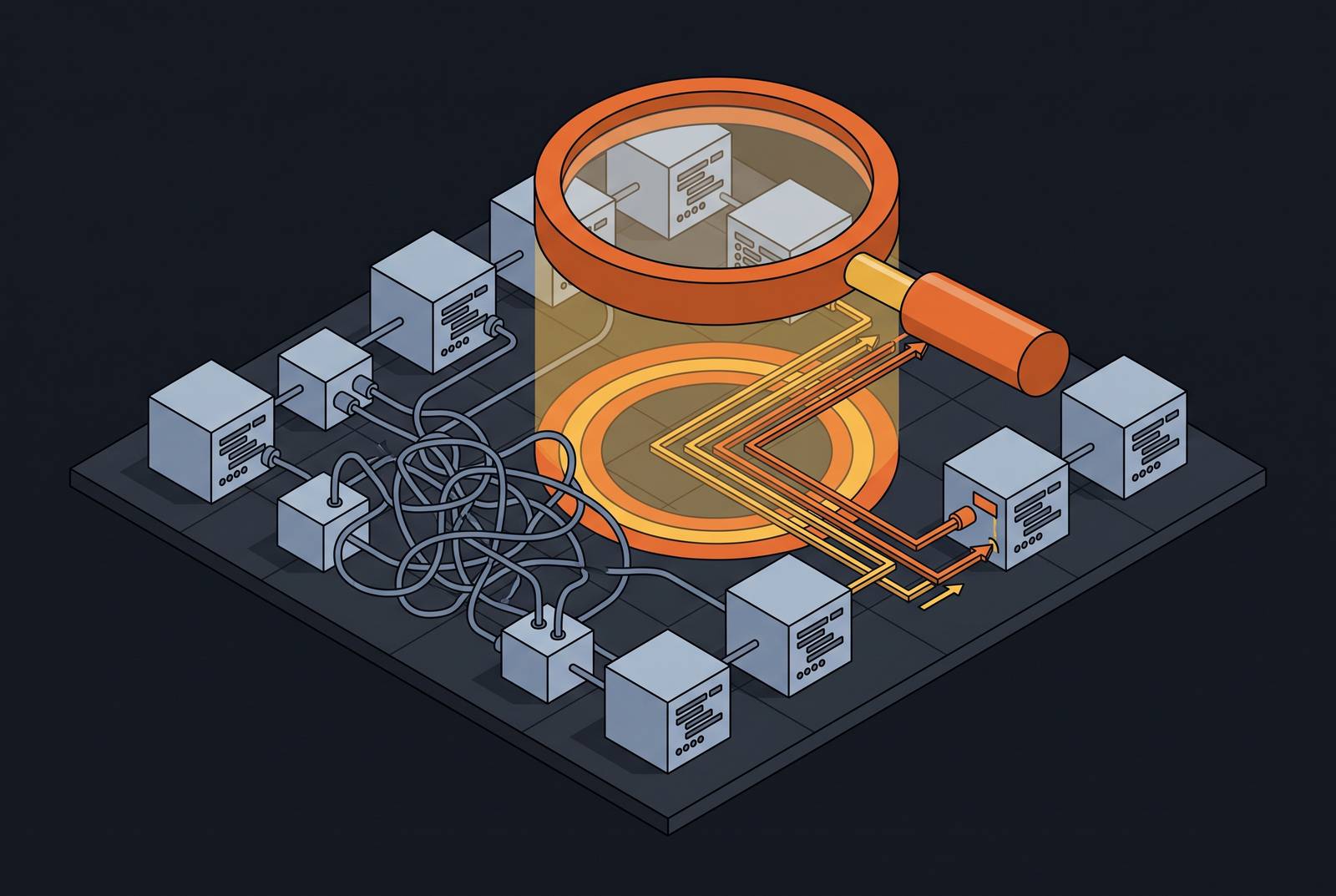
Enterprise code search gives staff engineers a continuously indexed, permission-aware view of definitions, references, and shared interfaces across repositories. For large enterprise codebases, the decisive capability is finding dependencies beyond the repository being changed. Staff engineers use that view to plan migrations, lead incident response, and guide architecture based on what the code shows instead of what they learn in meetings or what people remember.
Why staff engineers own problems that cross team boundaries
A staff engineer’s primary output is enabling outcomes across teams outside their control, work that depends on understanding code and interfaces owned elsewhere. The scope changes the tools the work requires. A local development environment can support implementation well while leaving the engineer unable to see how another team depends on that implementation.
Consider three teams making incompatible architectural choices. A staff engineer can write design principles that align their work and prevent expensive rework, but only after understanding what each team has built. The same constraint applies when coordinating a shared interface change whose consumers belong to several teams. Authority alone cannot reveal those consumers. Design documents and coordination become useful when they rest on an accurate view of the systems involved, including code the staff engineer did not write.
How cross-team dependencies become invisible and then expensive
Dependencies often form without anyone planning how the teams will depend on each other. A service consumes a shared data field, another relies on an RPC contract, and a library consumer remains pinned to an older version. Each team can understand its own implementation without documenting the whole chain. No single team owns the full picture. As the codebase grows faster than its documentation, these undocumented couplings become a normal condition.
The failure appears when a team changes something that looks local. Its own repository gives no indication that an unfamiliar caller depends on the old behavior, so the change proceeds until that caller breaks. The incident reveals the relationship too late. The dependency crosses the boundary within which the team normally looks for evidence. Finding it beforehand requires searching beyond that boundary without already knowing which other repository contains the caller.
What cross-repository code search actually does that single-repo search cannot
Cross-repository code search provides a continuously indexed, symbol-aware search layer across the organization’s repositories. Exact-match and regex queries locate names and repeated patterns, while code navigation resolves definitions and references across repository boundaries. Those capabilities answer different kinds of questions. A text match can show where an implementation was copied, while symbol-level references help find the callers of a given function.
The distinction becomes concrete when a staff engineer asks which services consume a data field or which repositories call an RPC. Single-repository search finds answers only in the repository being searched, so the engineer has to choose every other place to look. Cross-repo search removes that prerequisite across the indexed codebase. Cross-repository jump-to-definition and find-all-references then let the engineer follow the relationship rather than assemble it manually from separate searches.
That changes the cost of understanding a service contract. The engineer can investigate which fields downstream code actually uses and how broadly a proposed change reaches. Without that visibility, finding the same information often means asking representatives from several teams to reconstruct the dependency graph. A technical lookup becomes a coordination exercise that consumes several engineers’ focus time.
Three situations where staff engineers reach for cross-repo search first
An API deprecation starts with an apparently simple question about who still uses the interface. The migration cannot be sequenced safely around only the callers known to the owning team. Unknown consumers become surprises when the change lands. Cross-repo search finds callers throughout the indexed repositories, giving the staff engineer evidence for identifying affected teams, ordering the work, and setting a realistic deprecation timeline before implementation begins.
During an incident, the question changes to “what else does this touch?” The failing service may have consumers that do not appear in its team’s documentation, and reconstructing those relationships through a call costs time during the response. Searching for consumers or callers exposes the wider blast radius. After the immediate failure, the same search helps find copies of the fragile pattern elsewhere, so engineers can look beyond the first affected service.
Three teams may be considering incompatible approaches while an established implementation already exists elsewhere in the codebase. Before those choices spread, search can reveal an existing pattern, a competing production implementation, or code that the proposal would duplicate. That evidence gives the design discussion a concrete starting point. The staff engineer can guide alignment from the actual codebase rather than rely on someone remembering an earlier decision.
Why the interrupt tax falls disproportionately on staff engineers without this tool
When teams cannot independently answer “who uses this?”, they ask the person most likely to know, often the staff engineer who last changed the interface or understands the wider domain. Requests about ownership, service behavior, and change risk accumulate around the same person because the organization has no other practical route to those answers.
Getting back to full focus after a major interruption takes much longer than the interruption itself, so repeated questions about dependencies break up work that needs long stretches of thought. Scheduling those requests can protect focus but leaves other teams waiting for answers. The bottleneck remains, even when its calendar is orderly.
The structural remedy is to make more of those questions answerable directly from the codebase. A query for callers of an RPC can replace a request to the person who remembers its history. That lookup becomes available to other authorized engineers as well.
What the search layer needs to cover for staff-level work to be possible
The technical foundation is coverage of the full codebase, including repositories that individual developers have never cloned. Exact-match and regex search need to work across all that code, and symbol navigation needs to resolve definitions and references even when they are in different repositories. Freshness is part of correctness here. Continuously updated indexes let engineers reason from the current main branches rather than a snapshot that may predate the change under investigation. Results must also respect repository permissions.
Code alone does not explain every dependency. A staff engineer may find a caller yet still need to understand why the interface exists, when it was meaningfully changed, or whether a deprecation ticket is open. That context can live in PR descriptions, commit messages, ADRs, runbooks, tickets, and discussions. Many organizations therefore pair code search with organizational knowledge search across tools such as Confluence, Notion, Jira, Linear, and Slack.
Bringing those layers together makes the source of an answer important. Answers with source links let engineers inspect the code, ticket, or decision behind a claim. Access controls must extend to those sources too. A natural-language interface can also let PMs, support staff, and new hires look into service behavior or ownership themselves, so fewer questions have to go through an engineer.
How AI coding agents change the cross-repo dependency problem — and make context requirements stricter
An AI coding agent limited to a local repository inherits the same blind spots as local search. It can produce a coherent refactor without seeing callers in other services, or rename a field without seeing downstream consumers. Local coherence is not cross-system correctness. As agents make changes faster, missing information about dependencies can give the same failure more chances to happen.
Anthropic’s 2026 Agentic Coding Trends Report predicts that teams of agents will work together on implementation while engineers focus on architecture and strategy. That direction makes access to organizational context more demanding. Agents need the dependency evidence staff engineers use, as well as the design decisions and guardrails that constrain a change.
The Model Context Protocol, or MCP, lets agents get context from sources outside themselves. An MCP-connected code search layer lets an agent query the indexed codebase for consumers, callers, and contract dependencies without requiring local access to every repository. ADRs and design patterns can supply the surrounding constraints. The purpose is to retrieve evidence from the organization’s code and decisions rather than expect the model to reconstruct them from training data.
However, broader access also requires governance. Least privilege, audited tool calls, and rollback capability remain necessary when agents participate in engineering workflows. A read-only, deterministic search interface adds context without granting write access to the codebase, but it does not remove the need to govern what the agent can retrieve. Read-only access limits one class of risk. It does not make sensitive code unrestricted information.
What self-hosted deployment means for teams whose code cannot leave the network
For regulated and security-sensitive teams, cross-repo search can be used only if its deployment meets their security requirements. An index of the entire codebase may include trade secrets, code that processes patient records or financial data, or code subject to export controls. The data path is therefore a prerequisite. Search and agent context are not deployable merely because their dependency analysis is useful.
Inspection needs to run on the organization’s own compute, detection must not call an external model, and logs and findings need to remain in an organization-owned database. On-premises deployment makes data paths, residency, and access boundaries part of the architecture. These controls govern the surrounding AI workflow as well as the index.
A hybrid arrangement can separate sensitive code from non-sensitive tasks when full air-gapping is not possible. Self-hosted infrastructure handles the sensitive code, while cloud AI does the work that is allowed outside that boundary. Model choice must follow the same constraint. Bring-your-own-model support lets the organization choose its LLM provider and control where code is sent instead of inheriting a vendor-managed service’s defaults.
How should enterprises evaluate cross-repo code search for staff-level and agent use?
Engineering leaders and platform teams should evaluate enterprise code search against real dependency questions. The first test is whether it indexes every required repository, including private ones, and how quickly changes become searchable. Index lag affects incident work directly. When teams weigh build-versus-buy, they should check whether coverage is continuously updated or comes from scheduled snapshots, and whether searches cover the whole organization or only local clones.
Can find-all-references identify callers beyond the current repository, including across the languages used in the organization’s polyglot codebase? A broad text search is not an equivalent result. The evaluation should also examine whether an MCP server exposes the index directly to agents and whether that interface is read-only, so retrieving context does not require granting code-writing access.
Organizational connectors need equally concrete scrutiny. A Jira or Confluence connection should surface relevant decisions and tickets while respecting the source system’s access controls. The answer needs to remain inspectable through its sources. Natural-language access is useful when it lets authorized non-engineers resolve ownership and behavior questions without turning the staff engineer into an intermediary.
Deployment and procurement complete the evaluation. Teams should check whether the tool can run as a single container inside their infrastructure, whether source code stays within the required network boundary, and whether bring-your-own-model support lets them control how it is processed. They should also ask whether a free tier lets them test it against real repositories before they buy. A tool shows most clearly that it fits when it correctly answers an unfamiliar cross-team dependency question, stays within the organization’s access and data rules, and does so before a migration or incident makes the missing answer costly.