Cross-Repository Search Infrastructure as an Engineering Onboarding Accelerant
Unified code search across repositories cuts onboarding time and senior engineer interruptions.

A new engineer's first weeks on a distributed codebase rarely fail because of thin documentation or an absent mentor. They fail because no amount of careful reading inside a single repository produces an accurate picture of a system that spans dozens of them. An engineer assigned ownership of one service has to answer questions that do not resolve inside that service's own files: where does the input data actually originate, which downstream services consume this service's output, which functions are load-bearing enough that touching them requires coordinating with another team. None of those questions can be answered by reading a single repository closely, no matter how well-commented it is. The answers live in the dependency graph, the call graph, and the import graph, structures that by definition span repository boundaries and that no individual file reveals on its own.
The shift toward microservices, multi-platform architectures, and sprawling application portfolios has made this worse, not incidental. A shared utility function that lives in one repository and gets consumed by a dozen others is now a common pattern rather than an edge case, and single-repository search has no way to represent that fan-out. The traditional fallback, pulling a senior engineer away from their own work to answer one person's question, leaves the knowledge gap in the system untouched. It is an interrupt, not a knowledge-transfer mechanism, and every time it happens, context stays locked in one person's head instead of becoming something the next new hire can find on their own.
What text search gets wrong about code at scale
Text-based search, the kind built into grep, most IDEs, and per-repository GitHub search, is not just slow at enterprise scale. It cannot answer cross-repository questions because it matches characters, not meaning. Searching a large enterprise system for a common field name like accountId can return tens of thousands of hits spread across comments, docstrings, variable declarations, call arguments, and test fixtures, with no distinction between a live reference and a coincidental string match. The engineer still has to do the real work by hand: filtering, disambiguating similarly named symbols, and confirming each result is actually a call site.
Symbol-aware search parses the code to resolve its structure. It understands that a function defined in one module and imported into another is the same entity referenced twice, not two unrelated strings that happen to match. It can tell a call site apart from a comment, a live function from dead code that only looks relevant. The result of a symbol query is a set of resolved relationships, not a list of occurrences that still need to be interpreted. When a developer needs every caller of a function before changing its signature, that distinction decides whether the task takes minutes or an afternoon of manual verification.
IDE-based language servers close part of this gap but stop at the project boundary. They understand the current project and sometimes the packages it directly depends on, but they do not index the repositories that consume those packages downstream. For a team maintaining an internal library used by a dozen other services, that is exactly the relationship a new engineer needs to see, and exactly the one their editor cannot show them.
How a unified cross-repository index makes system relationships queryable
Cross-repository symbol resolution requires an index built across every repository at once, maintained as a single graph of relationships rather than a collection of per-project indexes stitched together after the fact. Without that, any given search tool is only ever operating on a fragment of the system, however good its results look on a single repo.
The underlying technique is structural: source code gets parsed into an abstract syntax tree, a representation that captures what each piece of code is (a function definition, a call, an import) and how it relates to everything around it. Cross-boundary resolution follows from that directly. When repository A exports a function and repository B imports it, both the export and the import get recorded as references to the same node in the graph, and a query against that graph returns results filtered by actual semantic relationship.
This is precisely where most IDE-based tools stop, because they do not index the downstream consumers of a package. For a team that owns a shared library or a platform service consumed across a dozen products, that gap decides whether they know a change is safe or find out it wasn't after the fact. Self-hosted code intelligence platforms like Sourcebot index code across every repository simultaneously and let engineers ask natural-language questions about code with inline citations. A new engineer can answer a cross-boundary question directly instead of routing it through whoever happens to remember the answer.
Source Context Management takes the same underlying idea further by precomputing semantic representations, using Lossless Semantic Trees, code embeddings, and dependency graphs, so that agents and humans alike retrieve the context they need instantly. Once that graph exists, questions that used to require a senior engineer's memory become ordinary queries: which services consume a specific field, which repositories call a given RPC, what the blast radius looks like if a service contract changes.
How symbol search compresses onboarding time in practice
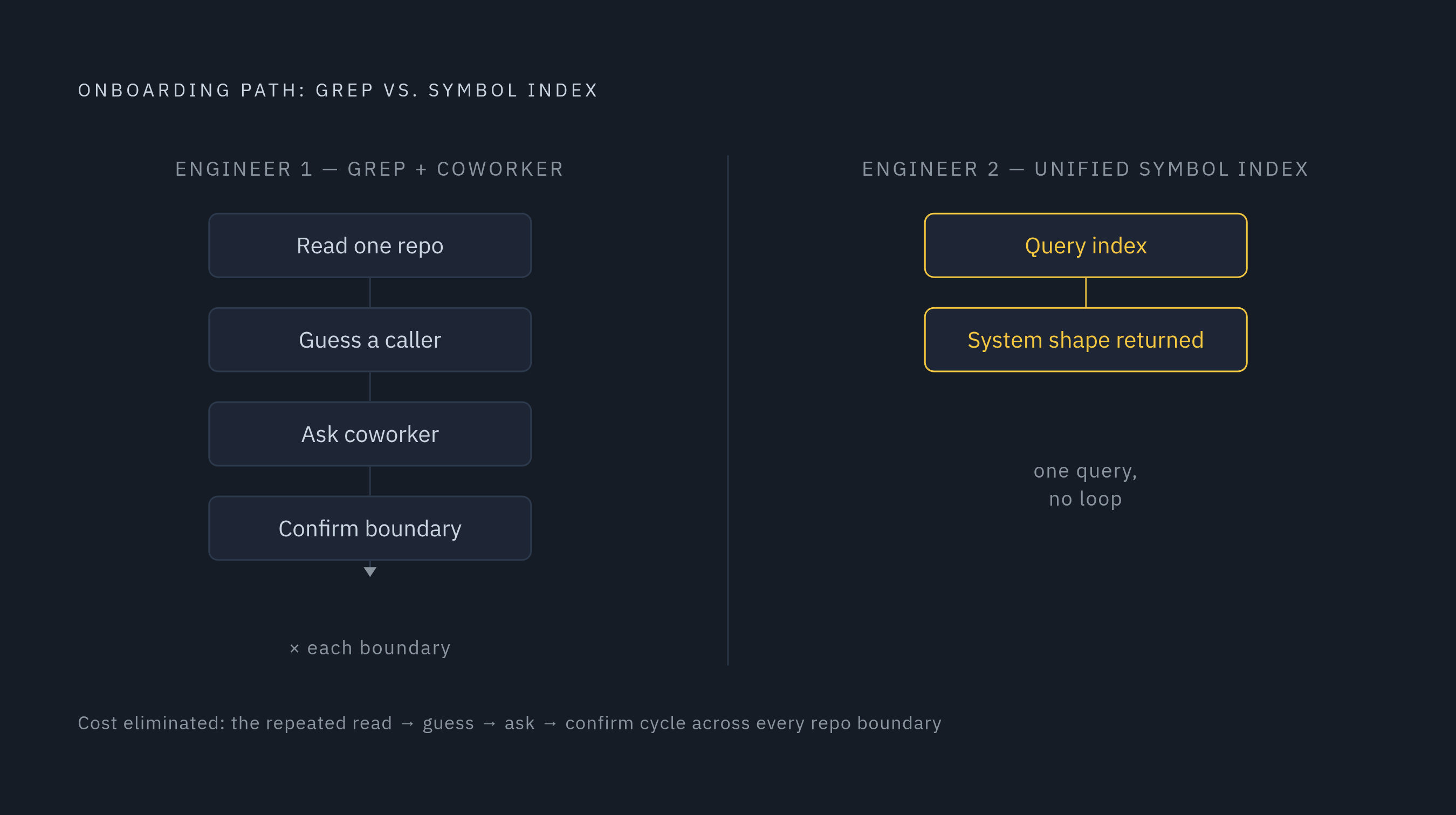
Consider two engineers assigned to the same unfamiliar service. One has grep, their editor's language server, and a coworker to ask questions. The other has a tool that can trace symbols, dependencies, and call sites across every repository in the company at once. The first engineer spends their early weeks reconstructing the system's shape from fragments: reading one repository, guessing at what calls into it, confirming the guess by asking someone, and repeating that cycle for every boundary they cross. The second engineer asks the index directly and gets the shape of the system back as an answer, not as a research project.
Cross-repository search answers two classes of onboarding question that nothing else fully addresses. The first is structural: how is this service connected to the rest of the system, what does it depend on, what depends on it. The second is about change safety: what breaks if a function changes, who else calls this API, which repositories require coordination before a change ships. Both classes of question are exactly the ones a new engineer has to answer before they can contribute safely, and both are exactly the ones that are unanswerable from inside a single repository.
AI-assisted internal knowledge retrieval, the "where is Y defined?" category of question, is already one of the fastest onboarding wins available when the underlying documentation is current and well-maintained. Cross-repo symbol search is what makes that retrieval accurate instead of approximate, because the answer it returns is grounded in the actual dependency graph rather than in whatever documentation happened to be updated most recently. A new engineer who can answer structural and change-safety questions independently stops generating the interrupts that would otherwise land on a senior engineer's desk, and each question resolved this way is also one less conversation pulling someone else out of their own work.
What cross-repo search reduces: senior engineer interruption
The real cost of slow onboarding is the senior engineer time consumed by questions that an adequate index would have answered without anyone's involvement. Every "how does this system work?" question that reaches a senior engineer is a context switch, and the cost of a context switch is never just the time spent answering it. It includes the recovery time to get back into whatever they were doing, the lost flow state, and the work that didn't happen while the conversation did.
Tribal knowledge produces that cost: when system relationships are not queryable by a tool, they can only be transmitted person to person, and the people who hold that context become bottlenecks by default, whether or not they want the role. Cross-repo search dissolves that bottleneck by making system structure queryable by anyone, the new hire, the product manager, the support engineer, without requiring a senior engineer to translate the answer first. Teams that treat AI-based internal knowledge retrieval as onboarding infrastructure report reduced tribal knowledge bottlenecks as a direct result, but that result depends on the index covering the full dependency graph across every repository, not just documentation for the one repo a new hire happens to be assigned to.
This is also where the argument stops being only about people. The same infrastructure that answers a new engineer's questions without pulling a senior engineer away from their work is what an AI coding agent needs before it writes a single line of code.
AI coding agents share the cross-repository blindness of new engineers
AI coding agents without access to a unified cross-repository index fail in the same way new engineers without that access fail: they act on the code directly in front of them and miss the system around it. By default, a coding agent asked to implement a feature reads files one by one, directory by directory, until it has assembled enough context to act. That process produces two distinct failure modes. The first is context window bloat: feeding raw source files to a language model is expensive, slow, and lossy, and the agent is left guessing which files are relevant, often guessing wrong. The second is semantic blindness: reading files tells an agent what code says, while what depends on what, which functions are high-risk to touch, and what design philosophy shaped a component stay hidden.
An agent asked to add rate limiting to an endpoint, working without a context engine, will often produce an implementation that compiles and passes its own tests while creating a second, inconsistent rate-limiting approach, one that misses the existing middleware pattern, the shared interface other services already use, and the observability integration sitting three directories away. Give that same agent a context engine: it queries before writing, retrieves the existing pattern, the interface it needs to implement, the metrics integration point, and the established test conventions, and the resulting pull request has a far better shot at approval on the first pass. The gap between those two outcomes is a gap in context quality, not model quality. The model is not what's holding the agent back. The absence of a precomputed, semantically rich, always-available representation of the codebase is.
Agents are a different class of consumer than IDE language servers were ever built to serve. They operate across entire repositories, across every phase of the development lifecycle, frequently in parallel across several tasks at once. They need the full semantic picture available before they start working, not something assembled incrementally as they happen to navigate into it.
MCP as the delivery layer that makes cross-repo context available to agents at query time
A unified cross-repository index solves half the problem. Agents still need a standardized, low-latency way to query that index at the exact moment they need context, and that is the role the Model Context Protocol plays. Google's internal Code Search system demonstrated, under its circa-2018 architecture, that semantic code queries can be served at a median latency of 50 milliseconds, establishing that serving resolved semantic answers quickly at large scale is a solved engineering problem.
MCP standardizes the interface between an agent and external context sources, so an agent running in any compliant coding environment can query the same MCP server without custom integration work for each tool it touches. That standardization turns what used to be fragile, bespoke plumbing into a stable, reusable connection. The resulting division of labor is clean: static analysis discovers and precomputes the semantic relationships, the unified index stores them, and MCP delivers them to agents on demand. Platforms that maintain this kind of global relationship graph, parsing code into structural representations and recording exports and imports as references to the same symbol nodes, let both humans and agents retrieve exact context instantly. Sourcebot's MCP-based architecture, for instance, precomputes semantic representations across every indexed repository, which turns questions about service dependencies and blast radius from open research problems into immediate, navigable answers.
With that architecture in place, an agent can ask precise cross-repository questions directly: which services consume a specific field, which repositories call a given RPC, what the blast radius looks like if a service contract changes. The efficiency gain is measurable in token terms as well as accuracy: replacing file-by-file context assembly with targeted semantic retrieval means an agent pulls what it needs instead of ingesting whole files on the chance that something in them is relevant. Engineering teams are increasingly codifying this as a context layer in its own right, architectural decision records, design patterns, and guardrails written once and surfaced to every agent through MCP, rather than hoping each model run rediscovers them from scratch. None of this runs itself, though. It is infrastructure, and infrastructure has to live somewhere.
Why this infrastructure belongs inside your network
An index that covers every repository in an organization has, by its own design, access to every piece of proprietary code the organization owns. That is not a side effect to manage after the fact, it is the central fact that should shape the deployment decision from the start. A system built to resolve symbols across the entire company's codebase is also, necessarily, a system with visibility into the entire company's codebase, which makes where that system runs a security and compliance question first and an operational convenience question second. Sending that index to a third-party cloud means trusting an outside vendor with the complete shape of the company's software, including the proprietary logic, the internal service boundaries, and the architectural decisions competitors would most want to see. Self-hosted deployment, the model tools like Sourcebot are built around, keeps that index and the queries against it inside the company's own network, under its own access controls, answerable to its own audit requirements. For infrastructure that touches every repository a company owns, that is the baseline the decision should start from.