Protecting Senior Engineer Deep Work Time During High-Growth Hiring Waves
Self-serve codebase knowledge keeps senior engineers available for review and architecture.
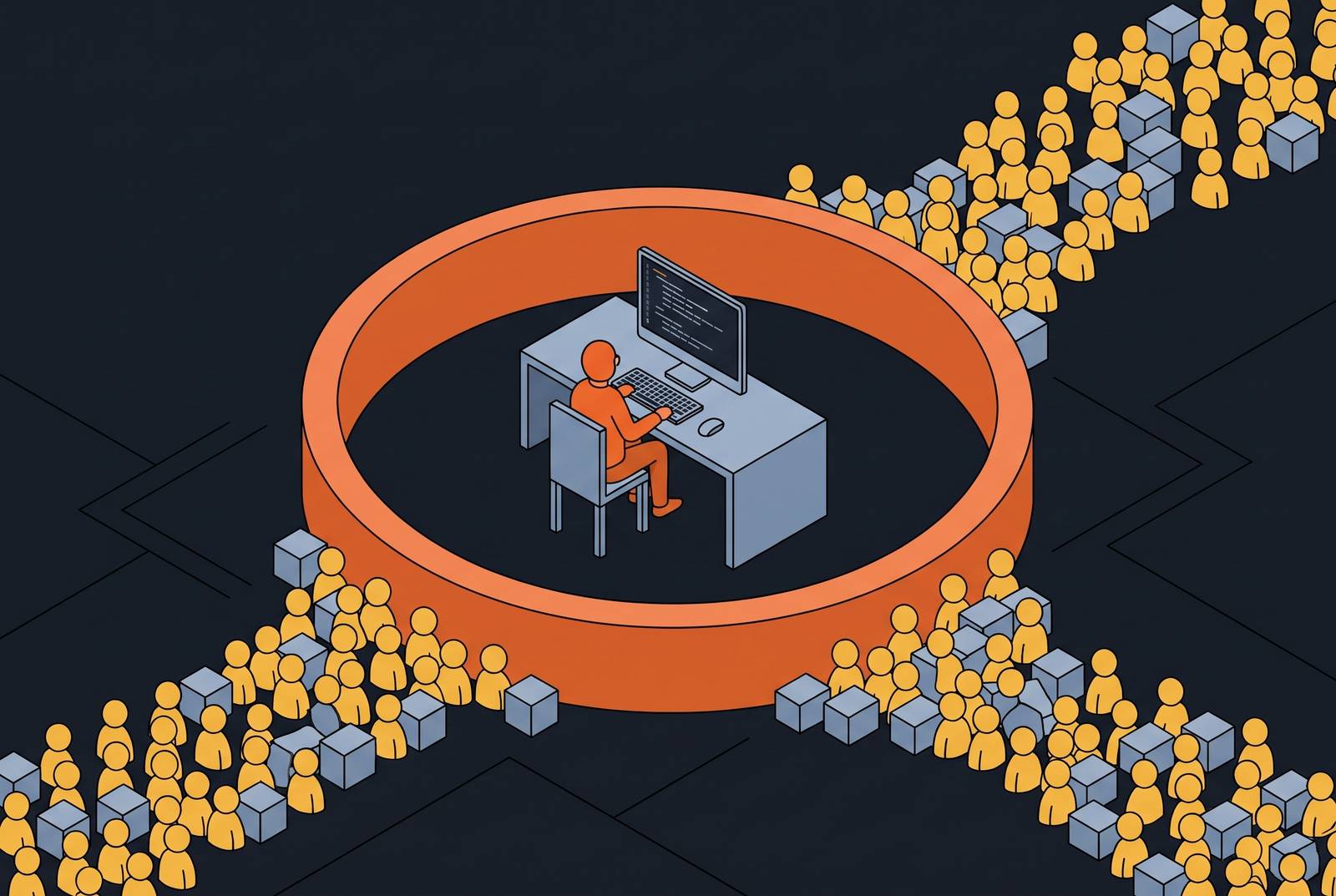
To protect deep work for senior engineers when hiring grows fast, engineering onboarding needs to let new hires find codebase knowledge on their own. New hires and AI agents need to be able to find the repository structure, dependencies, conventions, and project context before their questions reach a senior’s inbox. This leaves seniors time for architecture and accountable review by letting the codebase answer the questions it can.
Why senior engineers are scarce and getting scarcer in a high-growth hiring wave
Indeed Hiring Lab found that senior roles made up most of the rise in software-development job postings between May 2025 and May 2026. Roles with AI in their titles accounted for a substantial share, with considerable overlap between the two categories. Demand is growing, but not evenly across the profession. The expansion is concentrated at the senior and AI-fluent end of the market, while the entry-level door has narrowed sharply.
With so much demand focused on those roles, hiring fast is hard even when there seem to be plenty of candidates in the wider market. AI-fluent senior engineers find roles within weeks, while the rest of the market moves much more slowly. Growing teams compete for a small, fast-moving cohort. AI fluency also changes the seniority ladder because experience alone does not show that an engineer is ready to direct agents and review their output. With fewer junior hires entering the pipeline, the future senior bench shrinks too, making this a structural constraint.
What AI actually did to the senior engineer's job description
GitHub data shows that a large and growing share of pull requests involve an AI agent, up sharply from a year earlier. That increases the flow of changes into review without transferring responsibility for those changes to the tools that generated them. When AI adoption was high, pull request size, files touched per request, and bugs per request also rose significantly.
When a senior approves a change to an identity service in a regulated environment, that approval assumes organizational risk regardless of how quickly the code was produced. Review must check whether the implementation fits the system’s constraints as well as whether the generated code looks right. Faster generation can add more code whose effects a reviewer must understand before approving a change.
DORA’s 2025 research found that increased AI adoption was associated with improved delivery throughput, including lead time and deployment frequency, but also with higher change failure rates and greater instability. More code can move through the system while more changes fail or require rework. The review burden therefore cannot be treated as a temporary imbalance that faster production will resolve.
The onboarding interrupt as the hidden tax on senior capacity
A hiring wave adds another demand to that review queue. New engineers entering a large codebase need to know which service owns a table, where an event is published, and why a function has three unrelated call sites. These are navigation questions with deterministic answers. Answering them correctly generally requires access to the relevant codebase knowledge. Yet the person most familiar with the area often becomes the default route to that knowledge.
In practice, that route is a Slack interrupt. The visible cost is the time spent answering, but the larger cost can be reconstructing the context of the work that was interrupted. A two-minute reply can break a deep work session devoted to a sensitive review or an architectural decision. The same interruption also erodes the uninterrupted time needed to develop and exercise AI fluency. An engineer who uses agents in day-to-day work still needs time to focus on directing them.
The drain compounds as hiring accelerates. More new hires produce more navigation questions just as growth brings architectural decisions and AI-generated output expands review queues. Each request can be reasonable in isolation while the combined demand becomes incompatible with concentrated work. This is not a failure of willingness to mentor, nor does it resolve through a broader skills checklist. The structural distinction is between core architectural ownership and delivery capacity, which cannot be treated as interchangeable demands on the same people.
Why AI-assisted onboarding without codebase context just moves the problem
An AI coding assistant does not give people another way to find answers just by being there. Its usefulness depends on whether it understands the project’s structure, dependencies, patterns, and conventions. Local context is not architectural context. An agent that sees nearby files but misses an existing utility elsewhere can create a redundant new one. The new hire gets an implementation, but the codebase acquires duplication that a senior may later have to identify and correct.
Review does not reliably erase that risk. The paper “More Code, Less Reuse” found that reviewers tended to express more neutral or positive emotions toward AI-generated contributions than toward human contributions. That finding undermines the assumption that AI-generated changes will automatically receive greater scrutiny. Silent regressions can slip through a review queue that is already longer. A study of developers learning a new library also found significantly lower knowledge retention among AI-assisted participants, with those relying on Iterative AI Debugging learning the least and those fully delegating code writing scoring near the bottom.
A response can answer the question at hand while missing the wider knowledge needed to make the change it suggests safe for the system. Faster completion of a first pull request can therefore coexist with a weaker mental model of the codebase. That leaves the senior responsible for correcting both the implementation and the understanding behind it. The missing foundation is architecture knowledge found in the codebase.
How can codebase knowledge become self-serve before it reaches a senior’s inbox?
The lesson for engineering leaders is to make navigation answerable without assigning more senior time to it. A self-serve codebase lets a new hire establish which service owns a table or where an event is published without a human routing the question. The senior still decides whether a proposed change fits the architectural constraints, but the facts are found before the change reaches review. This separates finding the relevant implementation from judging what should happen to it.
AGENTS.md files provide one practical way to encode repository context. These Markdown files explain build steps, conventions, and testing rules, so both coding agents and new engineers can use them for onboarding. Research on 124 pull requests found that when these files were present, median agent runtime was 28.64% lower for completing similar tasks, a finding limited to agent execution. Explicit repository instructions spare agents from having to infer every local rule.
Alongside repository instructions and ad-hoc documentation, people still need purpose-built code intelligence as infrastructure to find code across the organization. The same capability can answer a PM or support colleague asking where refund logic is implemented. Making that question self-serve protects the same senior attention, even though the person asking is not an engineer.
What the right code intelligence infrastructure actually requires
Coverage is the first selection criterion for engineering onboarding. A tool that indexes only repositories open locally gives both new hires and agents a partial picture of the system. The missing repositories may contain the very patterns or utilities needed to avoid duplication. Broad search is therefore more than a convenience. Organization-wide indexing must show how the code is structured so a user can see how an implementation connects to its dependencies and the conventions already in use.
Data residency is the next constraint, particularly in regulated industries where code leaving the network boundary can block adoption. Self-hosted processing inside the company’s own infrastructure addresses that boundary without requiring the team to abandon code intelligence. The policy details deserve explicit attention. GitHub’s March 2026 Copilot privacy update announced that, from April 24, interaction data including code snippets and associated context would be used for model training by default for Copilot Free, Pro, and Pro+ users, with an opt-out available. Copilot Business and Copilot Enterprise users were not affected, making the distinction between product tiers essential to the decision.
Deployment must also be practical enough to reach evaluation. Using a single Docker container cuts the work of running the infrastructure, which can lead teams to give up on self-hosted tools before they see their value. The goal is use before a purchase decision. A free tier that indexes real repositories gives the team a way to establish whether the tool reduces onboarding interrupts without first completing a procurement cycle. During a hiring wave, that makes evaluation possible while the need is immediate.
Code coverage alone does not supply all the context a feature question requires. MCP-based connectors to Jira, Linear, Confluence, and similar tools extend discovery to the associated tickets and documentation. A new hire needs both the implementation and its project context. Model flexibility belongs in the same evaluation because teams should be able to choose which LLM processes their code and change that choice without re-architecting the tooling. Bring-your-own-model support preserves control over the data boundary as model choices evolve, rather than tying that control to the initial deployment.
What changes operationally when the codebase becomes self-serve
The first operational change is the route taken by a question. Instead of sending a navigation request to the senior most familiar with a service, the new hire obtains the relevant codebase context directly. Mentoring remains part of the senior’s role. What changes is that mentoring no longer has to serve as the lookup mechanism for every table, event, or utility. The senior’s attention can return to whether an AI-generated architectural decision fits the system and whether a sensitive change is safe to approve.
For new hires, direct navigation removes waiting from the learning process. A context-aware tool can help them see how services, call sites, conventions, and project intent fit together as they work toward their first contribution. They can build a stronger mental model as well as get a quicker answer. When a first pull request arrives in days rather than weeks, the gain is team delivery capacity as well as individual progress. That outcome depends on access to the system’s actual context.
The same context can reduce the correction required from reviewers. Agents can reuse existing utilities, follow established conventions, and flag changes that touch sensitive boundaries, so a senior does not have to find all of these alone. Review volume may still remain high. The improvement is less avoidable correction per pull request, leaving more attention for the decisions that no context file can encode. This resolves the distinction between accelerating implementation and preserving accountable judgment.
A PM asking which service handles payment retries can get the answer without opening a Jira ticket for an engineer, giving engineers one less source of interruption. That benefit accumulates across the people who need to understand the system.