How Staff Engineers Evaluate Code Search Tools for Monorepo Governance and Cross-Team Visibility
Staff engineers assess search tools as governance infrastructure, not just productivity aids.

Enterprise code search retrieves answers from a shared codebase for engineers, other stakeholders, and AI agents. For large enterprise codebases, the best tool is the one that combines complete indexing, precise retrieval, ownership-aware results, current dependency visibility, and compliant deployment. Staff engineers evaluate these capabilities as governance infrastructure, because faster access is useful only when people can distinguish what they can find from what they may change.
Why code search has become a governance problem in monorepos
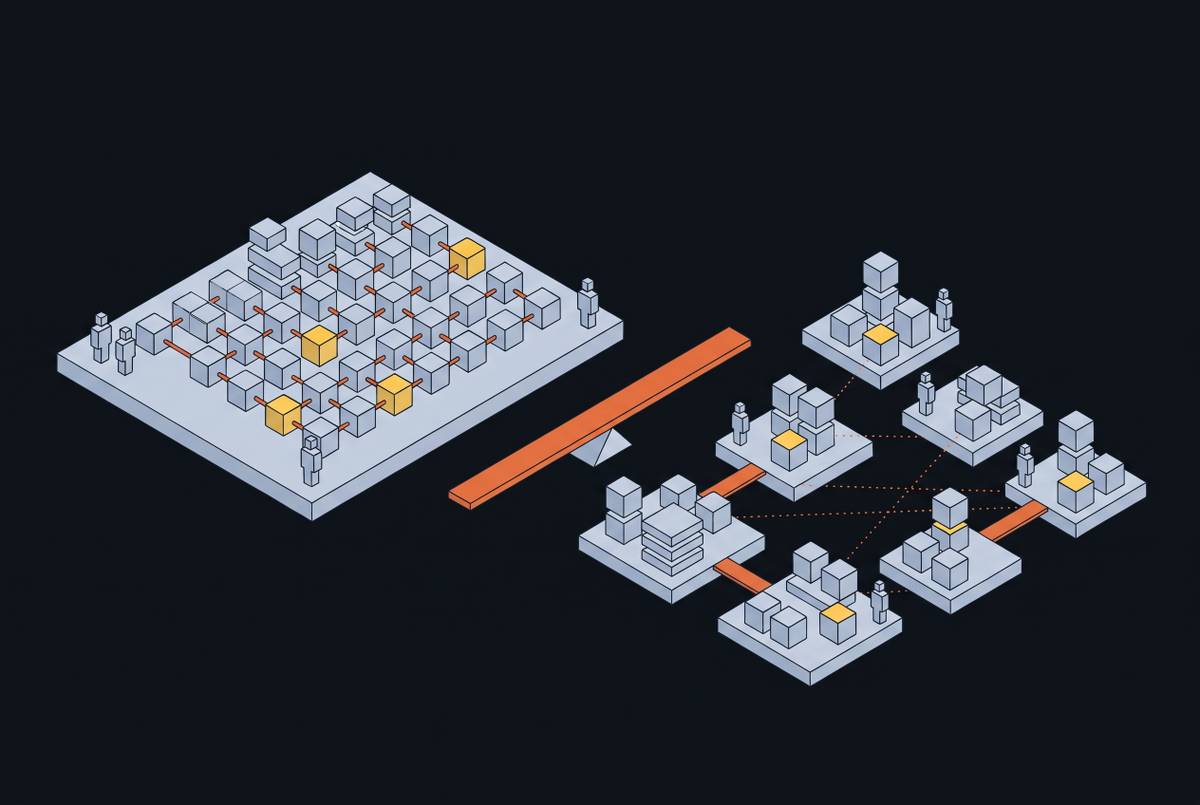
When a monorepo houses dozens of cross-functional services, visibility and control pull in different directions. Engineers share a repository, but each team is still responsible for its own services and libraries. A query about one service can return unrelated teams’ code unless the search layer scopes results accurately. Broad access can obscure which implementation applies and who is accountable for it.
The benefits of atomic refactors, shared libraries, discoverability, and standardized tooling depend on teams navigating those distinctions. Search must attribute results as well as retrieve them. Staff engineers sit between team autonomy and organization-wide coherence, so their evaluation extends beyond individual productivity. A tool that makes code easy to find but strips away its ownership context can weaken the operating model that makes a shared repository workable.
How context fragmentation turns poor search into an interrupt tax
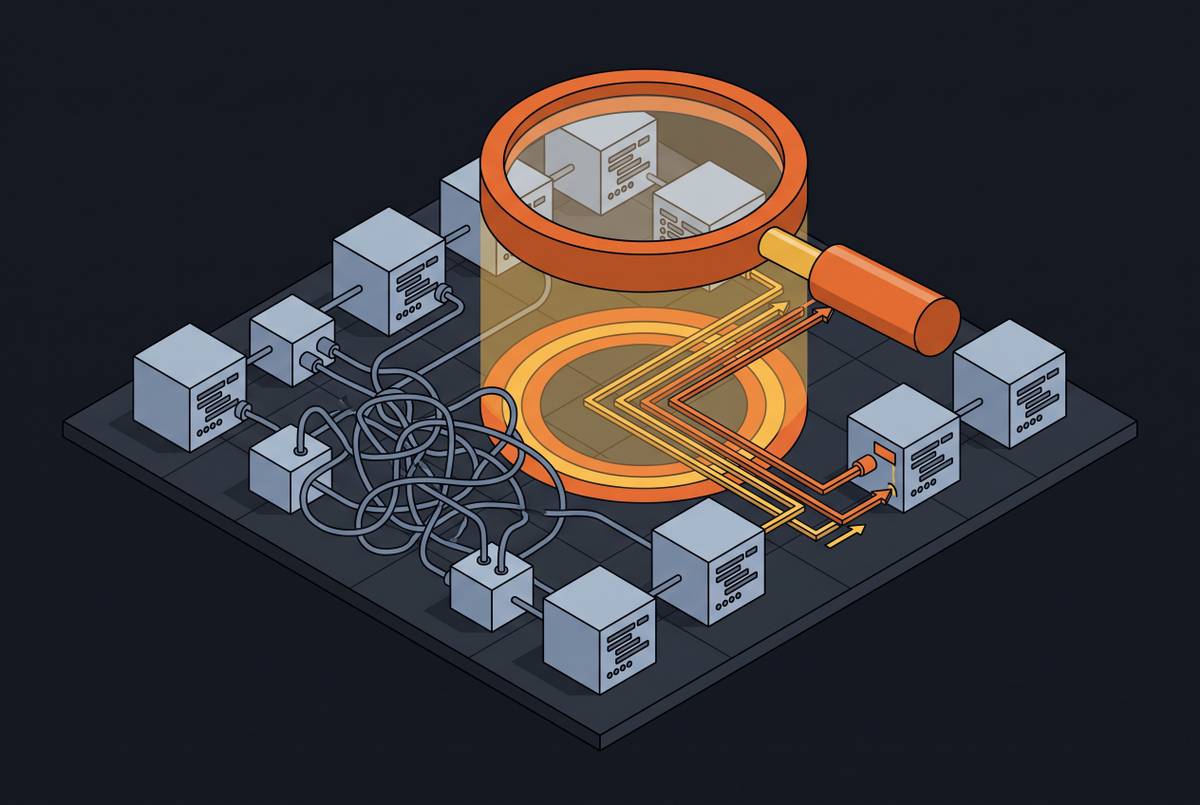
When search cannot answer cross-team questions, the retrieval gap routes to people who hold cross-team knowledge. Product, system, and team context become progressively narrower, while staff engineers bridge those layers. They become the default query interface for everyone else. A junior engineer needs an implementation explained, a PM needs current behavior clarified, and support needs to locate the code behind a customer problem. Each unanswered query competes with the senior engineer’s planned work.
Onboarding amplifies this dependence when outdated documentation and weak search leave new hires relying on experienced colleagues for weeks. An agent confined to one repository can produce an answer that overlooks behavior elsewhere, leaving staff engineers to reconcile it with the wider system. The evaluation therefore concerns more than retrieval volume. It concerns whether search can find the right few files without requiring a knowledgeable person to reconstruct the missing context.
What staff engineers actually look for first: index completeness and query precision
Index completeness is the foundational capability test. The tool must reach every relevant file, language, and subdirectory, including configuration, infrastructure-as-code, and documentation as well as application code. Otherwise, apparent coverage can conceal gaps precisely where teams need to compare infrastructure assumptions with implementation. Missing files are not merely inconvenient search results. They prevent engineers from knowing whether an answer represents the affected codebase.
Results must stay within the relevant domain without users having to know exact paths or how teams name things. A tool that demands this knowledge helps those who already know where to look while preserving the original context gap. Staff engineers probe that distinction with a shared utility defined in a library package and called across a dozen service directories. The result must include the definition and relevant callers without burying them in unrelated matches.
Query syntax also determines who benefits from the index. Natural-language retrieval gives product stakeholders, support staff, and new hires a way to ask questions without first learning regex or exact-symbol syntax. This is an access requirement. If only experienced engineers can formulate useful queries, other stakeholders remain dependent on the same human routing layer.
Ownership boundary enforcement as a search-layer requirement
A useful result identifies responsibility as well as location. Staff engineers look for CODEOWNERS integration or equivalent ownership metadata directly in the answer. Without it, engineers can find code but still not know who needs to review a change. The staff engineer still has to connect the person asking with the team responsible.
Search must respect applicable directory-level or team-level permissions, while making clear that visibility does not grant permission to modify code unilaterally. Google’s approach lets everyone see the code while directory ownership controls who can change it. That model still requires restrictions on sensitive configurations where appropriate and illustrates why search results must distinguish discovering an implementation from being authorized to change it.
Cross-team dependency visibility and impact analysis
Ownership identifies where to route a question, but dependencies reveal the consequences of a proposed change. A shared library can affect many application components, so directory attribution alone cannot establish its blast radius. Staff engineers need both views in the same answer. Before changing the library, they should be able to retrieve every consumer grouped by owning team. Otherwise, the work pauses for a manual audit or proceeds with downstream teams left out.
Dependency graph traversal must also extend beyond a physical repository boundary when the architecture requires it. Synthetic monorepos connect separate repositories into a unified dependency graph without consolidating their code. A search tool limited to one repository cannot answer organization-wide impact questions in that arrangement. The practical test is whether a query about changing an interface returns a complete, current account of affected services and owners. When staff engineers have to check dependencies separately or work from a days-old snapshot, they have to take on the work of coordinating teams again.
AI agent context quality as an evaluation criterion staff engineers now include
AI agents make retrieval quality a criterion for two audiences simultaneously. Humans may recognize a missing dependency and ask a colleague, while an agent’s retrieval gap can become a silent error in generated code. More context is not automatically better context. A broad dump of unrelated code can degrade output just as missing files can. Staff engineers check whether the search layer gives them the files the task needs while staying within its ownership and permission boundaries.
Model Context Protocol, or MCP, provides a concrete integration surface to probe. Tools that give agents live repository access through MCP can let them read current source under the same governance model used for human queries. Block built more than 60 internal MCP servers to give agents access to internal systems that can be controlled and traced. An MCP integration still needs evaluation for what it retrieves and what it permits the agent to see.
That permission test matters even more when secrets, configurations, and application code are in directories next to one another. Broad, ungoverned file access can expose sensitive material while appearing to improve context completeness. Staff engineers should ask whether agents follow the same permission model as people who use search. A tool that gives agents broader access creates an accountability gap.
The deployment and data residency question that often decides the evaluation
For regulated or sensitive codebases, deployment is an eligibility filter. A cloud service that requires source code to leave the organization’s network may be unacceptable regardless of retrieval quality. This question can end the evaluation early. The boundary covers both search indexing and AI context retrieval, because even when the index stays inside the network, rules on sending retrieved code to an external model still apply.
Self-hosting must also be practical to operate. A deployment requiring weeks of infrastructure work shifts cost from procurement into implementation, while a single-container model allows a platform team to test a real repository before committing to rollout. Bring-your-own-model support addresses the related need to substitute an LLM provider for compliance, cost, or performance reasons without rebuilding the context layer. The decisive test is whether the complete path can run inside the organization’s network without transmitting code externally.
How do enterprise teams search and navigate code at scale without slowing down developer workflows?
A successful proof of concept does not establish production operability. In a fast-moving monorepo, ownership and dependency answers describe the code as it is now if they are fresh, or as it was before if they are stale. Google’s monorepo handles approximately 86,000 daily commits, making multi-hour indexing lag consequential at that velocity. Staff engineers should measure when a new file, renamed symbol, or updated CODEOWNERS entry becomes searchable after a commit. Each tests a different part of the answer’s currency.
Latency needs testing under representative concurrency. Engineers who wait several seconds for results may return to local grep or ask a colleague, recreating the interrupt pattern. Workflow integration presents a related adoption risk. Connections to Jira, Linear, Confluence, and internal developer portals allow answers to appear where stakeholders already work. MCP-based connectors can save people the trouble of opening a separate code search interface.
For platform teams, that integration surface extends to software catalogs and self-service environment provisioning. Search disconnected from that infrastructure can become a dead end for the platform stack. Accurate answers must remain accessible at the pace and in the workflows the organization actually uses. A tool can reduce the work of coordinating people only if they keep using it.
The governance paradox: richer search accessibility can weaken ownership discipline
The capabilities that improve visibility also make it easier to act outside an ownership domain. Broad indexing exposes more code, natural-language queries lower the knowledge needed to find it, and agent access makes that context available during automated work. A searchable pattern may belong to another team, and an accessible instruction may not apply to the service being changed. Retrieval can return both without resolving the conflict.
This is the distinction between context accessibility and governance accountability. A fully searchable monorepo can still lack a clear answer about which context is authoritative, where instructions apply, and who owns them. When teams centralize search before settling who owns what, more people see poor or conflicting instructions. Reviewers then absorb the correction cost.
Local workflows can become embedded before shared search arrives, leaving the tool to index contested ownership with no agreed boundaries to clarify. The choice is therefore not simply between more access and less access. It concerns which responsibilities the tool enforces and which it assumes the organization already handles. Ignoring that distinction leaves incidents to expose the gap.
The practical resolution is to make those assumptions explicit during evaluation. Ownership-scoped attribution, CODEOWNERS context, permissions, and audit trails reduce the burden placed on informal discipline. They do not substitute for agreement about authority. A tool can show who owns a result, but the organization must still establish how conflicting team patterns are resolved and whose approval governs a cross-team change.
A practical evaluation sequence for staff engineers making the call
The evaluation should begin with deployment and data residency. Tools that cannot satisfy the organization’s restrictions are ineligible regardless of feature quality. For regulated or security-sensitive environments, self-hosted, single-container deployment with bring-your-own-model support provides an architecture to test against that requirement. The test must cover the whole retrieval path. Neither external indexing nor external model access can be left outside the assessment.
For eligible tools, the next step is testing a representative slice of the actual monorepo. That slice should include application code, configuration, infrastructure-as-code, and documentation, with cross-directory symbol queries compared against known ground truth. Ownership attribution follows directly from those results. A query should surface CODEOWNERS or equivalent metadata without a separate lookup, followed by an impact query that identifies what a change affects and whose review is required.
Agent evaluation then tests the same boundaries through MCP or an API. A cross-team debugging task reveals whether retrieval supplies relevant, scoped context or an unfiltered dump. Permission checks must accompany the task. The agent should not gain broader file access than a human user, and operability testing should then measure query latency, post-commit indexing lag, and access through existing stakeholder workflows. A free tier supporting real repositories can make these tests possible without a long procurement process.
The selection signal is a reduction in manual routing. The right tool lets stakeholders obtain accurate, current, ownership-aware answers without a staff engineer reconstructing the context between teams. Choosing it is a governance decision, and evaluation is the mechanism for determining whether shared visibility will support accountable change.