Build vs Buy Decisions for Internal Developer Tooling
AI has made building faster, but the real cost of internal tools still comes after launch.
The three paths and what each means in 2026
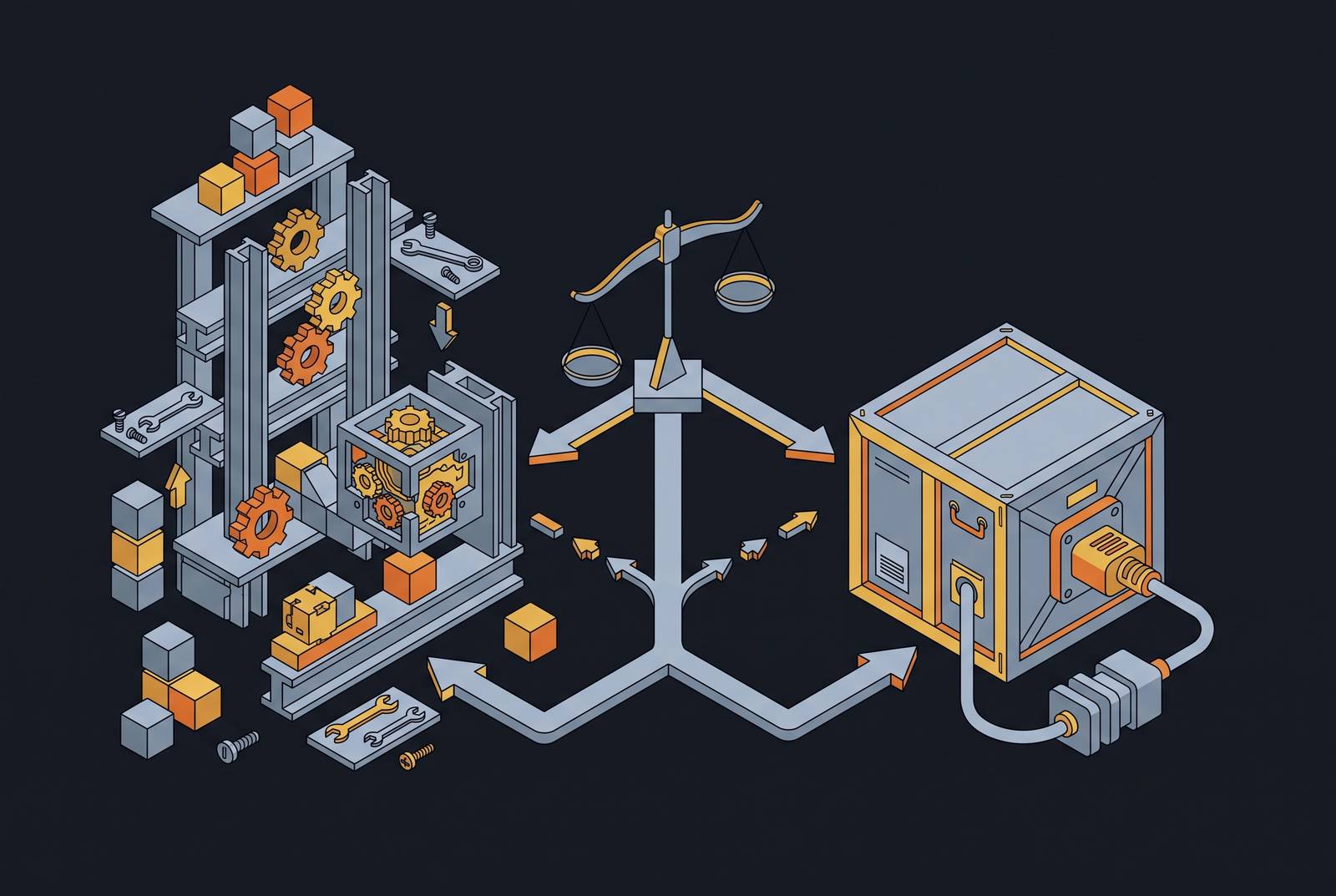
Build-vs-buy for internal tooling used to run on a gut check: two options, one brief debate, whoever argued loudest won. That era is over. The decision now runs through three real paths, a set of hidden costs that never make the pitch deck, and a maintenance tail that AI hasn't shortened one bit, even as it makes the first month of building look almost free.
The old rule of thumb was buy unless a team had six months and a full crew to spare, and it undersold building for years, because nobody counted what a purchased tool actually costs once the workarounds pile up. The new rule of thumb, something built in a week with an AI coding agent, makes the same mistake in reverse: it prices the sprint and ignores everything that happens after the demo. Retool's Build vs. Buy Shift Report, a survey of 817 customers and builders from late 2025, found that 35% of respondents had already ripped out at least one SaaS tool in favor of something built in-house, and 78% expect to build more in 2026. That's a real shift in behavior, not proof the behavior is correct, and the two claims get conflated constantly.
Answering it well means asking how much of this software needs to belong to you, and for how long. Answering it well means separating internal tooling, which lives or dies on process fit and lifetime cost, from customer-facing product bets, which carry an entirely different risk profile. Conflate the two and the wrong variables get the weight every time. What follows is a framework for the internal case specifically, built to produce a defensible answer rather than a comfortable one.
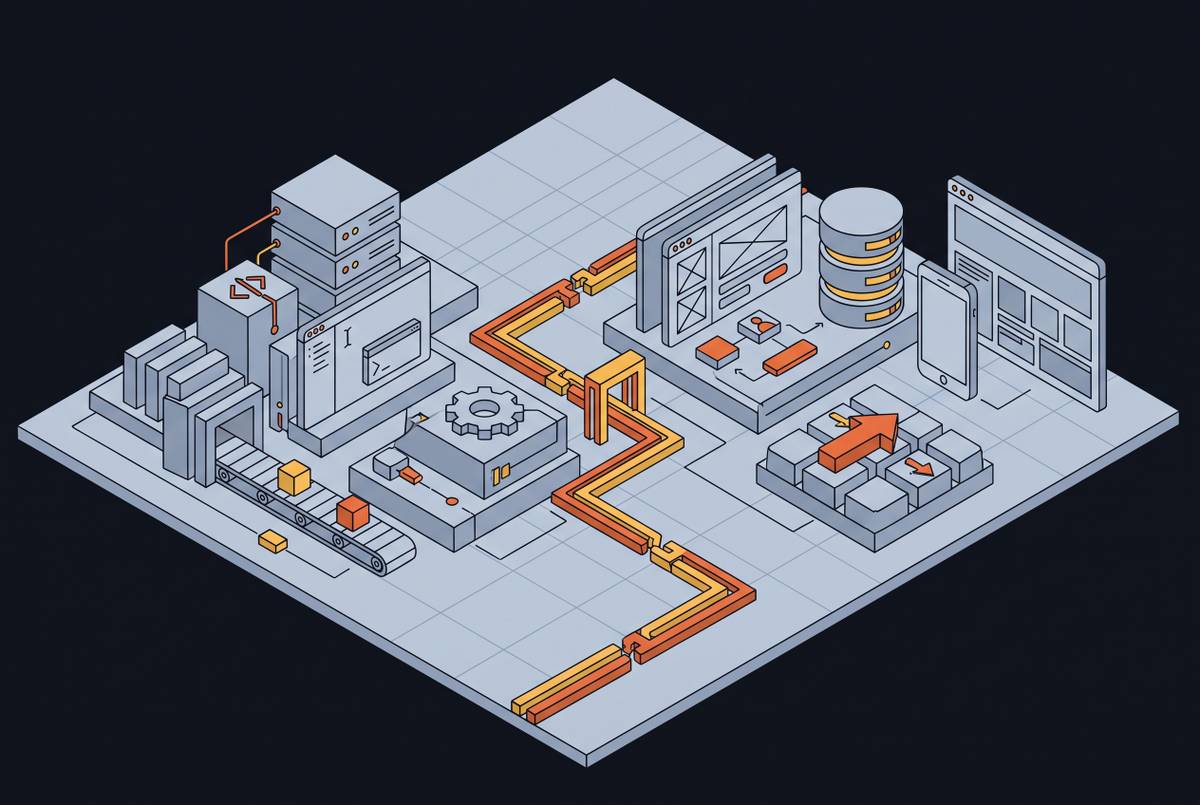
Build still means what it always meant: custom code, written and owned by the team, in the team's own stack. What's changed is the cost of the first draft. AI coding assistants have changed the economics of early prototyping, but that's a cost modifier on the build path, not a fourth option. The code still needs humans to maintain it once it ships, regardless of how fast it got written.
Buy means off-the-shelf software, SaaS or a licensed enterprise product, where a vendor owns the core and the team adopts their release cycle. It deploys fast. It also means inheriting someone else's roadmap, someone else's pricing changes, and often constraints on where the data physically lives.
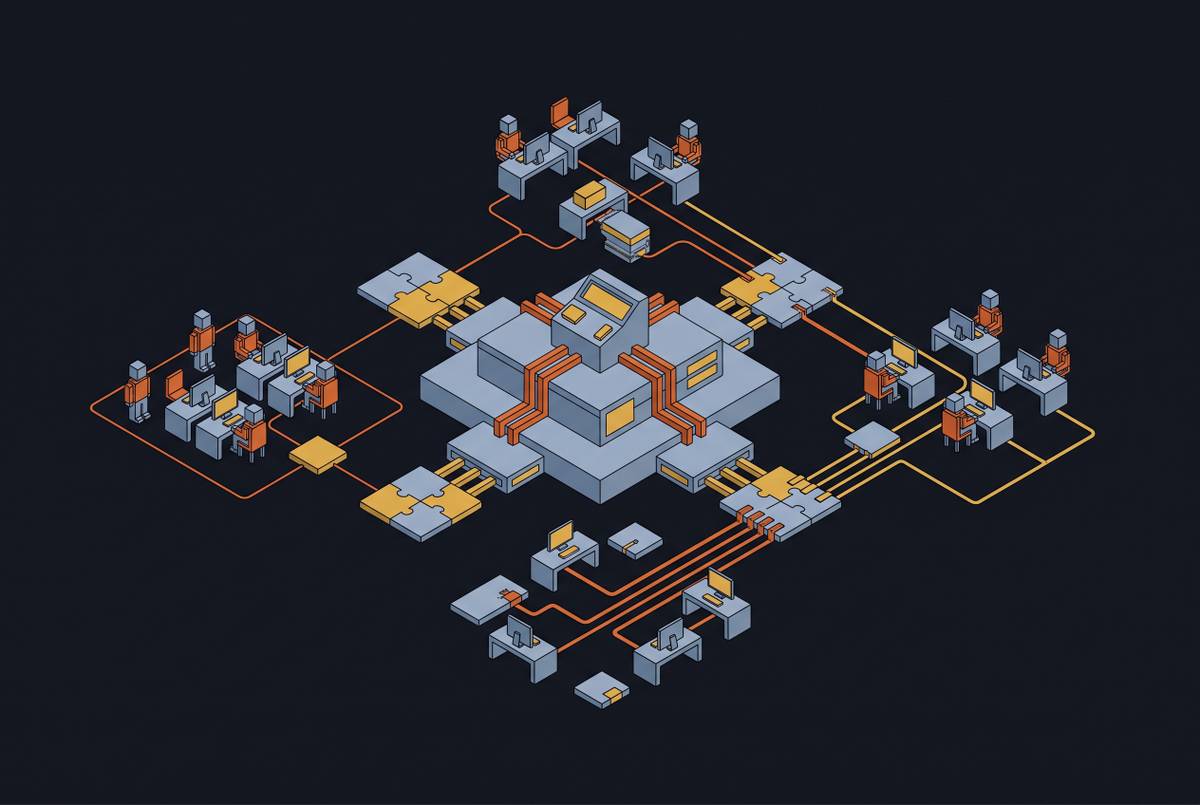
Buy-and-extend sits in between: purchase a platform, then customize it through APIs or an in-platform low-code layer, Salesforce Flow or ServiceNow App Engine, or by wiring in embedded AI agents. It moves faster than a ground-up build and gives more room than a rigid SaaS product, but the lock-in ends up looking a lot closer to buy than most teams expect going in.
For most companies past a certain size, buy-and-extend is the sane default, and teams that skip past it straight to "let's build" are usually solving an ego problem. Adopt buy-and-extend first, measure what it actually does for developer experience, and reserve a full build for the cases where a real, quantifiable gap opens up in what's commercially available. That's the discipline most build decisions skip: someone gets excited about owning the roadmap and never runs the comparison against the boring option.
Each path fails its own characteristic way. Build failure looks like technical debt nobody signed up to own, code that works but that nobody on the team wants to touch. Buy failure looks like SaaS sprawl: Zylo's 2026 SaaS Management Index found organizations use just 54.4% of the software licenses they pay for, wasting an estimated $19.8 million a year on seats nobody's logging into. Buy-and-extend failure looks like an extension layer so tangled that migrating off the base platform costs as much as building the whole thing from scratch would have. None of the three paths is safe by default. The job of the framework is finding the right one for a given workflow.
The four questions that drive the decision
These are lenses to look through at the same time. A strong answer on one doesn't cancel a bad answer on another, and treating them as a checklist to clear rather than a set of tensions to weigh is where most of these decisions go sideways.
Is this workflow how the company actually wins, or is it commodity? The test is simple to state, harder to apply honestly: would it change the outcome if a competitor used the exact same tool? For most internal software, the answer is no, and that's a clean signal to buy. A pricing-approval workflow that encodes proprietary margin logic, or a trading desk's order management system where the execution logic is the edge itself, deserves a serious look at building, because there the workflow is the differentiation.
Does the off-the-shelf option actually fit the process, or is the team the one bending to fit it? The real cost of buying rarely appears on the invoice. It appears in the workaround layer that grows around a tool that's close but not quite right, caused by plant-specific manufacturing logic fighting a packaged ERP or MRP module instead of running through it cleanly. Bending a process to match a tool is fine when the process isn't special. It gets expensive fast when it is.
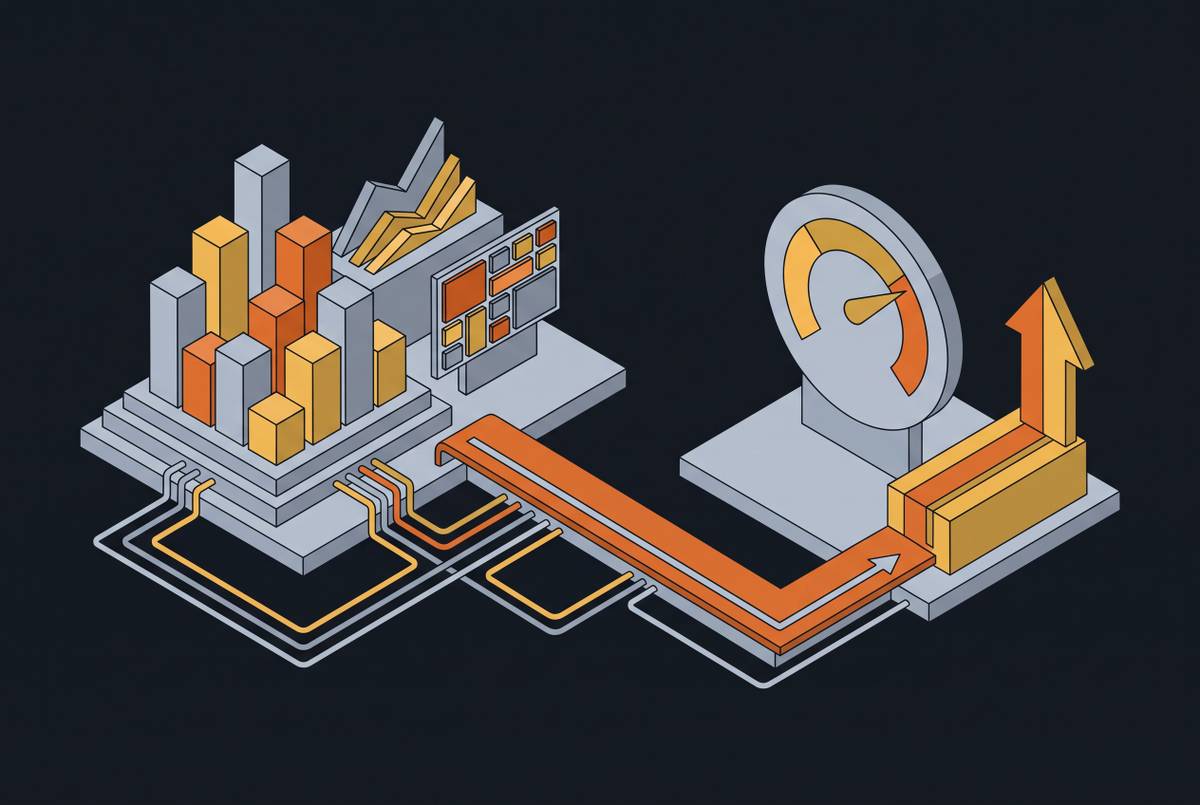
What does this cost over five years, not at the moment of signing? Buying compounds quietly: more seats, tier upgrades, usage-based pricing, integration work, someone's time spent administering the thing. Building front-loads the cost, then settles into a long maintenance tail, and a significant share of developer time already goes to maintenance and technical debt, a share that only grows as more custom tools get added to the pile. Neither path wins by default here. The crossover depends entirely on how long the tool needs to live and how many people touch it.
Does the company actually need to own this? Compliance requirements, data residency rules, or a flat code-and-data-stays-on-our-infrastructure policy narrow the field fast, usually down to build or a self-hostable buy, and usually rule out most SaaS regardless of price. Healthcare under HIPAA, financial services under GLBA and SOX, government contractors running air-gapped environments: for these, ownership isn't a preference, it's a hard requirement. Once that constraint kicks in, the whole framework collapses into one question, which self-hostable option costs the least to run.
Total cost of ownership: what the five-year number includes
TCO is where build decisions go wrong most often, and the failure mode repeats itself every time: teams price the sprint, not the decade of ownership that follows it.
Building carries costs that rarely make the original estimate. The biggest one, and the most underweighted, is opportunity cost: every engineer maintaining an internal tool is an engineer not working on the actual product. Systems that start simple accumulate complexity as the business changes around them, so the maintenance burden grows even if the tool itself never gets a new feature. Keeping pace with the surrounding infrastructure, cloud tooling updates, security patches, framework version bumps, adds a steady tax on top of that. A talent problem drives all of it, too: finding engineers who actually want to maintain internal tooling is a harder recruiting and retention fight than finding people to build something new and shiny. Research from McKinsey and the University of Oxford, drawn from more than 5,400 IT projects, found large IT projects run 45% over budget on average while delivering 56% less value than projected. Anyone pricing a build against that base rate optimistically is fooling themselves.
Buying has its own hidden costs, and they stay less visible precisely because they arrive as a single line item on an invoice instead of a maintenance backlog. Seat growth and tier-upgrade pricing compound every year, quietly. Someone ends up owning the SaaS stack, the integrations, the admin panel, even when no one's job title says so. At scale, that 54.4% license utilization figure from Zylo means the real cost per active user runs well above what the contract implies. Vendors don't sit still either: pricing changes, roadmaps shift, and companies disappear. Builder.ai, once a well-funded unicorn, filed for bankruptcy in May 2025. Point solutions built on venture funding carry a longevity risk that a five-year TCO model has to account for, not assume away.
Buy-and-extend's TCO is the trickiest to see clearly, because the license cost sits right there in the contract while the extension maintenance cost does not. Enough custom logic layered onto a platform's API or low-code tools can quietly grow into a maintenance burden that rivals a full build, minus the ownership that would have come with actually building it.
Score it instead of arguing about it: rate each dimension, differentiation, process fit, five-year cost, ownership requirement, on a scale from one to five, for both the build path and the buy path under consideration. The weighted totals surface the crossover point directly instead of leaving it to whoever argued loudest in the room. And one line belongs on the build side of the ledger that gets left off too often: institutional knowledge stays in-house, the roadmap is fully the team's own, and there's no renewal negotiation where leverage quietly shifts to the vendor's side of the table.
Where self-hosting changes the calculus for developer tooling specifically
Two ownership pressures act on developer tooling at once. The tools touch source code, which is about as sensitive as intellectual property gets, and the same engineers who use them every day are the ones who'd get stuck building and maintaining any custom replacement.
That combination is why self-hosted buy is the highest-leverage path in this category, full stop. It delivers vendor-maintained features and vendor-maintained security without the code ever leaving the company's own infrastructure, which is the one combination a pure SaaS product structurally can't offer. Plane has noted demand for self-hosted work-management tools is at an elevated point, particularly following the Atlassian Server end-of-support announcement, with organizations across a range of industries reassessing their deployment options.
The self-hosted developer stack has settled into recognizable patterns heading into 2026. A dev.to infrastructure guide points to a combination that appears repeatedly: Caddy for the TLS and HTTP gateway layer, Forgejo for private code collaboration, Vaultwarden for credential storage, Uptime Kuma for monitoring, MinIO for object storage. On the platform side, Microsoft Azure DevOps Server reached general availability in December 2025 as a production-ready, self-hosted DevOps platform with Git-first improvements, Visual Studio Magazine reported. Spotify's open-source Backstage project offers a service catalog, documentation, and software templates, but it needs dedicated engineers just to stand up and keep running. Open-source doesn't mean low-maintenance, and Backstage is a well-known example of that gap.
For a lot of regulated environments, the deployment choice is genuinely binary: bring-your-own-cloud into AWS, GCP, or Azure (or onto bare metal), against full SaaS. Some platforms now offer BYOC as a self-serve option, skipping the months-long enterprise sales cycle that used to gate the choice. A common approach for keeping a self-hosted tool's maintenance burden sane is single-container deployment: one Docker image doing the whole job. It cuts out the infrastructure sprawl that turns "we self-host our tools" into "we're running a second engineering org just to keep the tools alive," which is the actual failure mode teams walk into when they underestimate what self-hosting costs in headcount rather than dollars.
Code intelligence as a test case: what the build-vs-buy decision looks like for enterprise code search
Enterprise code search fails all four of the framework's questions in the direction of buy, and the pattern generalizes well beyond code search itself.
Searching a codebase is infrastructure, no matter how large the codebase gets, and it's a poor fit for generic off-the-shelf search: real enterprise code search needs cross-repository indexing that understands syntax and supports regex at a scale generic text search was never built for. The maintenance tail is brutal, too. Keeping an index current and accurate across hundreds of repositories, while code changes constantly, takes sustained engineering attention rather than a one-time setup. And the data-sovereignty requirement applies almost every time, because source code is frequently the single most sensitive asset a company owns, one that can't get shipped off to a third-party cloud for indexing.
The scale failure is concrete. A search tool that works fine on a 50,000-line side project can fail silently the moment it's pointed at a 50-million-line enterprise codebase spread across hundreds of repos. "Find all usages" turns into a query someone runs before a coffee break and checks on after. Onboarding a new engineer stretches into a quarter instead of a week, because nobody can hand them a reliable map of the system, and nobody's confident which services still call the function someone's trying to delete.
The security failure is just as concrete. The difference becomes acute during security incidents: teams with a full codebase index can locate a vulnerable pattern across all repositories in a single query, while teams without one face an open-ended manual search across individual repos, which is the gap between having an index and not having one.
AI coding agents don't close this gap, and treating them as though they do is the mistake to watch for going into 2026. None of the major agents, not Cursor, not Claude Code, not Codex, are built to automatically discover and search across every repository in an enterprise. Each is designed around a working context scoped to the code a developer is actively editing, a sensible design for writing code and a poor fit for searching an organization's entire history of it.
The path that actually threads all four questions is self-hosted code intelligence: a platform running as a single container inside the company's own infrastructure, where code never leaves the environment, the vendor maintains the indexing engine, and platform teams aren't stuck standing up a second engineering project just to keep search working. The lesson holds beyond code search specifically. Whenever a workflow is infrastructure rather than differentiation, doesn't fit general-purpose tools well, and comes with a real data-sovereignty requirement, self-hosted buy wins the TCO comparison consistently, every time this gets modeled honestly. The maintenance burden stays on the vendor's books. The data stays on the company's own.
The context layer's role in the build-vs-buy decision
The shift from suggestion to action happened fast. Heading into 2026, the conversation around AI coding tools has shifted noticeably toward agentic workflows: multi-step task execution, large refactors, full features implemented with minimal hand-holding along the way.
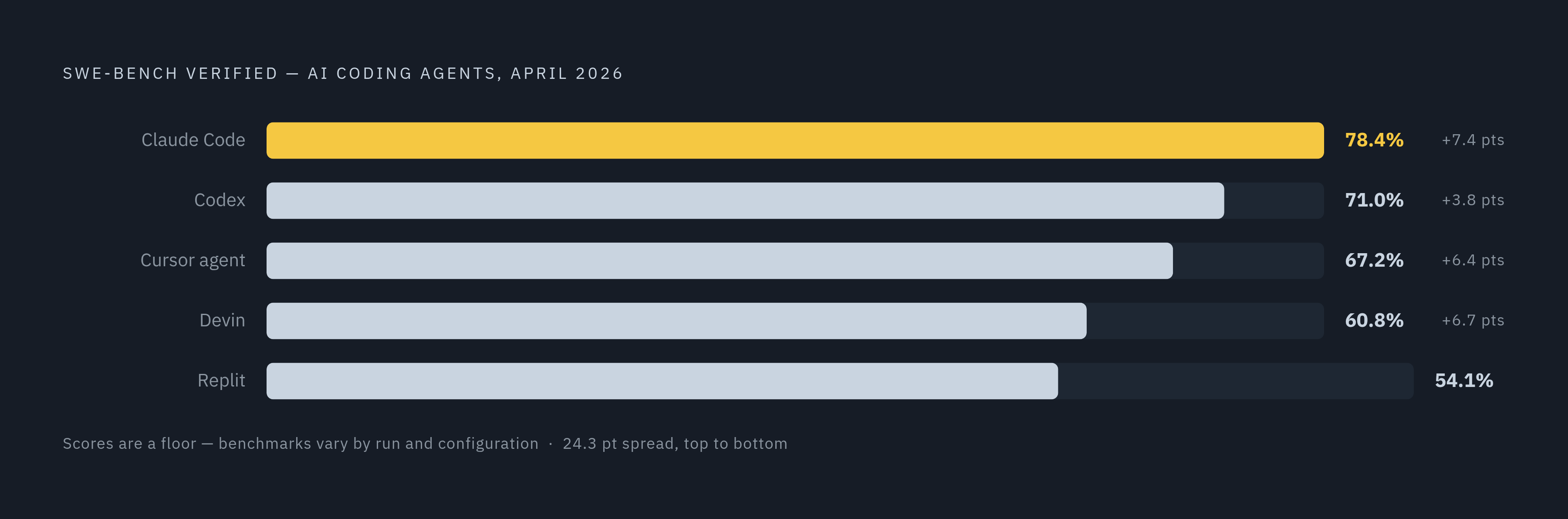
The market has split into recognizable lanes: closed IDE-forks like Cursor and Devin Desktop (formerly Windsurf), terminal-native agents like Claude Code, and extensions built for VS Code and JetBrains. As of August 2026, the major players in each lane offer agentic code execution and increasingly connect to external tools and context sources. SWE-bench Verified scores from April 2026 put Claude Code at 78.4%, Codex at 71.0%, the Cursor agent at 67.2%, Devin at 60.8%, and Replit at 54.1%. Treat that as a floor, not a ranking that settles anything: tool-use reliability and MCP compatibility matter more for real enterprise workloads than a benchmark percentage ever will.
Research into AI-assisted development has found that perceived productivity gains and actual output gains can diverge meaningfully, with experienced developers not always completing tasks faster than they expect. That gap between felt speed and measured speed is why tool selection needs to rest on measurable enterprise value rather than on how fast a demo feels in the room. Signing a contract based on a live coding session, in other words, is buying the perception gap along with the tool.
Every major agent operates on workspace-local context, a shared architectural limit that produces the issues described above. Cursor indexes the local workspace to support context-aware code suggestions. Claude Code searches on demand within the working context available to it. Codex works against a single working directory. None of them reaches across a full enterprise codebase on its own, which is precisely the gap Model Context Protocol was built to close.
MCP, introduced by Anthropic in November 2024, was donated to the Agentic AI Foundation under the Linux Foundation in December 2025, moving it from a single vendor's protocol to shared, vendor-neutral infrastructure. That matters directly for the build-vs-buy decision on developer tooling, because it means the context layer, the system that decides what an agent can actually see and search, is becoming a distinct, buyable component rather than something bundled invisibly inside whichever agent a team happens to pick. For teams running the TCO framework, that layer is where the build-vs-buy decision for developer tooling heads next, and it's shaping up to look a lot like the code-search case already does.