Cross-Repository Code Search as a Dependency Governance Tool
Symbol-aware search across repositories lets teams assess dependency impact before shipping changes.
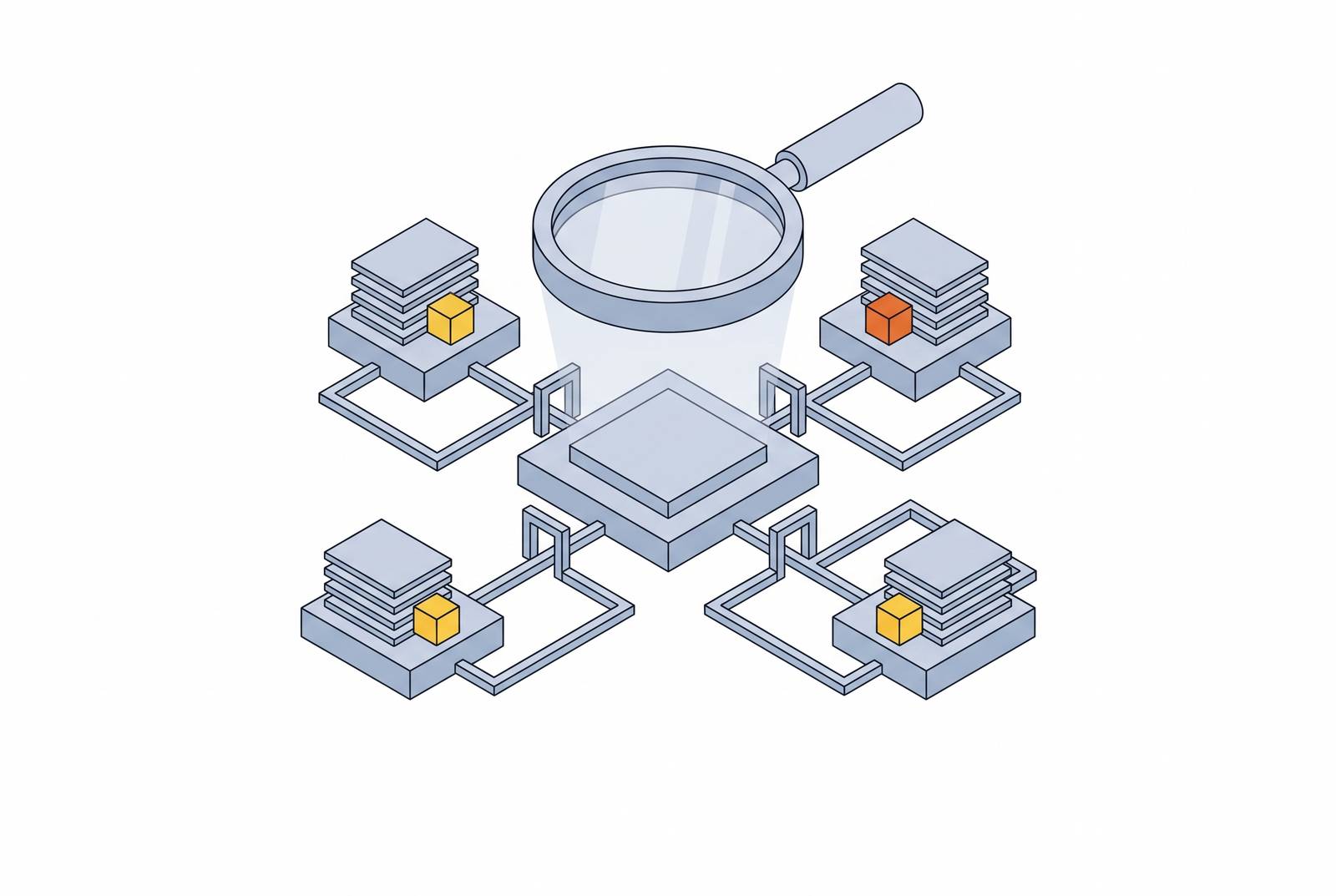
Enterprise code search resolves definitions, callers, and consumers across repositories so teams can assess dependency impact before a change ships. For large codebases, its value depends on symbol identity, cross-repository resolution, and a continuously updated index. Cross-repository code search becomes a dependency governance tool when it makes those relationships observable, queryable, and available to the people and agents changing the code.
Why dependency management breaks down when repositories multiply
Large engineering organizations run code in many repositories, version control systems, and language stacks at the same time. Platform-native search cannot bridge all of those seams. A shared utility may live in one repository while many others use it, and a field defined in one system may flow through downstream services. The repository boundary splits up the evidence developers need to understand the dependency, so they can change a definition without seeing everything that depends on it.
The prevailing workaround is to ask a senior engineer who knows the system. That engineer becomes the query interface for everyone else, translating a proposed change into a mental map of affected services. This arrangement is neither searchable nor durable. Knowledge leaves when engineers leave, and the number of relationships grows beyond what human coordination can reliably track. The dependency graph is already encoded in the code, but without a way to inspect it across boundaries, teams discover its consequences only when a change reaches production.
Why text search fails as a governance primitive
Text search finds occurrences, while symbol-aware search resolves identity. A search for a common field name can return comments, documentation strings, variable declarations, call arguments, and test fixtures. Those matches do not establish which references belong to the same data element. The developer must reconstruct that distinction from surrounding code. IN-COM describes how cross-repository symbol search narrows this flood to a specific element and its actual usage, turning hours of reconstruction across dozens of codebases into a task that can take minutes.
Symbol-aware search parses code into an abstract syntax tree that identifies what each element is and how it relates to other elements. It can then resolve a request to find the definition of processPayment and every location that calls it. Coincidental matches no longer compete with the relationships the developer needs to inspect.
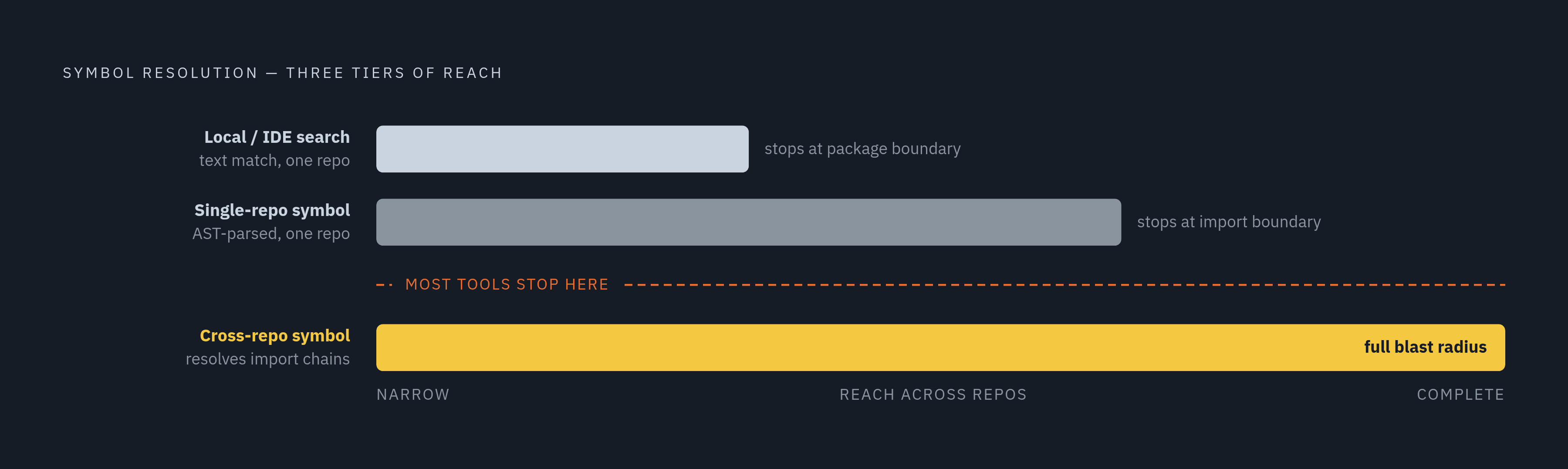
Cross-repository resolution extends that model beyond the current project. A unified index must resolve import chains and recognize that a function exported from one package and imported into another is the same symbol. IN-COM identifies this boundary as the point where most tools built into development environments stop, because they do not index downstream consumers of shared packages. For shared-library teams, that omission hides the places a breaking change will reach. Governance requires precise usage evidence because a control cannot reliably enforce a dependency rule against an undifferentiated collection of strings.
How cross-repo symbol search functions as a dependency governance layer
Cross-repository symbol search gives an organization a way to control changes when it lets teams see how those changes will affect dependencies. A query can identify all callers of a function, importers of a package, or consumers of a data field across the indexed codebase. A developer planning a signature change can see its blast radius before opening the PR, instead of finding out about consumers after CI fails in three downstream services. The control operates before the change ships.
The same capability supports security governance when a CVE affects a shared dependency. Teams need to ask which repositories actually import the package at a version in range. Cross-repository search can answer that question in minutes with usage evidence. This gives security teams a basis for prioritizing remediation by real exposure. The scope of that evidence remains important, because results describe only the indexed codebase.
Search does not turn visibility into enforcement by itself. Its governance role is to make the dependency relationships available for queries, audits, and decisions about proposed changes. A graph that teams can query gives them the evidence they need to apply controls, while a dependency graph left implicit in source code gives them no shared place to review those relationships.
Where manual dependency tracking creates compounding risk
Qodo illustrates the failure with a change to BillingClient that makes a field mandatory and removes the validation fallback. The diff compiles, and the tests pass. But three downstream services still send payloads without that field and fail at runtime. The risk sits outside the modified file. Standard code review tools evaluate the pull request diff, but the evidence needed to understand this failure is distributed across the services consuming the interface.
This gap allows cross-repository contract drift to accumulate quietly. Services diverge from shared contracts over time, while no single review surface catches the divergence because no single PR touches all the relevant repositories. Manual tracking depends on someone remembering each consumer at the moment of review. Every untracked dependency adds another silent assumption. As more teams adopt the shared component, the cost of a breaking change grows with the consumers that cannot be found without manual search.
GitHub’s May 2026 change to Dependabot access illustrates the same boundary problem in dependency updates. Previously, Dependabot could only access repositories within the same organization, so cross-organization dependencies hosted in internal repositories could not receive automatic updates. The change lets administrators grant access to internal repositories in other organizations within the enterprise. It requires explicit administrator enablement and does not extend that access to private repositories. Even tools built to automate dependency updates need to see across boundaries, because per-repository controls cannot act on dependencies they cannot reach.
What it takes to build a cross-repo index that is actually accurate
The hardest part of an accurate cross-repository index is correctness at language and ecosystem boundaries. Multi-language search needs language-specific parsers, a unified symbol model, and a dependency resolution layer that links producers to consumers across repositories. Each component serves a different purpose. Parsing identifies structure within a language, while the shared model and resolution layer establish relationships that would otherwise remain separated by repository or ecosystem.
Parallel single-language indexes do not provide that connection. A tool may search several languages yet still fail to resolve a COBOL field flowing into a Java service or a Python package consumed by a Go service. If the index treats each language as an isolated world, its apparent breadth conceals the missing dependency evidence. For governance, this creates false confidence precisely where a developer needs to know whether a change reaches another system.
Freshness is a separate requirement for correctness. An index that lags behind development describes an older dependency graph, even if its symbol resolution is otherwise precise. A missing caller can look like proof that no caller exists. The index therefore needs to be updated on commit. Enterprise code search used for governance must combine structural accuracy with current code, because either an unresolved boundary or a stale relationship can undermine the same impact assessment.
How AI coding agents change the stakes for cross-repo visibility
An AI coding agent without cross-repository context has the same blind spot as a developer limited to a local checkout. It can inspect the code in scope and search the references available to it. It cannot discover consumers in repositories it cannot access. When asked to deprecate an API field or modify a service interface, the agent may produce a confident, internally consistent change that remains structurally incomplete. The agent may reason correctly about the code it can see and still miss the full blast radius because its context is too narrow.
The Model Context Protocol offers a way to give the agent that missing information. A cross-repository MCP server can answer structured questions about which services consume a field, which repositories call an RPC, or which consumers an interface change will affect. Static analysis discovers the dependency graph, and the server exposes it to the agent. The agent then reasons over a structured answer. It does not have to reconstruct the software estate through file reads and exploratory tool calls that consume its context window.
This division of labor makes the index part of the agent’s safety constraints. Reasoning faster cannot make up for a consumer the agent cannot see. As agents take on more autonomous coding tasks, they need access to cross-repository dependency evidence to avoid breaking distributed systems. The index’s accuracy and freshness requirements therefore apply equally to human searches and agent queries. An agent receiving stale or incomplete relationships inherits the same false confidence as a developer reading those results.
Self-hosted deployment as a governance requirement, not an infrastructure preference
A cross-repository index concentrates symbol relationships, call graphs, and dependency chains from across an organization. That makes this developer service a place that holds a great deal of valuable intellectual property. Its location becomes a governance decision for that reason. Bringing previously siloed repositories into a unified, queryable graph creates an aggregation risk if the search surface sits outside the organization’s security perimeter. The capability that improves dependency visibility also makes the combined structure of the codebase available through one surface.
For organizations whose governance requirements demand control over where that information runs, self-hosted deployment addresses that constraint. The organization can keep the index within its own visibility and access controls instead of distributing the stack across a vendor’s cloud. The governance tool must itself be governed.
The single-container model contributes to this argument through auditability as well as simplicity. An accurate index lets teams trust the dependency evidence, while deployment control governs where that evidence is kept and whose controls apply to it.
Making cross-repo search accessible beyond the engineering team
A precise index can still reproduce the original visibility problem if only senior engineers can query it. PMs tracking feature impact, support staff diagnosing production issues, and new engineers learning the codebase all need dependency information. Most do not know how to write symbol queries against a code index. If every question must pass through an expert, the organization has changed where the knowledge is stored without removing the human bottleneck. The graph is technically observable but remains practically inaccessible to many of its users.
New engineers face a particularly difficult version of this problem. They need to understand dependencies to work safely, yet they lack the codebase familiarity needed to choose a query or interpret its results. Natural-language access extends the search surface to questions about consumers, feature impact, and affected services without requiring the requester to express them as symbol queries. The resolution work is still needed to make that access useful.
This broadens dependency governance from a specialist task into an organizational capability. People who need dependency information must be able to obtain it without an expert intermediary. That access has to remain available as the code changes. Dependency governance is not a tooling problem solved once by building an index, but a continuing visibility problem whose answer must stay accurate and accessible to the people making decisions.