Onboarding Ramp Time as a Productivity Metric for Growing Engineering Teams
Measuring onboarding by time to tenth merged PR shows teams improving ramp time by half.
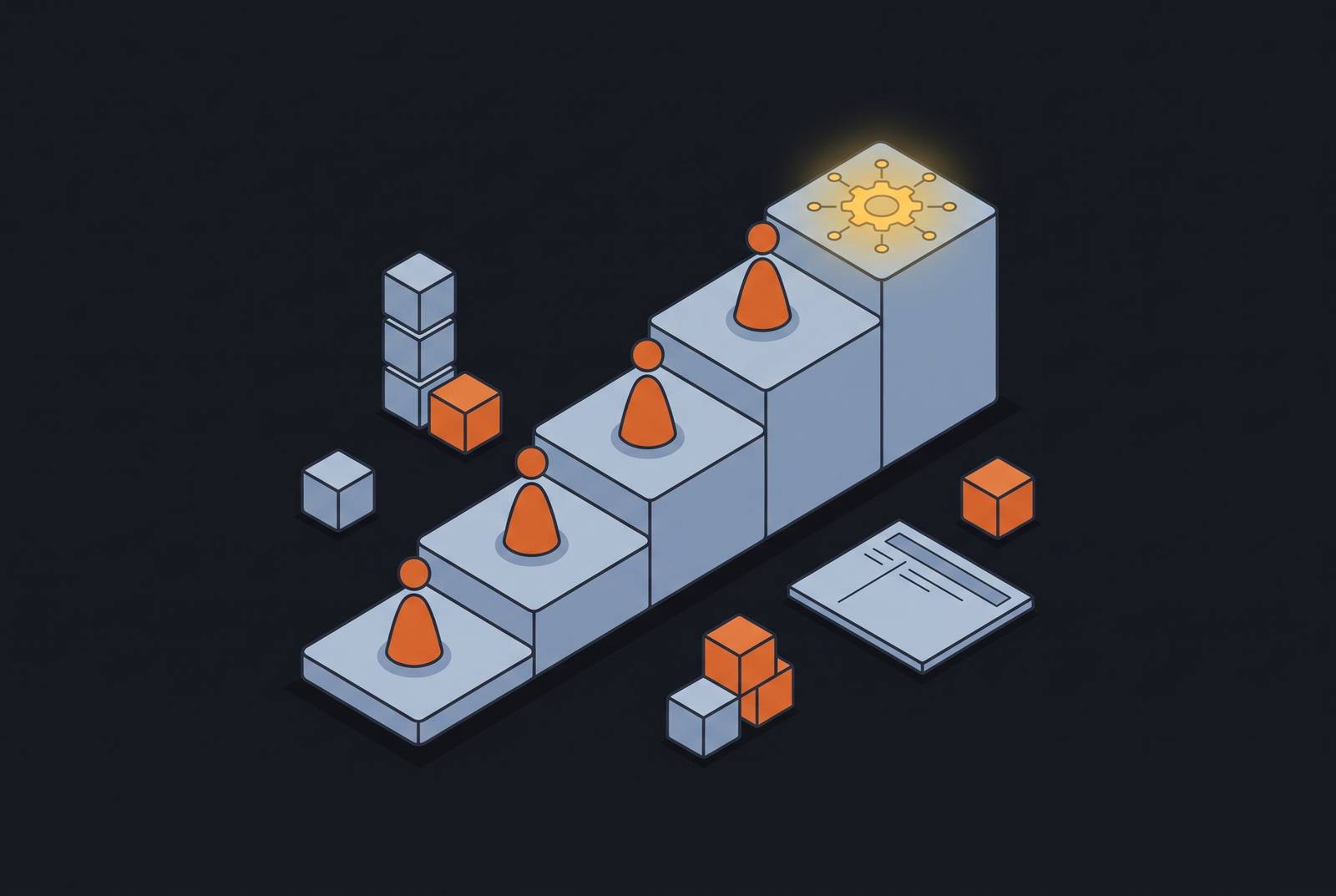
Ramp time is the span between a new hire's start date and the point where they contribute independently, at the quality bar the team actually expects. That distinction matters: it is an outcome metric, not an activity metric, so it measures what onboarding is supposed to produce rather than the motions that supposedly produce it. Most engineering organizations don't track it that way. Onboarding gets run on a feeling, a rough sense that a new hire "seems to be getting it," with no defined finish line and no way to tell whether someone is ahead of schedule or quietly falling behind until a missed deadline or a botched deploy makes it obvious.
Engineering makes this worse than most functions. A new hire in sales or marketing needs product knowledge and process familiarity. A new engineer needs a working local environment, fluency in build tooling, a mental map of services that may span dozens of repositories, and enough architectural context to know why the codebase looks the way it does rather than the way a textbook says it should. The distance between "shows up" and "ships independently" is simply longer and more expensive to close in technical roles, and every week spent closing it is a week of senior engineer time spent explaining rather than building.
The upside of getting this right is not abstract. Organizations with strong onboarding programs see 82% higher retention than those without one, according to Trainual's research.
What the numbers say about how long engineering onboarding takes
The published baselines are wide, and that width is itself informative. Glean's research puts full productivity at three to eight months for a typical new hire, a range broad enough to cover almost any outcome, which is exactly the problem. Cycloid's 2026 guide narrows it somewhat: the median time to productivity across knowledge-based industries is 65 days, but technical roles, engineers and data specialists specifically, run to 90 days, driven by environment setup and the sheer work of mastering unfamiliar systems Developer Onboarding Process: The Complete Guide (2026) - Cycloid. AllenComm's figures track closely: entry-level roles often reach productivity within 30 days, while technical or senior positions commonly need 60 to 90 days or longer.
Remote work adds its own tax. Remote-first hires report ramp times running roughly 15 to 20% longer than in-office peers, a gap Cycloid attributes to fragmented information flow and the loss of the incidental hallway conversations that used to answer half a new hire's questions before they became blockers Developer Onboarding Process: The Complete Guide (2026) - Cycloid.
Survey data fills in what these averages feel like from inside the experience. Across a survey of 1,200 software engineers, 67% said their first production-ready contribution took more than four weeks. Nearly as telling, 42% said onboarding documentation was significantly out of date. A large share of new hires are being pointed at instructions that no longer describe the system in front of them. And 31% said they felt lost for the first 60 days with no clear path to productivity, a sensation that has less to do with individual competence than with the absence of a defined finish line. Gallup's numbers put a hard ceiling on how good most onboarding actually is: only 12% of employees strongly agree their organization does a great job onboarding, which suggests the gap between what companies intend and what they deliver is close to universal How to ramp new hires faster: best practices for effective onboarding.
These are averages spanning every kind of onboarding, across every function. They say the ramp is long and unevenly managed, but they don't isolate what's specifically happening inside engineering, or offer anything a team could put on a dashboard and watch move week to week. That requires a narrower, engineering-native signal.
Time to 10th PR: what a precise engineering ramp metric looks like in practice
Time to 10th PR measures the average number of days between a developer's start date and their 10th merged pull request.
The choice of the 10th PR, rather than the first, is deliberate. A first pull request is frequently a trivial setup commit, a config change or a typo fix assigned specifically because it's low-risk and confidence-building. The 10th PR represents something different: a pattern of sustained, reviewed contribution that a new hire has repeated enough times to demonstrate it's not a fluke. DX's Engineering Enablement newsletter, drawing on a random sample of 400 companies across large global organizations with 500 or more developers, spanning both tech and non-tech sectors, tracked this figure from October 2025 through February 2026. The current average as of April 2026 is 33 days, down from 39 days in the previous quarter, a roughly 15% quarter-over-quarter decline Developer ramp-up time continues to accelerate with AI. Measured against Q1 2024, before AI tools were in wide use, the figure has fallen by more than half Developer ramp-up time continues to accelerate with AI.
That's a genuinely large movement in a short window, and it deserves scrutiny rather than applause alone. DX's own newsletter flags the metric's narrowness as a limitation: Time to 10th PR tracks milestone speed, but says nothing about the quality of the changes merged, how much rework they generated afterward, or how deep the new hire's systems understanding actually runs. Speed to the milestone and depth of understanding are not the same thing, and DX marks this as an open question for further analysis.
The practical response is not to discard the metric but to pair it with others. They surround it, catching what it can't see on its own. The obvious next question is what's actually driving the dramatic improvement in Time to 10th PR since Q1 2024, and the data points to one variable above the rest: AI tool adoption. Complementary signals look like milestone completion at 30/60/90 days, early retention through 90 days, ramp consistency across hires, and new hire confidence at check-ins (per Trainual and AllenComm).
What AI coding tools are doing to ramp time
AI coding tool adoption has stopped being a differentiator and become the baseline. JetBrains' survey found 90% of developers use at least one AI tool at work, Stack Overflow's 2025 Developer Survey put the figure at 84% using or planning to use AI tools, and Pragmatic Engineer's data shows adoption reaching 95% among senior-developer cohorts specifically. Given that saturation, it would be strange if ramp time hadn't moved.
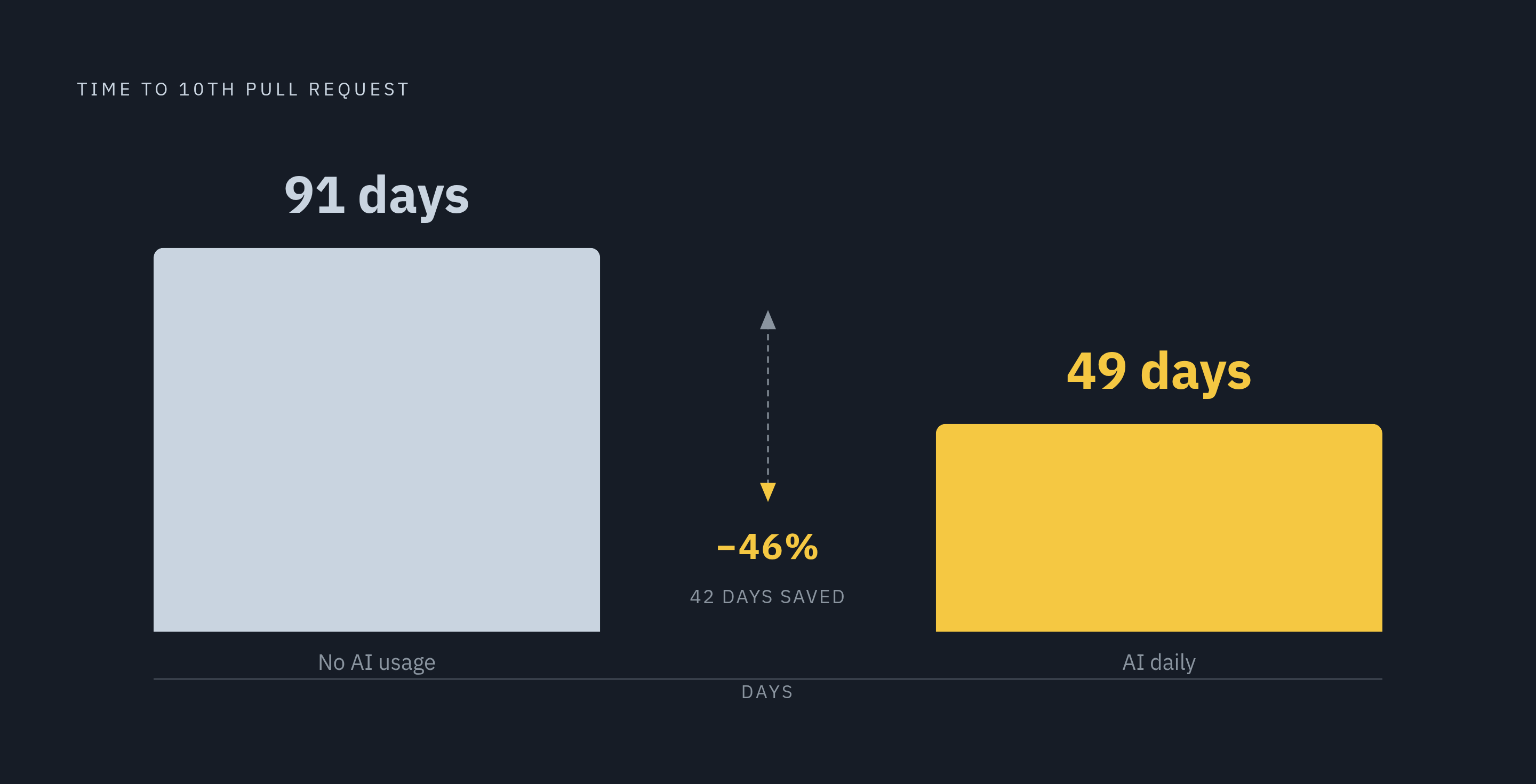
DX's Engineering Enablement analysis shows exactly how much it moved in some companies: Time to 10th PR fell from 91 days for engineers with no AI usage to 49 days for those using AI daily, roughly cutting the ramp in half. The mechanism behind that gap is straightforward. That's a meaningfully different use of AI than autocomplete Developer ramp-up time continues to accelerate with AI.
That's a reasonable caution. Not every part of learning a codebase is a lookup problem.
The tools themselves have moved past simple code completion into what's often called agentic coding, the third phase of AI in development running through 2025 and 2026, where an AI agent takes multi-step actions across multiple files, runs tools and tests, makes commits, and produces pull requests with minimal step-by-step supervision. Productivity gains for engineers who use these agentic tools well are in the 50 to 150% range, according to industry guides. On the SWE-bench coding benchmark as of April 2026, Claude Code leads at 78.4%, followed by Codex at 71.0%, Cursor Agent at 67.2%, Devin at 60.8%, and Replit at 54.1% AI Coding Agents: Claude Code vs Cursor vs Codex 2026.
None of that erases a real trust problem sitting underneath the adoption numbers. Stack Overflow's 2025 survey found 46% of developers actively distrust the accuracy of AI output, and Sonar's State of Code Developer Survey put the figure far higher still, with 96% of developers saying they don't trust AI coding agent output. Faster contribution and correct contribution are not automatically the same thing, and that gap is where the next problem lives. The mechanism is that AI shortens the "figuring things out" phase (new hires are guided to use AI to ask questions about the codebase, explain architectural decisions, and propose draft changes for senior review). Why the gain is real but not magic: the DX analysis raises whether ramp time is approaching a natural floor (remaining steps may not be easily compressed by AI, especially those involving judgment, relationships, and system-level understanding).
Why AI agents without codebase context are a ramp liability, not an accelerant
AI coding agents, by default, see only what's directly in front of them: code open on the local machine, the current file, whatever text got pasted into the prompt window. Without access to the full repository, and without the history, conventions, and cross-service relationships that repository holds, an agent will still answer confidently. It just won't necessarily answer correctly. The output is plausible. That's precisely what makes it dangerous.
Senior engineers have a defense against this that new hires don't: pattern recognition built over months or years of exposure to how a particular codebase actually behaves, which lets them spot the moment an AI suggestion contradicts an established convention. A new hire has no such baseline to check the answer against. They are, structurally, the population most likely to accept a confidently wrong suggestion as fact, precisely because they lack the experience to know it's wrong.
This reframes the ramp-time gain described in the previous section. The "figuring things out" phase gets shortened by AI only when the AI has real access to the context needed to answer architectural questions correctly Developer ramp-up time continues to accelerate with AI. Without that context, the same AI that shortens the "figuring things out" phase can just as easily shorten the time it takes to write a wrong answer. Speed without accuracy is not a smaller version of the benefit. It's a different outcome entirely.
Consider the kinds of questions a new hire actually needs answered in the first weeks: how a request flows through a chain of services, which team owns a given service and what it depends on, why a particular architectural decision was made in the first place. These are orienting questions. Answering them requires context that spans repositories and often spans documents that were never checked into version control at all, not intelligence confined to a single open file.
When AI can't answer, the question doesn't disappear. It gets redirected to a senior engineer instead. Per Valorem Reply's research, cited by Cycloid, a typical manual onboarding sequence pulls a senior engineer or platform team member away from their own work for 15 to 20 hours. Across 10 to 15 hires in a single quarter, a normal pace for a growing engineering org, the hand-holding load adds up to roughly a full-time equivalent's worth of senior engineering time spent answering questions rather than building. That's not a one-off cost. It's a recurring tax that scales with headcount growth.
The underlying limitation isn't unique to new hires. It's the same context ceiling that constrains AI agent output across an entire engineering org Developer ramp-up time continues to accelerate with AI. New hires simply absorb it at the highest concentration, because they're the ones with no accumulated mental model to catch the agent's mistakes before those mistakes ship. The fix isn't asking new hires to develop instant institutional memory. It's giving the AI access to the memory that already exists Developer ramp-up time continues to accelerate with AI.
Code intelligence as onboarding infrastructure: what it means to make the codebase queryable
That's a reasonable description of how it happens today. It's not a reasonable description of how it should happen. The alternative is treating codebase orientation the way infrastructure teams already treat environment provisioning: as a self-service system, built once and used by every hire after, rather than a manual ritual repeated from scratch each time someone new joins.
A genuinely queryable codebase means natural-language search that spans every repository a team owns, capable of answering something like "how does authentication work across these services" the way a senior engineer would, in prose, with the reasoning attached. It means cross-repository navigation that surfaces service ownership, dependency maps, and API relationships without requiring a senior engineer to walk a new hire through it by hand. And it means surfacing architecture decision records, runbooks, and team coding standards from a single interface, rather than scattered across a wiki nobody has updated since the reorg before last.
This isn't a fringe idea. Gartner's forecast has 80% of large software engineering organizations establishing platform engineering teams by 2026, up from 45% in 2022, and the expectation those teams are built around is self-service by default. Internal developer platforms already made environment provisioning self-service, cutting out the ticket-and-wait cycle that used to gate a new hire's first commit. Code intelligence enables understanding of the codebase, not just access to it.
A software catalog alone doesn't close this gap. A catalog tells a new hire who owns a service. It doesn't tell them how that service actually works, and both pieces of information are needed before someone can operate independently. The audience for this kind of system is also broader than engineers. Product managers, support staff, and new technical hires who aren't yet fluent in the code should be able to query repositories in plain language without routing every question through an engineer, which lowers interrupt load on the team and widens who can use code context productively in the first place.
For enterprises, where the codebase is often the company's most sensitive asset, this raises a real constraint. Sensitive code shouldn't need to leave the company's own infrastructure to get indexed by a third-party cloud service. A self-hosted deployment connected to internal repositories alongside project tools like Jira, Linear, and Confluence gives a team that context layer without handing data outside its own walls. The connective layer making this practical across different tools and vendors is MCP, the Model Context Protocol, an open standard that lets AI agents reach code intelligence, project tools, and internal documentation through one consistent interface. By mid-2026 it has been adopted broadly across the industry, with Anthropic, OpenAI, Google DeepMind, Microsoft, and thousands of enterprise vendors and development teams shipping or supporting MCP-compatible tooling.
How to set up ramp time as a managed, improvable metric on your team
Nothing gets shorter if nobody defines what "done" looks like first. Without that definition, every manager ends up applying a different bar, and ramp time becomes unmeasurable by construction.
At 30 days: orientation completion, early knowledge assessments, first PR merged, and environment and access confirmed working. At 60 days: task independence, integration with teammates, participation in normal team workflows without needing to be prompted into them. At 90 days: performance output, an honest read on retention likelihood, fit with the role, and, critically, ramp consistency measured across several hires rather than just one, which is what separates an individual's slower pace from a genuine process failure.
Layered on top of that structure, a few engineering-native signals do the real diagnostic work. Time to 10th PR remains the primary throughput signal, the one number that tracks most directly to actual shipped contribution. Review cycle time for a new hire's pull requests matters too: longer cycles often point to context gaps rather than skill gaps, a distinction that should be made before assuming someone is struggling. The volume of questions escalated to senior engineers works as a rough proxy for how self-sufficient the codebase navigation infrastructure actually is. And new hire confidence, gathered at 30 and 90 days through direct check-ins, is qualitative but functions as an early warning sign for retention risk long before a resignation letter shows up.
Steer away from activity metrics. Logins, hours logged, training modules opened, all of these show someone is busy. None of them show someone is ramping, and treating them as proxies for progress just measures presence dressed up as productivity. Ramp consistency deserves its own attention as a diagnostic tool in its own right: if one new hire ramps in three weeks and the next takes twelve doing comparable work, that variance is a signal about the onboarding process, not a verdict on either person's talent. Consistent infrastructure should produce consistent outcomes; wide variance is the process talking. Measurement cadence uses quarterly cuts of Time to 10th PR across recent hires (the DX dataset uses October–February windows), giving enough sample size to detect trends without waiting for annual reviews.
AI adoption needs to be tracked alongside all of this, not treated as a side detail. DX's analysis lays the comparison out directly: engineers using AI daily hit the 10th-PR milestone in roughly half the time of those who don't. Teams that actively guide new hires toward using AI for codebase questions from day one, rather than leaving that decision to individual preference, are the ones capturing that structural gain. Whether the trend eventually plateaus also bears watching. DX's own data raises the possibility that Time to 10th PR is approaching a natural floor, where the steps left to compress are less about tooling and more about judgment built through time and experience. When ramp times stop falling, the next move is diagnosing whether the remaining bottleneck is an infrastructure problem, thin documentation, gated codebase access, or a judgment problem that no dashboard shortens. Per Trainual and AllenComm, organizations that define what "productive" looks like at each milestone (30/60/90 days) are far more effective at shortening the ramp window; without a clear definition, managers default to subjective assessments. The measurement structure is the 30-60-90 structure.
The cost case for treating ramp time as a priority, not a nice-to-have
Every week a new engineer spends orienting rather than shipping is a week the team paid full salary for partial output, and a week of senior engineering time diverted into answering questions instead of building. That cost compounds at scale: a team hiring 10 to 15 engineers a quarter and losing 15 to 20 hours of senior time per hire to manual onboarding is running the equivalent of a full-time senior engineer permanently pulled off the roadmap. Manual onboarding produces shipped features, faster review cycles, and senior engineers who get their actual jobs back.
They're succeeding because they stopped treating codebase understanding as something new hires have to discover for themselves, and started building it as infrastructure any hire can query on day one. That's the whole argument in one line: ramp time isn't a soft measure of how onboarding feels. It's a hard number with identifiable causes, and every one of those causes is something a team can actually fix.
Sources
- Developer ramp-up time continues to accelerate with AI
- Successful Onboarding: Time-to-Productivity + Early Performance Signals | AllenComm
- How to Measure Time to Productivity for New Hires
- Developer Onboarding Process: The Complete Guide (2026) - Cycloid
- How to ramp new hires faster: best practices for effective onboarding
- AI Coding Agents: Claude Code vs Cursor vs Codex 2026
- Developer Onboarding: Cut Your Ramp Time in Half With This Framework
- The engineering metrics used by top dev teams