What Happens to Codebase Knowledge When Senior Engineers Leave
When senior engineers leave, 80% of their knowledge walks out the door with them.

The engineers a company can least afford to lose are leaving fastest, and the reasons are structural rather than cyclical. No amount of counteroffer budget reverses the trend. Four converging forces are driving deliberate exits from corporate employment entirely: eroded autonomy from mandatory AI-adoption KPIs, return-to-office mandates reversing remote-work gains, stagnant senior compensation as hierarchies flatten, and accumulated existential fatigue with work that has become editorial rather than architectural. That is the irony sitting at the center of the current moment: the judgment an organization most needs from its most experienced people is precisely the judgment that policy is making redundant.
The pipeline meant to replace these engineers is narrowing at the same time. Junior developer roles have contracted in the segments most exposed to AI tooling since adoption became widespread, even as senior pay has ticked up only modestly. Fewer juniors today means fewer candidates with the accumulated judgment to become seniors a decade from now, so the gap is widening on both ends at once.
Layered on top of the voluntary exodus is a demographic one that has been building for years and has nothing to do with AI policy at all. In 2022, nearly a quarter of the manufacturing and engineering workforce was over 55, and roughly 10,000 Americans reach traditional retirement age every day through the end of the decade. A single senior engineer often holds the institutional memory for an entire product line, so each retirement is not a headcount adjustment but the quiet removal of a reference library nobody else can read. Treating this as an ordinary attrition cycle, solvable with higher offers or faster recruiting, misreads what is actually happening. The supply of senior judgment is contracting for reasons unrelated to any single company's retention policy, and the knowledge that judgment represents is leaving with it.
What a departing engineer produces versus what they carry
The question that matters when a senior engineer resigns is not what they built, but what they understood that never made it into the build. Every engineer produces two different kinds of knowledge over a career, and only one of them survives their departure by default.
Explicit knowledge is the kind that gets written down: documented APIs, runbooks, architecture diagrams, the comments left in a pull request. It stays behind because it already exists outside the engineer's head. Tacit knowledge is different in kind, not just in form. It is experiential and personal: the intuition behind a decision, the pattern recognition built up over years of watching systems fail in particular ways, the felt sense of why a given constraint exists even when nobody wrote the constraint down. Estimates place tacit knowledge at roughly 80% of an organization's total knowledge base: the overwhelming majority of what a senior engineer actually knows was never captured in the first place. Explicit knowledge stays on the server. Tacit knowledge walks out the door with the person who held it.
This distinction is what makes a senior departure different from a junior one. A junior engineer's departure is a staffing problem. A senior engineer's departure is a knowledge-transfer failure, because the reasoning behind the architecture rarely gets written down at all: which tolerances were loosened and why, which approach was tried and abandoned, which vendor burned the team badly enough that nobody will touch their product again. These facts live in memory, not in any document. The decision is visible directly in the code. A service built with its own database, isolated from the rest of the system, encodes a decision that made sense under constraints the architect understood. Without the reasoning attached to it, that same service looks to a new engineer like poor design rather than a deliberate response to a transaction-isolation failure that nearly took down the platform. The architecture is still there. The justification for it is gone.
Three categories of knowledge, ranked by how completely they disappear
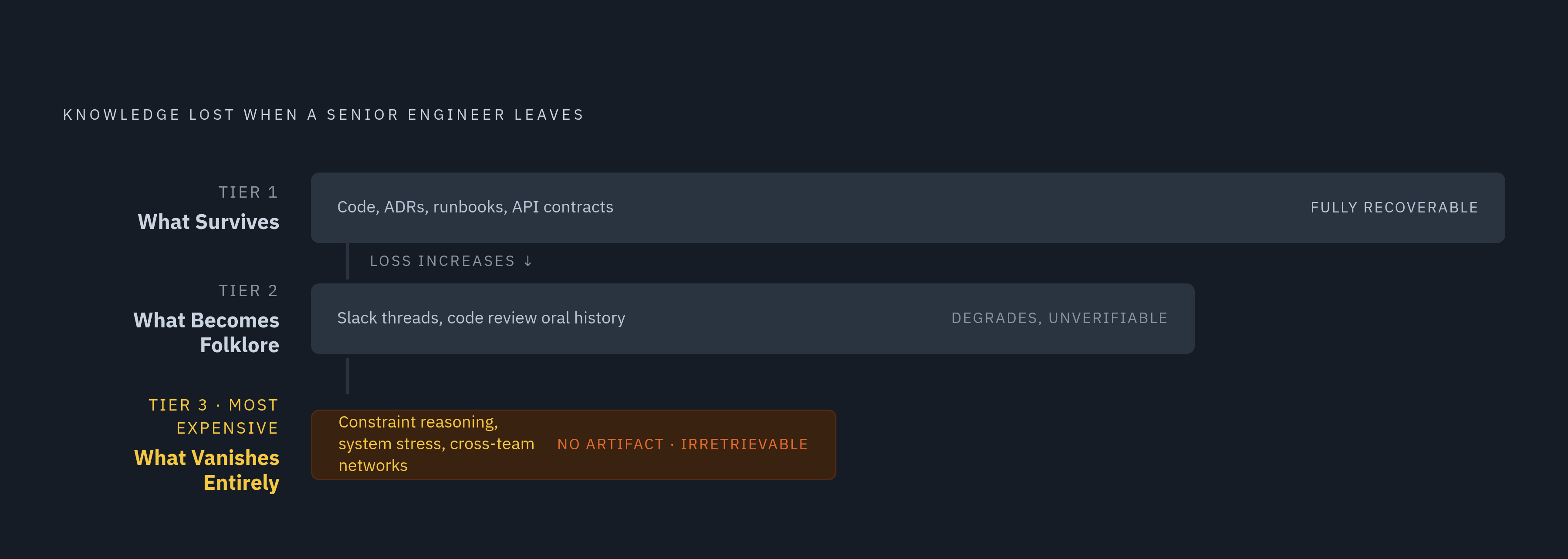
Not every piece of a departing engineer's knowledge is lost at the same rate. Some of it survives intact in the codebase, some degrades slowly into unreliable folklore, and some disappears completely on the day the engineer walks out.
The first category is what survives. Code that is self-explanatory, properly commented, tested, and backed by architecture decision records holds up well after someone leaves, as do documented API contracts and runbooks with real operational detail. This is the explicit layer the engineer actually wrote down, and it is durable precisely because it does not depend on anyone's memory.
The second category is what degrades into folklore. This is the oral history that circulates among the engineers who remain: the "we tried that in 2024" knowledge traded in code reviews and Slack threads, unindexed and unverifiable, dependent entirely on whoever happens to remember it that week. This layer is the one most engineering organizations don't realize they are relying on until it erodes, and it erodes with every subsequent departure. The canonical failure pattern plays out like this: a new engineer inherits a codebase, notices a service running its own database instead of sharing the central one, and spends two weeks planning a consolidation that looks like an obvious cleanup. Only when the plan reaches review does somebody remember the 2024 incident that forced the split in the first place. The knowledge wasn't gone. It was folklore, held by one remaining engineer who happened to still be in the room, and the system survived this time only because that engineer hadn't left yet.
The third category is what vanishes entirely, and it is the most expensive of the three. It includes the reasoning chain behind decisions made under constraints that no longer exist, such as a vendor limitation that was later resolved or a regulatory interpretation that was later revised. It includes the felt sense of system stress, the kind a senior engineer carries that lets them sense something is about to break before any alert fires. And it includes the informal network of relationships with adjacent teams that quietly informed cross-service decisions for years. None of this leaves an artifact behind. There is no document to search for and no PR comment that surfaces it later, which is what makes it the hardest category to reconstruct once the person who held it is gone.
Why the cost compounds faster than most teams expect
The standard way organizations budget for a senior departure is to estimate the replacement hire's ramp time and call that the cost. That estimate misses almost the entire problem, because the real expense is not what the new hire takes to get up to speed, it is the ongoing tax the knowledge gap places on every engineer who stays behind.
Knowledge workers already lose an average of 5.3 hours a week waiting for information or recreating knowledge that should have been documented somewhere. When the person who actually held that knowledge leaves, that weekly loss grows for both the successor trying to do the departed engineer's job and the broader team that now has nowhere reliable to ask. A new hire, even under a structured onboarding program, takes meaningful time to reach full productivity, and for a senior role that climb stretches across most of a year rather than a few weeks. That is the cost line everyone expects. The one that gets missed is what happens to the people who are not new.
Every manual onboarding sequence pulls a senior engineer or a member of the platform team away from their own work for weeks at a time, and once a team is hiring at any real scale, that interruption adds up to something close to a full additional role spent answering questions rather than building anything. Engineers already spend a substantial share of their time re-treading ground that earlier decisions already covered. When the one person who knew where all of that ground was leaves, that share grows for everyone left on the team. The mechanism compounds across departures rather than resetting with each one: every subsequent exit strips away more of the folklore layer described above. The engineers who remain absorb a larger share of the interruption burden at precisely the moment they are most likely to be considering an exit of their own. Junior developers feel a second-order version of the same problem. Without a senior engineer available to interrupt, a junior developer facing an unfamiliar piece of the system has only two options: re-solve a problem the team already solved once, or escalate to whichever senior engineer is left, adding to that engineer's load and pushing them one step closer to the exit that started the whole cycle.
Where documentation programs fail
The default organizational response to an impending senior departure is to ask the engineer to write everything down before the last day. That instinct is reasonable, and it works for a specific slice of what the engineer knows. It is structurally incapable of capturing the rest, and the limitation has nothing to do with how much effort goes into the exercise.
Documentation does its job well on self-contained procedural knowledge: how to deploy, how to rotate credentials, how to run a particular migration, along with API contracts and explicit architectural constraints that can be stated as rules. This is the explicit tier from the taxonomy above, and capturing it is genuinely valuable. The trouble starts with everything that isn't procedural.
The deeper failure happens before anyone even starts searching. Tacit knowledge is often inaccessible to the very person who holds it, because engineers do not know what they know in the abstract. A specific problem has to surface the knowledge before the engineer can even articulate it. An offboarding interview or a farewell-week wiki-writing exercise can only prompt answers to questions that have already been asked. It cannot prompt the engineer to volunteer the answer to a problem that hasn't happened yet. This is why documentation sprints scheduled at the moment of departure are structurally mistimed: they happen exactly when the engineer's remaining time is shortest and their systematic access to their own experience is weakest. The knowledge transfer that actually matters happens continuously, through years of code review and incident response rather than in a single scramble during someone's final two weeks. Documentation is necessary, and organizations should keep investing in it. It simply cannot substitute for the tacit layer, and other interventions have to fill that gap.
How codebase search changes what is recoverable after a departure
A larger share of what a senior engineer "knows" about a system is sitting in the codebase itself than most organizations assume, encoded in commit history, pull request threads, and the structure of the code, provided the team has tooling capable of surfacing it. A codebase holds more than its current state. It is the full accumulated history of decisions made, reversed, and built upon, and commit messages, PR descriptions, and inline comments often contain reasoning that was never transcribed into any wiki page.
Access is the catch. Without fast, full-codebase search, that implicit record is effectively locked away: a new engineer has no practical way to search across hundreds of repositories for the pull request where a transaction-isolation decision was made, or to find every place in the codebase where a particular pattern was deliberately avoided for a reason nobody remembers. Cross-repository code search makes the folklore layer partially indexable for the first time. The decision still exists somewhere in the history, and a well-formed query can now surface it directly, reducing the team's dependence on oral history that erodes every time someone leaves. This does not recover the tacit layer in full. The reasoning still has to have been written down somewhere in a commit message or a PR comment for search to find it, and the felt judgment behind a decision rarely makes it into either. What search does is extend the recoverable fraction well beyond what documentation alone ever reaches.
The benefit is not limited to engineers. Product managers, support staff, and new hires trying to understand what a system does, or why it behaves a certain way, currently have exactly two options: interrupt a senior engineer or read the raw code themselves. Natural-language search over the full codebase opens a third path, one that answers the question without pulling a senior engineer away from their own work. For regulated industries and any enterprise protecting sensitive intellectual property, how that search tool is deployed matters as much as what it can find. A platform that indexes an entire codebase has to do so without ever sending that code to an external server. On-premises or single-container self-hosted deployment is the only architecture that makes broad indexing acceptable inside most enterprise security postures.
What AI coding agents see without codebase context
An AI coding agent working without full codebase context fails in the same way a new hire fails when the handoff never happened: it can see what the code looks like today, but not the reasoning layered into its history. By default, agents see only fragments of an enterprise codebase, reconstructing context separately for each task from whatever sits in the local file or the active editor window, with no access to commit history, PR threads, or the architectural decision that explains why the code looks the way it does. The result mirrors the undocumented-departure scenario directly: an agent proposes consolidating a service that was deliberately split apart after a prior failure, or it makes a change that quietly violates a constraint that exists nowhere in the current file but everywhere in the codebase's history.
The Model Context Protocol, introduced by Anthropic in November 2024, addresses part of this by giving agents a standardized way to retrieve current information from external sources, including code repositories, rather than reasoning only from what is baked into their training weights. With that kind of context layer sitting between an agent and the repository, the agent's queries resolve against the same full, indexed codebase that human engineers can now search, rather than whatever fragment happens to be open in the editor. The same indexing work done to preserve knowledge for human engineers, making commit history, architecture decision records, and PR reasoning searchable, doubles as the context infrastructure that makes an AI agent less likely to repeat a mistake the team already made and fixed once.
That capability has a real limit, and it should be stated directly rather than implied. Current agents are good at retrieving documented context and poor at reconstructing judgment, the felt sense of why a decision was made under constraints that no longer appear anywhere in the written record. A context layer closes the retrieval gap between an agent and the history it needs. It does not close the judgment gap between an agent and a person who lived through the incident that produced that history.
The governance question: agent access to codebase context and new attack surfaces
Giving an AI agent persistent, rich access to an entire codebase solves a real knowledge problem and opens a real security problem at the same time, and organizations that adopt the capability without addressing the second half are trading security for convenience. The Model Context Protocol itself is a genuine improvement over the brittle one-off integrations it replaces, standardizing how agents connect to tools and data sources. That standardization also introduces new ways for things to go wrong. Tool results returned from an MCP server enter the same context window the agent uses to process instructions, so a tool result that has been crafted maliciously can redirect the agent's behavior from inside a channel the agent was never meant to treat as untrusted input.
The attack classes that follow from this are specific and already documented: context injection at the protocol level, privilege escalation as an agent chains together access across multiple tools, and context leakage through the very mechanisms MCP uses to share context between systems. OWASP's MCP Top 10 catalogs the broader pattern, flagging token mismanagement and secret exposure, privilege escalation through scope creep, tool poisoning, command injection and execution, and a general lack of audit and telemetry as the risks that mature governance has to address before broad agent access becomes standard practice. None of this argues against giving agents codebase context. It argues that the organizations doing the indexing work described earlier need to treat agent access with the same rigor they would apply to any system holding the full history of their most sensitive intellectual property, because that is what it now is.