Monorepo vs Multi-Repo Tradeoffs for Scaling Engineering Organizations
Repository structure shapes AI agent capability and cross-service change coordination at scale.
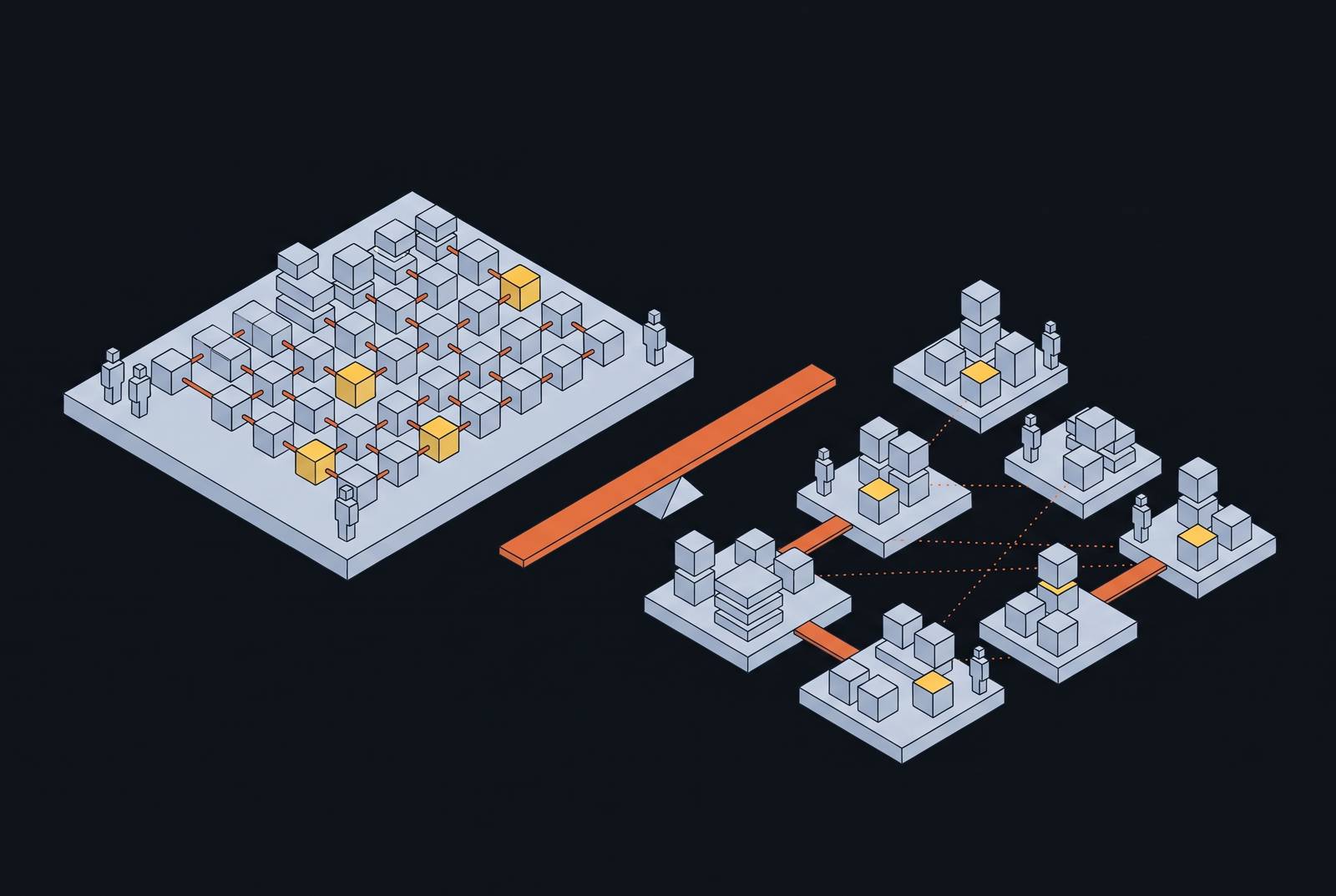
Enterprise code search lets teams and AI agents find code and its dependencies across a large codebase, including multiple repositories. How well it works depends on repository boundaries, shared context infrastructure, and access controls. For scaling engineering organizations, the monorepo vs. multi-repo decision is therefore architectural and should follow service coupling, platform capacity, and the next stage of growth.
Why repo structure is a foundational architectural decision, not a developer preference
Repository structure is often treated as a developer workflow preference, as though the main question were where engineers prefer to open pull requests. That framing misses the organization-wide consequences. The layout shapes how teams handle changes across services, decide who owns what, build CI/CD pipelines, and let AI coding agents see dependencies. A monorepo is a source-control layout that can contain many independent microservices with independent builds and deployments.
The reverse distinction is just as important. Separate repositories do not create modularity when services still depend on the same contracts, data models, and release timing. As service counts rise, dependency drift and integration gaps can make that separation expensive to maintain. Google, Meta, Microsoft, and Uber have documented monorepo approaches supported by significant custom tooling investment. Because switching strategies also consumes time and effort, engineering leaders need a decision tool grounded in team size, service coupling, and language mix at each growth stage.
What each model actually gives you: the concrete mechanical tradeoffs
A monorepo makes a logically unified change representable as one commit across services, with one revert for the corresponding code change. Shared libraries can reference each other directly, so there is no need to publish a package version for every edit. Linting, formatting, and testing rules apply across the repository, while onboarding and code review benefit from shared context. The costs are equally concrete. Clone and history size grow, repository-wide visibility complicates permissions, and small edits can trigger broad rebuilds without selective build tooling. Dependency isolation also needs attention because a transitive upgrade in Service A can silently break Service B.
Multi-repo gives each service its own versioning, release cadence, permissions, and narrower build pipeline. Checkouts are smaller, and a broken build in one repository need not halt work elsewhere. Independence is the main mechanical benefit. In exchange, cross-repository changes require coordinated pull requests, version bumps, release ordering, and compatibility windows, potentially turning one logical change into days of coordination. Shared packages can drift into conflicting versions, integration tests need separate orchestration, and new engineers must navigate distributed documentation and ownership maps. Neither layout substitutes for intentional service boundaries, and monorepo scalability still depends on architecture patterns such as domain-driven design or hexagonal architecture.
How team size and organizational structure should drive the initial choice
For a small team of roughly ten or fewer engineers working on a handful of services, multiple repositories can introduce coordination overhead without providing useful independence. A monorepo gives that team shared context for onboarding and review. These are directional inputs. Even a small team may need separate repositories when access restrictions or independent release cycles matter most. Repository boundaries should match how work is split in practice, or they risk dividing work that still has to move together.
As organizations grow to fifty to a few hundred engineers and use multiple languages, they have to pay more attention to what their build-system needs. A polyglot monorepo requires heavier tooling investment, with Bazel or Buck becoming necessary to avoid CI bloat. Headcount alone does not settle the choice. Autonomous teams with distinct stacks and independent releases have a stronger case for multi-repo, while synchronized deployments favor keeping related code together. For several hundred engineers and beyond, distinct product domains can support a hybrid approach with a monorepo per domain. Leaders should assess both the current team and that next organizational stage before committing.
Why CI and build infrastructure become the dominant cost as monorepos scale
Causify’s hybrid architecture paper names long CI/CD build times as a major monorepo drawback because small changes can cause a lot of code to be rebuilt and tested. Shared code makes changes easier to coordinate, but it also broadens the work a naive pipeline performs. Tools such as Bazel, Buck, Nx, Lerna, and Lage address the need to rebuild only affected components, while adding complexity to the development workflow. Code search and browsing also get harder as the repository grows, so teams need specialized tools and plugins.
Multi-repo has a substantial advantage at this layer. Each repository has a narrower pipeline, and independent services do not need to participate in every build. Its bottleneck appears elsewhere, in keeping versions aligned and catching cross-service regressions through integration testing across heterogeneous environments. Managing dozens of repositories therefore moves complexity into orchestration. The leadership implication is to treat build infrastructure as a precondition for a scaled monorepo.
How AI coding agents change the optimization function for repository structure
AI coding agents add a new cost to repository fragmentation because their output depends on the dependencies they can inspect. Type definitions, call sites, tests, and dependency relationships give an agent evidence about the impact of an edit. Missing context changes the quality of that reasoning. Engineers have long kept track of how services connect in their heads, while agents need to see the actual graph. A repository boundary becomes a context wall when the agent’s tools expose only the checked-out repository.
Consider an agent renaming a field in a shared protobuf definition consumed by five services. If it sees only the definition repository, it cannot update the consumers, leaving each to break on its next build unless a human coordinates the changes. In a monorepo, the agent can modify the definition, update call sites, adjust tests, and produce one commit. The task remains one coherent code change. Across repositories, it becomes a distributed transaction involving coordinated pull requests, version bumps, release ordering, and compatibility windows.
A practical operational observation in Claude Code and Cursor is degradation past approximately 150k tokens of relevant context, even with retrieval, including loops and noisier diffs. The advantage of a connected dependency graph depends on exposing relevant code, rather than indiscriminately loading the whole repository. Multi-repo can still work for AI-assisted development, but teams now have to invest in context and coordination across repository boundaries because agents cannot yet reliably automate all the work humans used to do.
MCP and shared context infrastructure: what this means for multi-repo teams that cannot consolidate
Anthropic introduced Model Context Protocol in late 2024, and broad adoption in 2025 and 2026 has made it a shared context standard. An agent in Cursor can use the same MCP servers as an agent in Claude Code, reducing fragmentation between tool environments. Consolidation is therefore not the only available path. A local shared context server can serve files for a project, such as CLAUDE.md,.cursorrules, and AGENTS.md, as live resources, replacing separate static snapshots with a common source for tools to read.
AGENTS.md provides an open standard for project instructions, context, and agent behavior, with interoperability across frameworks including Codex, Cursor, Devin, GitHub Copilot, and Jules. Instructions alone, however, are distinct from searchable code context. For enterprise code search across multiple repositories, a self-hosted code intelligence platform with an MCP endpoint can let agents search the full index across checkouts. The useful comparison criteria are cross-repository coverage, dependency visibility, compatibility across agent tools, and deployment controls. Replicating and maintaining shared context across dozens of repositories still requires sustained platform investment, even when the protocol is common.
The hybrid model: what "runnable directories" and domain monorepos look like in practice
Causify’s “Runnable Directories” paper presents a concrete hybrid proposal built around self-contained, independently executable directories. Each directory has its own development, testing, and deployment lifecycle, supported by a unified thin environment and shared helper utilities. Isolation is built into the execution unit. Docker-based workflows give each runnable directory its own container, providing consistent environments and isolated dependencies without requiring a shared repository. The proposal is for codebases that are growing and getting more complex and need CI/CD that runs well without taking on either model in full.
Domain monorepos apply a related compromise at organizational scale by grouping internally coupled services within separate product domains. Changes can still be atomic inside a domain, while work that crosses domains has to be kept in step at their boundaries. This is a conditional fit. Google, Meta, and Uber demonstrate that large-scale monorepo operation is possible with substantial tooling investment, rather than proving that every organization needs the same layout. Hybrid arrangements still need shared tooling, an environment layer, and CI orchestration that understands directory-level dependencies. Agents retain relevant context within a domain or runnable directory set, but cross-domain reasoning still depends on bridging infrastructure.
Data privacy and security tradeoffs that the repo structure decision surfaces
Repository structure determines how code access is organized, but tool deployment determines where that code is processed. A monorepo simplifies deploying self-hosted code intelligence over one source tree, while a misconfigured AI tool can process everything within its scope. Multi-repo starts with narrower repository-level permissions. However, an agent that needs cross-repository context must receive broader access, potentially recreating the exposure that repository separation was intended to limit.
With SaaS AI tools, the vendor’s policies govern how code is kept and used for training, while self-hosting inside a private VPC keeps code behind the organization’s network controls. Air-gapped deployment goes further for environments without outbound internet. Yet a local installation is not automatically private, because telemetry, embeddings, plugins, and update checks can still expose data. For organizations with data residency or AI governance requirements, the lesson is to audit the architecture end to end and evaluate code intelligence deployment together with repository access.
How to make the decision and commit: a framework for engineering leaders
Engineering leaders should begin by assessing coupling. Atomic changes help services that share contracts, data models, or deployment timing, while services that can release on their own have more reason to use separate repositories. The next test is organizational capacity and coordination cost. Smaller teams often lose more to cross-repository coordination than they gain from isolation, while larger teams need sufficient platform capacity to support monorepo builds. Language mix sharpens that assessment because uniform JS/TS stacks have mature monorepo tooling, whereas polyglot environments require heavier build-system investment.
Active or planned agentic workflows increase the value of accessible dependency context, while restrictions on broad code access can favor narrower repository permissions. Those requirements need a deployment decision as well. Enterprise code search and agent infrastructure must provide the required reach without processing code outside the organization’s permitted boundaries. For teams that cannot consolidate, MCP-based shared context infrastructure offers a way to bridge repositories, provided the organization accepts the ongoing maintenance cost.
A monorepo is the stronger commitment when services are tightly coupled, the stack is uniform, and the team will invest in build infrastructure, particularly for cross-cutting agent work. Multi-repo fits genuinely independent services, separate release cycles, granular access needs, and teams whose stacks are too heterogeneous for shared build tooling. Hybrid fits internally coupled but externally independent product domains. It also serves organizations that need broader agent context but cannot move everything into one repository. The final decision should be sized for one organizational stage ahead, with the required infrastructure included in the commitment, because reversal remains possible but expensive.