Reducing Interrupt-Driven Engineering Work Through Tooling and Self-Service
Self-service tooling closes knowledge gaps that routing merely redirects to busier people.
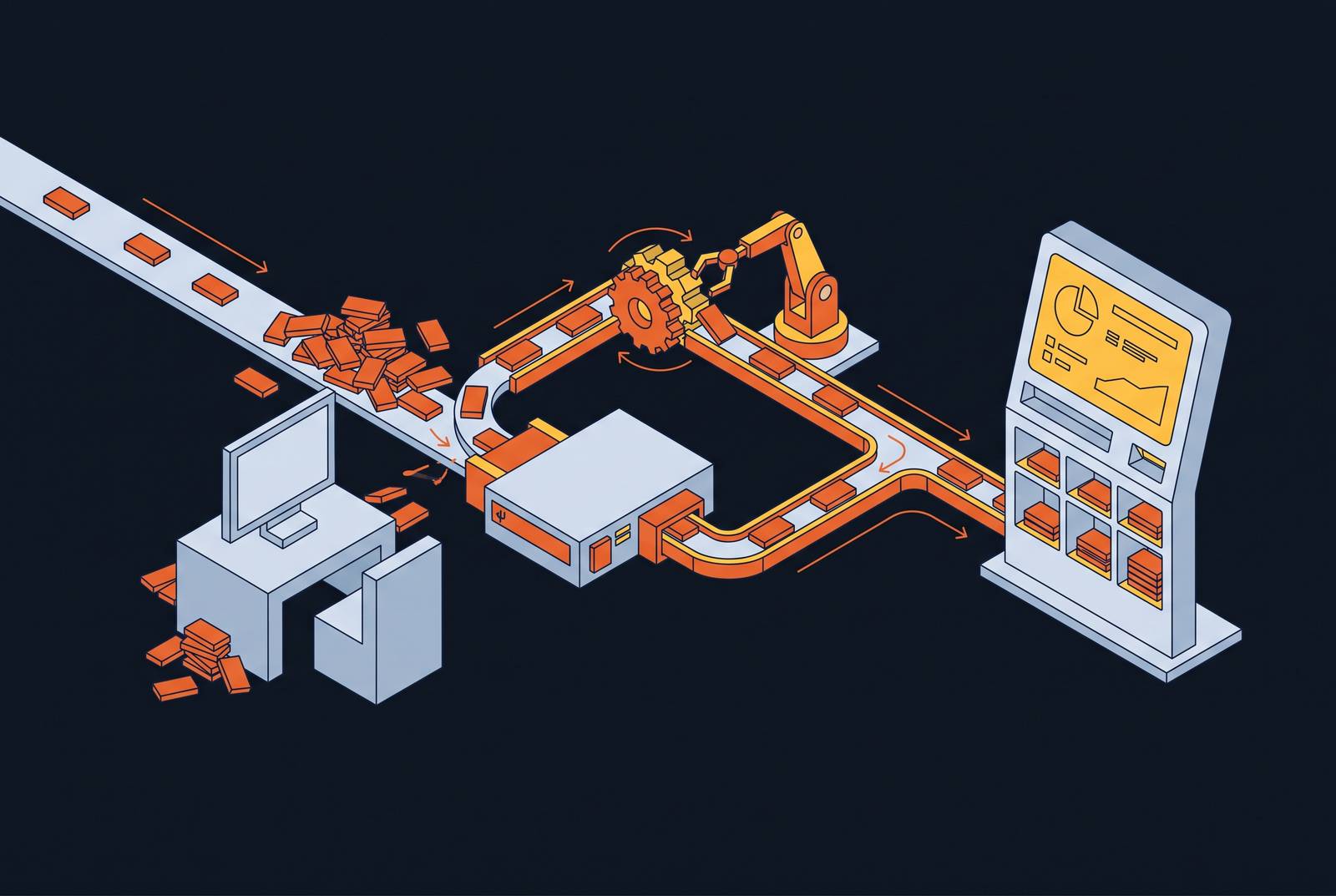
Interrupt-driven engineering happens when knowledge about a system lives only in the heads of a handful of senior engineers. Every question about how something works then has exactly one path: find the person who remembers, and interrupt them. The usual fixes, tickets, bots, rotations, leave that dynamic fully intact because they reroute the interrupt instead of closing the knowledge gap that caused it. Only three categories of self-service tooling actually touch the underlying cause, and most organizations pick the wrong one for the interrupt they're trying to kill.
Why interrupt-driven engineering compounds as the default mode
Four kinds of interrupts appear in most engineering organizations, and they don't share a root cause. A product manager or a new hire asks how something actually works. A developer sits blocked on infrastructure, waiting on an environment, an access grant, a config change somebody else has to approve. An urgent bug forces an engineer to jump domains, from frontend logic into a database query plan into an infrastructure config, in the same afternoon. And a new engineer, six weeks in, asks a question that three other engineers already asked and already got answered, verbally, in a hallway or a Slack thread nobody bothered to index.
The math on this is not gentle. Four interruptions in a focused work session, each costing five minutes to actually handle, cost roughly twenty minutes of recovery time apiece before the interrupted engineer gets back to the depth of focus they had before. That's one hundred minutes gone from a single session, for four five-minute questions. Multiplied across a team, the lost output accumulates into a significant share of total engineering capacity, evaporated into context-switching overhead that never appears as a line item anywhere.
Not all switches cost the same, either. Moving between two adjacent tasks in the same domain is cheap. Moving from frontend to database internals to infrastructure, the kind of jump an on-call escalation forces, can run substantially longer recovery time before the engineer is back to full speed. The interrupt itself might take five minutes. The tax on the rest of the day does not, and that gap between the visible cost and the real one is why the problem keeps getting underestimated by the people who could fix it.
Why routing tools treat symptoms without curing the disease
Faced with interrupt overload, most organizations reach for process, setting up tiered support queues, a dedicated Slack channel for escalations, and an on-call rotation whose job, explicitly, is to absorb interrupts so the rest of the team doesn't have to. The instinct makes sense on paper. It also doesn't work, because none of it touches the cause.
The knowledge gap that produced the question is still there after the ticket gets filed. Routing changes who receives the interrupt and how fast it moves through the queue, but the person answering it still has to reconstruct the same tribal knowledge, from memory, every single time. A Slack bot that pings the right on-call engineer does nothing to make the underlying system less opaque to the person who asked in the first place.
If a sprint runs more than 80% interrupt-driven requests, that team has quietly become the new ticket queue. Better labeled, maybe, routed through a nicer tool, but functionally identical to the thing it replaced. A report on internal developer portals found that 70% of developers spend three to four hours a day on work that isn't their core job, because internal tooling doesn't give them what they need, and routing tools address a different problem than the underlying friction that produces that number.
The three categories of self-service tooling that address distinct classes of interrupts
Not every interrupt shares a cause, so no single fix covers all of them. Most self-service rollouts fail for exactly this reason: an organization buys one tool, points it at every category of interrupt, and then concludes self-service doesn't work when two-thirds of the volume keeps recurring anyway. The tool wasn't wrong. The expectation was.
Code intelligence and knowledge-retrieval tooling handles the "how does this work" class, where the person interrupted is usually a senior engineer and the person asking is a non-engineer, a new hire, or a developer working outside their usual part of the codebase. Internal developer platforms handle infrastructure-access and provisioning interrupts, where the person interrupted sits on a platform or DevOps team and the person blocked is a developer waiting on tooling they can't grant themselves. AI coding agents with real codebase context handle a third, quieter category that isn't a human interrupt at all: the cognitive tax an engineer pays re-exploring territory someone on the team already mapped.
Matching the tool to the category is the whole exercise. Get that match wrong, and the new tool just becomes noise stacked on top of the old noise.
Code intelligence as the answer to codebase opacity, and where it breaks
The "how does this work" interrupt survives because the tools available for surfacing that knowledge fail at the point of need, even when the answer already sits in a senior engineer's head. Documentation drifts. Comments go stale. Search tools return file lists, not answers. So the fastest path to a correct answer stays, stubbornly, a person.
The people generating this interrupt class include a PM asking why a feature behaves the way it does, a support engineer tracing a bug report to its source, a new engineer onboarding into a service nobody explained properly, and a developer stepping into an adjacent part of the codebase for the first time. None of them need more documentation. They need fast cross-repository search, symbol navigation that actually traces dependencies, and natural-language queries that come back with an answer instead of a reading list.
Scale is where this breaks, and the break point is measurable. CodeScaleBench, run across more than forty of the largest open-source repositories, spanning nine languages and producing 1,281 scored agent runs, found that agents relying only on local tools such as grep, file read, and glob start failing systematically once a codebase crosses roughly 400,000 lines of code. That threshold isn't unique to AI agents, either. It tracks with where human engineers, using that same category of blunt search tools, start losing the thread too. Past that size, opacity is a tooling failure rather than a knowledge problem, because the volume of code overwhelms search built for a smaller scale. No amount of tidier wikis fixes that. It needs tooling built for the scale, full stop.
Internal developer platforms and the self-service portal layer that replaces infrastructure tickets
Platform engineering adoption is around 55% across organizations surveyed in the Puppet State of DevOps and Gartner platform engineering reports. Yet a substantial share of these initiatives fail to show measurable value in their first year. Adoption and success are not the same curve, and the gap between them is where most of the disappointment in platform engineering actually lives.
The failure mode is diagnostic, most of the time. A platform gets built around the abstractions infrastructure engineers already understand, Helm charts, Terraform modules, and it makes perfect sense to the people who built it. It just doesn't map to how a developer actually thinks about the task in front of them, so the friction doesn't disappear. It moves to a different desk.
A platform that actually works tends to share the same handful of components regardless of which specific tools sit underneath: a service catalog, golden paths that make the easy way also the correct way, workflow automation, guardrails that catch the obvious mistakes, and visibility into production once something ships. What varies most, and what predicts whether the platform earns its keep, is automation maturity. At level 1, a nicer digital form gets bolted onto a manual request, and a human still has to approve it. Level 2 is template-driven provisioning. Level 3 is fully declarative, event-driven workflow, where a developer's request triggers the whole chain without anyone in the middle to sign off. Most organizations are at level 1 or 2, and it isn't because level 3 tooling doesn't exist. It exists, and most organizations sit at level 1 or 2 because the organizational habits required to trust it just haven't caught up yet. The organizational habits required to trust it just haven't caught up yet.
AI coding agents and why codebase context determines whether they reduce or redistribute cognitive work
Adoption is no longer the open question here. 84% of developers are using or plan to use AI tools in their workflow, up from 76% the year before. Whether that adoption actually lowers cognitive load is a separate and much harder question, and the answer comes down to one variable: what the agent can actually see.
Used well, an AI coding agent's real value is fewer handoffs, less domain-hopping, less time spent rediscovering things someone already figured out. That's a direct hit against the third interrupt category, cognitive overhead, and it's the category most self-service conversations skip past in favor of talking about tickets and access requests.
The same scale wall that limits code intelligence tools limits agents built on the same retrieval approach, though. Those same 1,281 scored CodeScaleBench runs, across more than forty large repositories, showed agents relying only on local tools like grep and glob degrading past that same 400,000-line threshold. Model quality stops being the bottleneck once a codebase gets that large. What the agent can actually retrieve becomes the bottleneck instead, and an agent that can't find the relevant code doesn't fail quietly. It raises a question back to the engineer, and the interrupt that was supposed to disappear just changes shape. If the agent skips retrieval, it ends up as a more polished routing layer, no different in kind from the Slack bot it was supposed to replace.
MCP as the connective tissue between agents and the enterprise systems that hold context
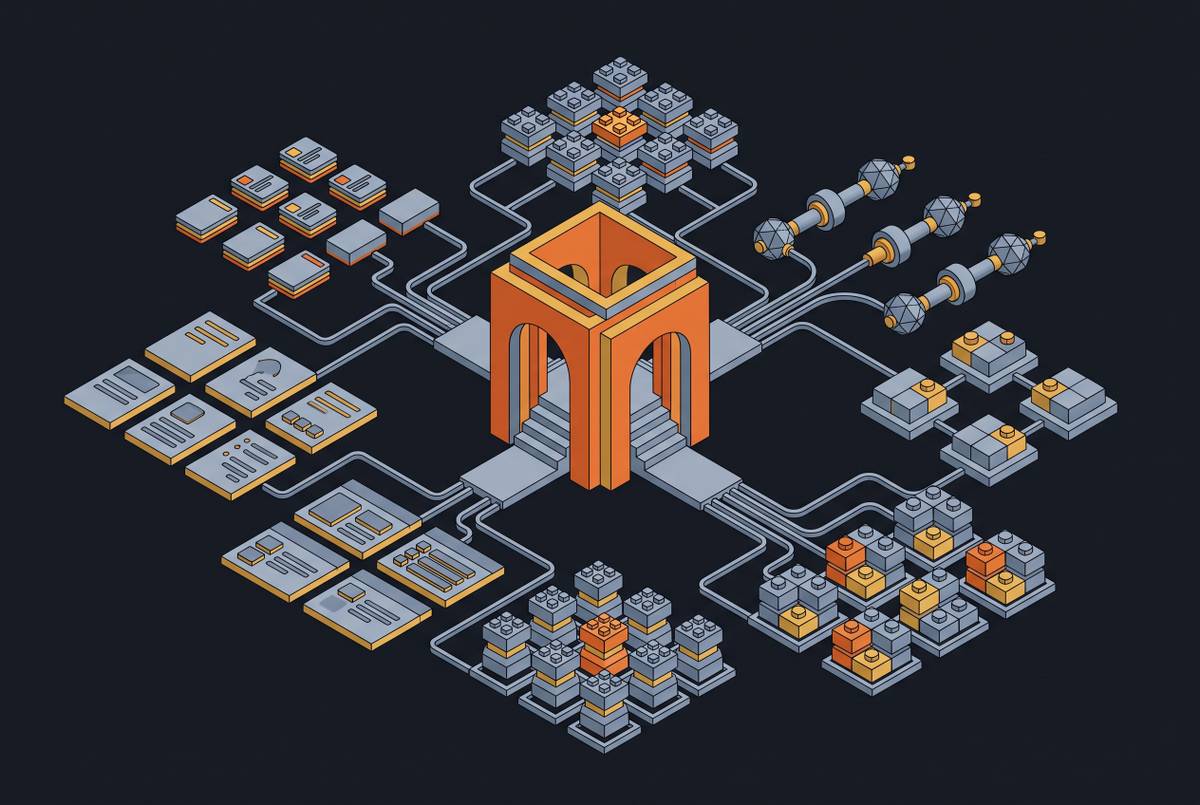
Before a shared protocol existed, connecting multiple AI models to multiple enterprise systems, Jira, Confluence, a code repository, an observability stack, created an N×M integration problem. Every new model added to the stack, or every new system it needed to reach, multiplied the number of custom authentication flows, schema mappings, and error-handling paths someone had to build and maintain by hand.
The Model Context Protocol, introduced by Anthropic in November 2024, collapses that multiplication into something closer to N+M. It was donated to the Agentic AI Foundation, a directed fund under the Linux Foundation, on December 9, 2025. By that point it had already reached over 97 million monthly SDK downloads, and it's now supported natively across ChatGPT, Claude, Gemini, Microsoft Copilot, Visual Studio Code, and Cursor.
MCP exposes three things to a model: tools, executable functions an agent calls to take an action or pull live data; resources, structured data objects the model reads without running any code; and prompts, reusable instruction templates that shape how the model approaches a task. Most community-built MCP servers expose tools and stop there. Resources and prompts appear more often in enterprise deployments, where the shape of the data being accessed is already well understood and worth encoding directly.
The real payoff is interoperability. An agent running inside Cursor can call the same MCP servers as one running inside Claude Code or Codex, and the old pattern, re-integrating every enterprise system from scratch every time a team adopts a new agent, is on its way out. That matters as much as any single tool in this piece, because the context an agent needs to actually answer a question, instead of bouncing it back to a human, has to live somewhere the agent can reach without a custom integration every time the tooling changes. Get the plumbing wrong, and every fix described here, code intelligence, platforms, agents, ends up rebuilding the same walls with better paint.