Developer Portal Design for Large Engineering Organizations
Building a developer portal means staffing two systems, not one.
What a developer portal is, and how it differs from an internal developer platform
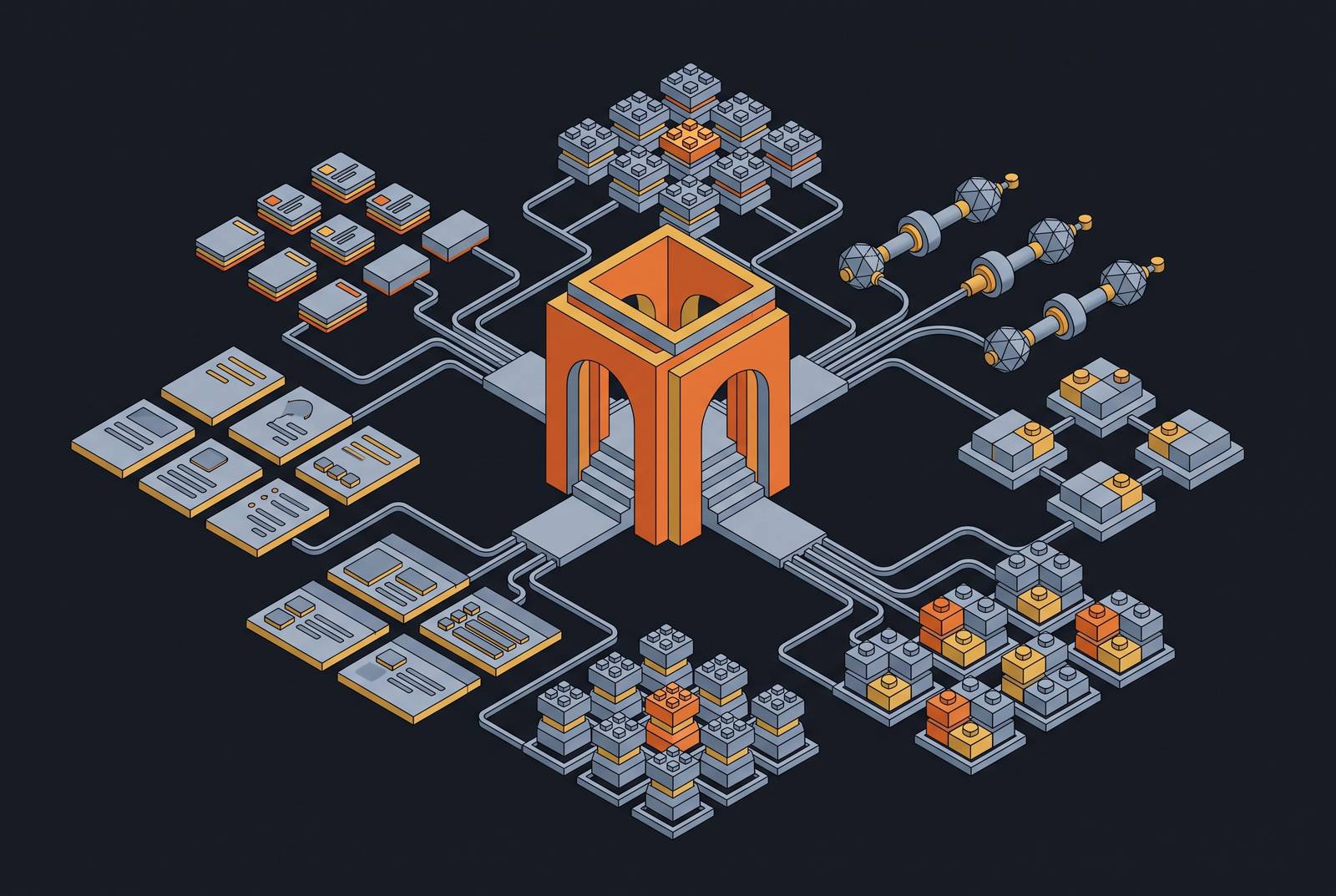
A developer portal is the interface. It's where an engineer goes to find a service, read its documentation, look up an API, or kick off a workflow they've run a hundred times before. A platform is the thing underneath that actually does work: it provisions infrastructure, runs deployments, manages secrets, and orchestrates the mechanics of shipping software.
That distinction is not academic. A portal, on its own, cannot provision a database, deploy a service, or rotate a credential. It presents information and, if wired up correctly, hands a request off to something else that does the work. That's why most organizations running Backstage or Port are really running a front door to a separate platform layer sitting behind it. The architecture is common, and it's also where the real cost hides: two systems to integrate, two systems to keep in sync, two systems to update whenever either one changes. Teams that treat the portal as the whole project, rather than the visible half of one, produce a pretty catalog and no working self-service, because the portal is only one part of a two-part system.
The three procurement models and their costs at scale
Three paths exist here, and the honest answer is that none of them is cheap. Each just moves the cost to a different line item, and the failure to see that upfront is what sinks most budgets a year in.
Building self-hosted, typically on Backstage, gives maximum flexibility and demands a permanent staff to match. It routinely needs three to five dedicated engineers just to keep the thing running and current, which is a standing cost most teams don't put on the original proposal. Backstage's external adoption rate averages around 10%, and that number has less to do with the software's quality than with how much ongoing customization it demands from teams that budgeted for a project instead of a product.
Buying a proprietary SaaS portal, such as Cortex or Port, gets a polished interface out of the box, and it should: that's the entire pitch. The tradeoff is vendor lock-in that doesn't loosen with time, plus a proprietary data model that quietly absorbs ownership records, scorecards, and service relationships into a format that's hard to get back out later.
The third path is hybrid: managed Backstage, offered by vendors like Roadie, which keeps the open-source ecosystem while removing the engineering tax of running it day to day. Roadie's Teams plan starts at $24 per developer per month, with a 50-seat minimum; the Growth plan is custom-priced with a 100-seat minimum, and non-coding staff like PMs and leadership get access for free. Roadie names the hidden cost in this category the "TypeScript tax," the ongoing burden of maintaining frontend infrastructure that most DevOps teams were never built to carry. That tax gets paid either way, in a vendor invoice or in engineer-hours nobody accounted for.
Service catalog design: why most catalogs become unusable as organizations grow
The service catalog is the foundation every other portal feature sits on, and it degrades fastest. The pattern is close to universal: the catalog gets populated at launch, ownership fields go stale within a quarter, nothing enforces accuracy, and within months developers stop trusting what the catalog tells them. Once that trust is gone, they route around it, asking a colleague instead of checking the tool, and the catalog becomes a monument nobody visits.
Cortex's Engineering Benchmark Report found that testing coverage, secure coding practices, and clear service ownership are each named as critical by only 30 to 40% of engineering leaders. That's a low number for something this basic, and it says ownership clarity isn't a settled industry expectation so much as a live, unresolved fight most organizations are still losing.
Ownership is a governance problem the catalog happens to make visible. Scorecards, the mechanism used by tools like Cortex and OpsLevel, try to formalize this by defining production-readiness requirements, named owners, SLOs, runbooks, rollback plans, vulnerability ceilings, and measuring every service against that bar continuously instead of once at launch. Scorecards have become the default governance mechanism inside most IDPs, and commercial adoption is wide. What's consistent across the space is that commercial adoption is wide while the evidence base remains largely vendor-sourced. That doesn't make scorecards wrong. It makes them a bet worth watching, and organizations should treat them accordingly, since the tooling alone will not fix what is a discipline problem.
Designing accountability into the portal structure to address ownership fragmentation
Ownership degrades in large organizations for structural reasons that have nothing to do with laziness or bad tooling. Teams reorganize. Engineers leave and take context with them. Monorepos get split into a dozen new repos with no clean mapping to the old ownership records, and acquired codebases arrive with their own conventions that never quite line up with the org chart's tidy boxes.
A portal that displays an ownership field without enforcing its accuracy makes this worse than having no field. An empty field prompts someone to ask a question; a stale one gives false confidence to whoever's paging the wrong person at 2 a.m.
A few design choices actually hold up against that pressure. Production-readiness gates, where a service cannot be marked ready until ownership is a filled and validated field, force the issue at the moment it matters most, rather than leaving it to someone's good intentions during the next sprint. Automated ownership inference, drawn from commit history and PR review patterns, takes the manual burden off teams who'd otherwise need to remember to update a record nobody's looked at in months. Runbooks that surface the actual on-call rotation and escalation chain, not just a named owner, turn the portal into something useful during an incident instead of a directory that's technically correct and useless when it counts.
AI integration raises the stakes on getting this right, and quickly. Once an agent can query who owns a service and what changed in it recently, the portal becomes a live operational dependency, because static, manually maintained registries were never built to support that need.
Self-service design that reduces ticket volume without creating new failure modes
Self-service is the reason developers choose the portal over pinging someone on a team messaging app. If it is taken away, the portal becomes a read-only dashboard, bookmarked once and never opened again.
Self-service without guardrails doesn't reduce operational risk, though. It relocates it. Handing developers the ability to provision environments, deploy services, and spin up databases with no opinionated structure around how those actions happen tends to raise incident rates and change failure rates, because velocity without constraint just means more ways to make a mistake faster.
The design tension is holding developer autonomy and platform-team guardrails at once, not picking one. Golden paths, pre-approved templates for the common tasks (spinning up a service, provisioning an environment, wiring up a database), solve this by making the safe way also the easy way. But a golden path with zero flexibility is a trap of its own: forcing developers down a single approved route with no room to deviate tends to create friction that undermines the system's goals, usually in ways that surface only after something breaks.
Self-service scope needs to be stated outright, not left implicit. Can a developer provision an environment, deploy a service, connect a database, and configure secrets without opening a ticket to ops? If the answer takes more than a sentence to explain, the self-service claim is mostly marketing. And this is where the portal/platform distinction stops being academic: a portal-only tool with no platform layer actually doing the provisioning cannot deliver real self-service. It can only offer a button that, behind the scenes, still routes to a human who has to approve it manually.
Onboarding flows for large organizations, where tribal knowledge is the hidden bottleneck
Onboarding fails in large organizations because the portal assumes the new hire already knows what to look for. That assumption holds for someone's fourth job at their fourth company and falls apart completely for someone in their first month.
The failure modes repeat everywhere. A service catalog with hundreds of entries tells a new engineer nothing about which handful of those services actually matter to their team, or how they connect to each other. TechDocs in Backstage, and tools like it, tend to be accurate at the level of a single service and silent on the cross-cutting architectural story that explains why the services are shaped the way they are. Most portals also have no natural-language entry point. A new hire has to already know a service's exact name or the right query syntax before the search box does them any good.
Interrupt-driven work is the real cost here, and it appears nowhere on a budget line. When new hires can't find an answer in the portal, they ask a senior engineer instead, and that engineer's afternoon becomes someone else's onboarding problem. Multiplied across a large hiring class, this becomes a substantial tax. It's a recurring drain on the most experienced people in the org, the ones least able to spare the interruption.
Non-engineers get left out of this design almost by default. PMs and support staff have legitimate reasons to look up which service owns a feature or what a codebase does, and a portal built only with engineers in mind turns that group into permanent interrupters, people with no self-serve path and no option but to ask.
Codebase context makes the portal useful to AI agents, not just human developers
AI coding agents now operate in a genuinely agentic mode: multi-step work across files, running tests, executing tools, making commits, opening pull requests with minimal hand-holding. Engineers using these tools well report productivity gains in the range of 50 to 150%, a wide range, but even the low end of it marks a real shift in how software gets built.
Context is what caps how far this goes. An agent typically sees only what's open in the editor or passed into the prompt, and it rebuilds that context from scratch on every new task. At the scale of a large organization, with hundreds of repositories and services that depend on each other in ways no single file reveals, that's not a minor inconvenience. It produces inconsistent output, misses cross-repository dependencies that matter, and compounds risk with every task the agent finishes without knowing what it doesn't know.
What an agent needs from the portal is close to what a new human hire needs, delivered differently. Full codebase context means search, jump-to-definition, and find-references that work across every repository open locally. Live service metadata means the same ownership records, SLOs, recent changes, and runbooks the catalog is supposed to keep accurate for people, used as-is for machines. Structured access through something like the Model Context Protocol means the agent connects to these systems through a standard interface instead of a custom integration built and maintained for each tool and each vendor, forever.
MCP itself is an open standard created by Anthropic and donated to the Linux Foundation's Agentic AI Foundation, with backing from Google, Microsoft, AWS, Cloudflare, and Bloomberg. When Anthropic announced on December 9, 2025 that MCP was being donated to the Agentic AI Foundation, a directed fund under the Linux Foundation, the protocol had already reached over 97 million monthly SDK downloads and more than 10,000 active public servers. That scale of adoption in a short window says the industry wants a shared standard for this exact problem, not another round of bespoke integrations that each vendor builds and maintains alone.
Self-hosted versus SaaS portal deployment, and what large organizations trade off
The real decision comes down to control against operational overhead, and large organizations usually know which side of that line they're on well before anyone opens a pricing page.
SaaS portals, Port, Cortex, and Roadie among them, deploy fast, handle their own upgrades, and generally offer a more polished experience out of the box. The cost is reduced control over where data resides and how the underlying system is configured. Self-hosted options, Backstage run in-house, Northflank's BYOC model, or Cycloid deployed on-premises, keep that data inside infrastructure the customer already controls, but the burden of running and patching the system falls entirely on the platform team, with no vendor to call at 2 a.m.
For regulated industries, finance, healthcare, defense, this is a compliance requirement, one that rules SaaS out entirely for any service touching sensitive data regardless of how good the vendor's security posture is. Northflank's BYOC model is available self-serve into AWS, GCP, Azure, Oracle, CoreWeave, Civo, on-premises, and bare-metal, letting an organization run the platform inside infrastructure it already owns without a months-long enterprise sales cycle standing in the way. Cycloid takes a similar stance with a modular design that runs as dedicated SaaS, multi-tenant SaaS, or fully self-hosted on-premises, with data sovereignty requirements treated as a core design consideration.
Neither side of this tradeoff is correct in the abstract, and treating it as a simple better-or-worse choice misses the point. The right call depends on what the organization is actually required to protect, and how much engineering capacity it's willing to spend protecting it, day after day, long after the launch announcement is forgotten.