When to Formalize a Developer Experience Team
Formalize a developer experience team when friction costs more than the team itself.
Developer Experience teams go by a handful of names now: DevEx, Developer Productivity, Platform Engineering, Engineering Enablement. All of them point at the same idea, a dedicated group that treats internal developers the way a product company treats its customers. Deciding when to formalize one of these teams is not a company-size question or an org-chart fashion choice. It's a structural decision, and the conditions that trigger it are specific enough to name.
The working definition comes from a 2023 ACM Queue paper by Abi Noda, Margaret-Anne Storey, Nicole Forsgren, and Michaela Greiler, which framed developer experience as the lived experience of engineers and the friction they hit doing everyday work. The paper broke that experience into three parts: feedback loops, cognitive load, and flow state. That framing matters because it turned something people used to describe as a vibe (engineers grumbling about their laptops) into something measurable.
The name a company picks for this function isn't cosmetic. It changes who applies for the job and how the budget conversation goes. A posting titled "Developer Experience" draws a different applicant than one titled "Infrastructure," even for overlapping work. And when a CFO hears "Platform Engineering" or "Internal Developer Platform," that reads as investment in leverage. "DevOps" or "Infrastructure" reads as overhead. Same engineers, same roadmap, different conversation.
It also helps to know what this isn't. Platform Engineering, in its narrow sense, is about infrastructure, deployment pipelines, and production systems. SRE is about keeping production reliable, not about whether a new hire can get a local build running. Engineering Management covers people and delivery, not the systems that make both of those things possible. DX sits at the intersection and historically got handled the way most cross-cutting problems get handled: badly, and by whoever was annoyed enough that week to fix it. A dedicated team turns that ad hoc fixing into a standing job.
Why this decision is urgent in 2026, not hypothetical
Gartner has forecast that 80% of large software engineering organizations will run dedicated platform teams by the end of 2026. Five years ago, few org charts included that function.
The clearest signal that this shifted from niche practice to boardroom line item came in September 2025, when Atlassian acquired DX, the developer experience measurement company co-founded by Abi Noda, in a deal reported at roughly a billion dollars. Companies don't spend that kind of money on a discipline still treated as a nice-to-have.
Gartner's own survey work backs this up: 58% of software engineering leaders call DevEx a critical qualitative metric for their organization, and 89% say they're actively taking steps to improve it. Gartner also found that organizations with strong developer experience are 31% more likely to improve delivery flow, a number that lands on a C-suite dashboard rather than staying inside an engineering all-hands.
Platform engineering drew scrutiny as hype around the function intensified in 2024, with some observers questioning whether the trend would sustain. But the adoption forecast didn't move. The hype cooled, but the structural trend didn't, and organizations that acted on the trend gained ground while those waiting for hype signals didn't. Leaders waiting for this function to feel fully "mainstream" before acting are, by definition, waiting for the moment the decision stops being a competitive advantage. The organizations inside that 80% number are making this call now, not later.
The productivity case that makes formalization hard to defer
Writing the code takes a day. Shipping it takes a month. That gap has nothing to do with anyone's coding ability. It's a systems problem, and it's the single clearest argument for formalizing DX before the org convinces itself the gap is a hiring or discipline issue.
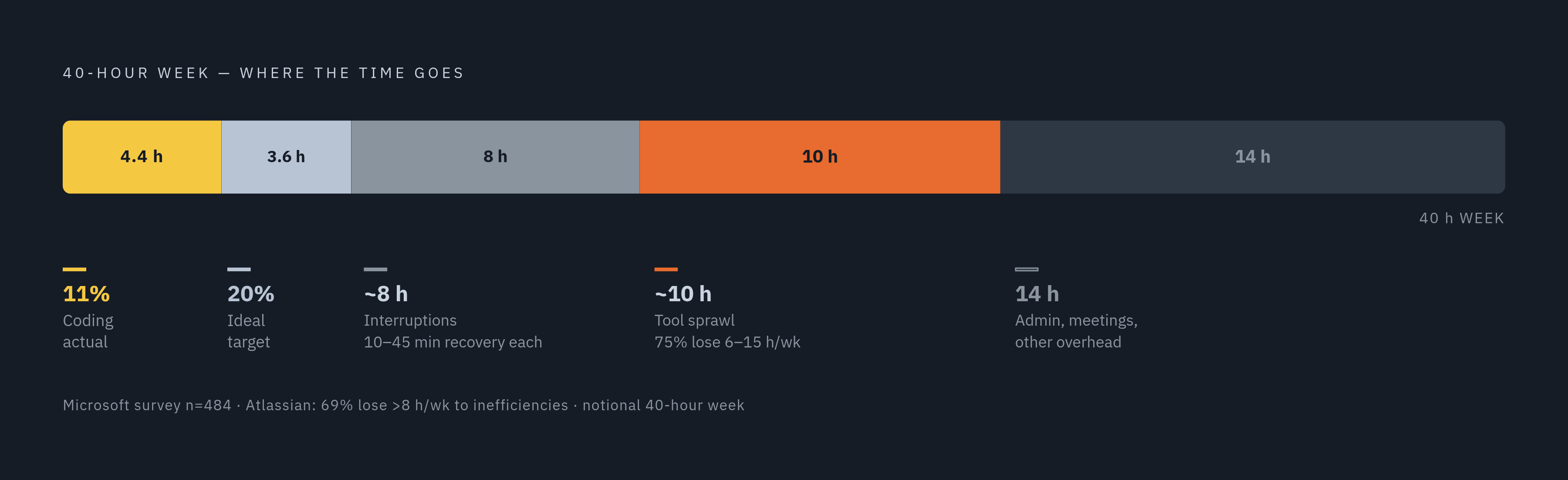
Atlassian's State of Developer Experience report found that 69% of developers lose more than eight hours a week to work inefficiencies, which is more than a full workday, every week, gone to friction rather than features. And yet 38% of companies still evaluate developers on hours logged rather than what shipped, which tells you the friction is invisible at the level where it's being measured.
A Microsoft survey of 484 developers found actual coding time running around 11%, against a self-reported ideal of 20%. Most of a developer's week goes to something other than writing code, and that something is rarely glamorous: waiting on builds, hunting down which service owns a config, re-establishing context after a ping from a messaging app.
Research on tool sprawl found that 75% of developers lose between six and fifteen hours a week to juggling too many disconnected tools. That's not an edge case affecting a frustrated minority, it's close to universal. Layer interruption cost on top of that. Research out of Duke and Vanderbilt, published as "Breaking the Flow," found it takes 10 to 15 minutes just to get back into editing code after an interruption, and 30 to 45 minutes to recover the full mental context that was there before the interruption hit. The 2024 Stack Overflow Developer Survey backs this up directly: 78% of engineers named too many interruptions as their top productivity blocker, ahead of technical debt at 67% and tooling problems at 52%.
Nobody bills for context-switch recovery or environment drift on an invoice. Nobody bills for context-switch recovery or environment drift. It survives budget review after budget review, until an organization puts someone in charge of hunting it down. The DX Index research offers one way to size the payoff: each one-point gain in DXI score correlates with roughly 13 minutes of developer time saved per week, and teams in the top quartile of DXI scores show four to five times higher performance across speed, quality, and engagement.
Headcount thresholds and the ranges where formalization starts making economic sense
Headcount tells an engineering leader when to start watching, not when to pull the trigger. It's a threshold, not a switch.
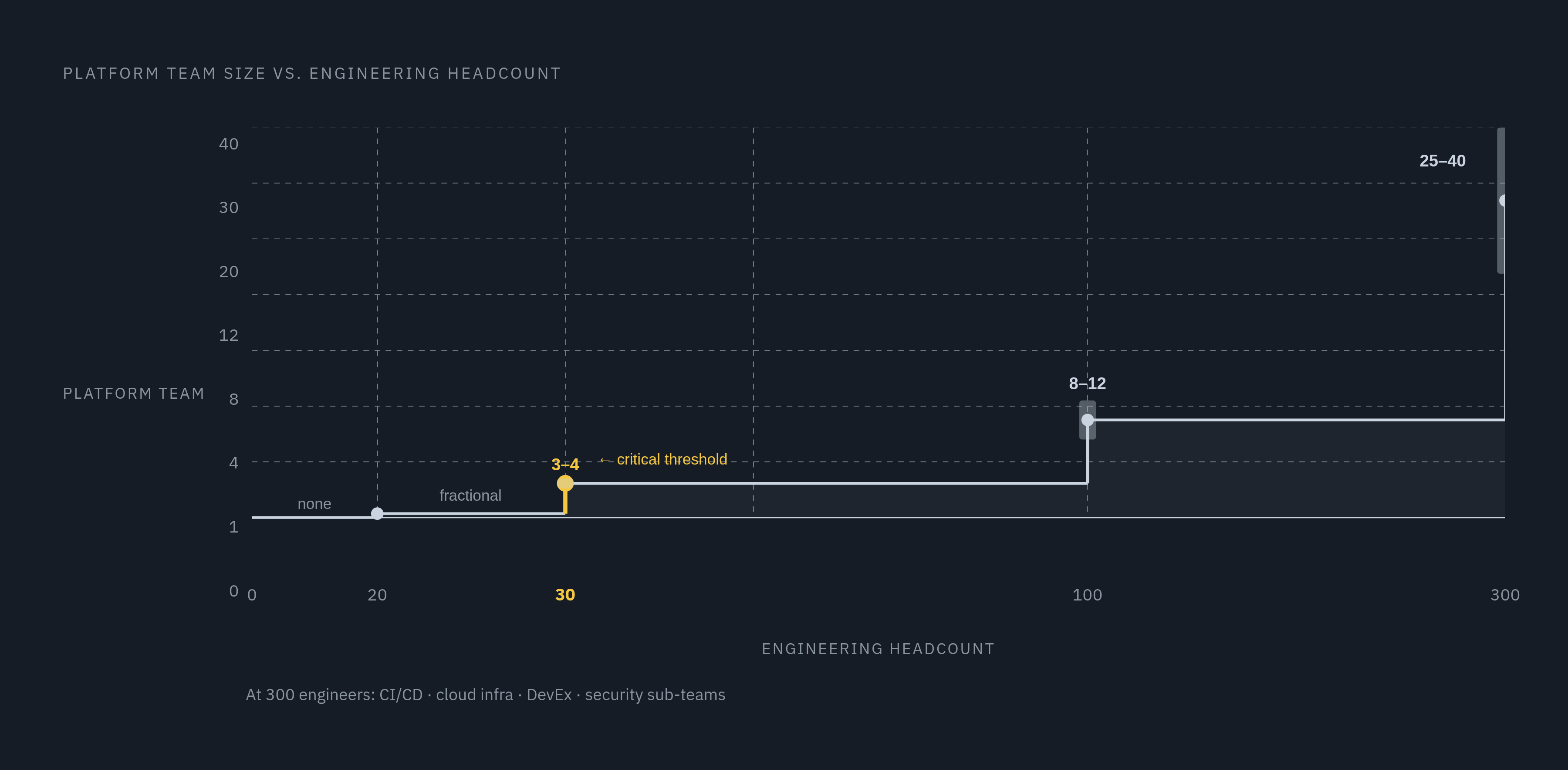
Below roughly 20 engineers, managed cloud services and a few shared conventions usually beat the overhead of standing up a dedicated function. Somewhere between 20 and 30 engineers, one fractional platform engineer, a senior IC spending maybe 20 to 40% of their time on platform work, is often the right shape for the problem. Above 30 engineers, the absence of a dedicated function costs teams in lost time and duplicated work, even though that cost never appears as a line item anywhere. Past 50 engineers, that cost is being paid regardless of what leadership decides. Whether that cost is being paid on purpose or by accident is the only open question.
Rough staffing ratios track the curve. An organization around 30 engineers tends to need a team of three to four dedicated to platform work. At around 100 engineers, that grows to somewhere between eight and twelve. By 300 engineers, the range runs from 25 to 40, usually split into sub-teams covering CI/CD, cloud infrastructure, developer experience proper, and security.
These are observed ranges, not a formula anyone should plug numbers into and trust blindly. A 40-person startup running a single well-maintained monolith on mature cloud tooling may need a fraction of what a 40-person team needs after inheriting five years of undocumented microservices from an earlier, less disciplined phase of the company. Headcount opens the window. Walking through it means looking at what's actually happening inside the engineering org.
The friction signals that indicate a team is already paying the cost
If two or more of the following signals persist for a full quarter, the case for a dedicated function, even a small one of two or three engineers, is already strong.
New hires taking multiple days just to get a working local environment running is a direct measure of how undocumented and fragile the setup process has become. Engineers losing meaningful time each day to deployment, environment, or infrastructure tasks is a tax that never appears as its own category on any report, it just quietly subtracts from feature work. When the time it takes a new hire to land their tenth meaningful pull request starts trending upward instead of down, the bottleneck is internal infrastructure, and adding more engineers into that bottleneck makes it worse.
Watch for five slightly different ways to deploy the same kind of service, or security gaps nobody actually signed off on, or the same integration problem solved from scratch by three separate teams who never talked to each other. The cognitive-load pattern appears at scale in exactly this way. And when teams start reporting that a significant share of their capacity goes to infrastructure work instead of product features, the hidden cost has stopped being hidden and become structural.
What ties these signals together is that none of them live on a product roadmap or a sprint board. They only become visible once somebody's actual job is to go looking for them.
AI coding agents raise the stakes on all of this. The same environment drift, missing documentation, and scattered tooling that slows down a human engineer's onboarding also degrades what an AI agent can do with a codebase, since these agents depend heavily on the context they can pull from the repo and its surrounding tooling. A DX problem in 2026 is also an agent productivity problem. It's an agent productivity problem too.
What a mature DX team owns as the org scales
Early on, a small platform team with generalist coverage owns a fairly contained set of things: CI/CD pipelines and build reliability, reproducible local dev environments, some standardization around deployment, and basic onboarding docs. Nothing exotic, just the plumbing that lets everyone else move.
As the org grows, the scope grows with it. Mid-maturity teams start building an internal developer portal and service catalog, scaffolding templates and internal CLI tools, and a real measurement program built around DXI, DORA, or the SPACE framework. Some organizations bring in a dedicated product manager at this stage, someone whose job is to define developer personas, prioritize the platform roadmap, and actually drive adoption rather than assume engineers will find the tools on their own.
Full maturity brings a role that didn't exist in the early scope at all: the DevEx engineer as a distinct title, separate from the infrastructure-focused platform engineer. This occurs once an organization passes roughly 80 product engineers, and it's usually hired once the platform team itself reaches five to seven people and the binding constraint has shifted from "can the platform do this" to "will developers actually use it." That's a different hiring profile entirely: frontend or CLI development skill, strong technical writing, real user research chops, and an internal-product mindset rather than an infrastructure one.
Large engineering organizations illustrate this scope in practice, with dedicated DevEx leadership focused on separating reactive support from strategic platform work so that service-owning teams can get back to their core responsibilities.
A mature DX team's time tends to split roughly 60% roadmap work, 20% support and incident response, 10% documentation and internal advocacy, and 10% training and upgrades. That 20% support number is also the trap. A DX team that lets reactive support creep past its allotted share loses the leverage that justified building the team. The charter needs real boundaries from day one, or the team quietly turns back into an infrastructure help desk with a nicer name.
Non-engineers and AI agents as part of the DX team's constituency
The traditional DX charter assumed product engineers were the only users who mattered. That assumption no longer holds.
Product managers, support staff, and new hires all need answers from the codebase on a regular basis: which service owns this behavior, where does this config live, what does this API actually do. Without some accessible way to get those answers, every one of those questions becomes an interrupt landing on a senior engineer's desk, which folds straight back into that 78% of engineers who named interruptions as their biggest productivity blocker.
AI coding agents add a genuinely new constituency. An agent working without full codebase context produces worse output, hallucinates more, and misses dependencies that cross repository boundaries, and the same fragmented tooling and stale documentation that slows down a human's onboarding limits what that agent can do too. JetBrains found that 90% of developers already use at least one AI tool at work.
Infrastructure for this is no longer theoretical. The Model Context Protocol, now governed by the Agentic AI Foundation as a directed fund under the Linux Foundation as of December 2025, has been adopted across essentially every major AI coding platform: Claude Code, Cursor, VS Code Copilot, Codex, Windsurf, Zed, Continue.dev, and others. Agent-context infrastructure is a plannable, budgetable piece of DX work now.
The same investment often serves both constituencies at once. A DX team that builds real code search and context infrastructure isn't choosing between helping human engineers and helping AI agents, the work benefits both. Tools that let a non-engineer ask a plain question about a repo and get an answer, without pulling a senior engineer off their work, are a direct example of DX infrastructure serving the full stakeholder map rather than just the original one. Self-hosted deployment of that kind of tool, keeping the actual code inside the company's own environment, tends to be the precondition that gets it past security review at any organization serious about adopting it.
Organizational signals that indicate formalization is overdue rather than premature
Acting too early has a real cost. Standing up a platform team inside a 15-person engineering org creates overhead that outweighs whatever friction it removes, and managed services plus a few shared conventions are the right tool at that size.
Acting too late has a cost too, and it compounds quietly. Every quarter of delay means more engineering capacity displaced into infrastructure work, onboarding curves that keep lengthening instead of flattening, and senior engineers slowly turning into an informal help desk they never signed up for.
A handful of signals, taken together, tend to mean the moment for formalizing has already passed. Senior engineers repeatedly acting as the default support tier for tooling and environment questions is one. New hire productivity curves flattening or lengthening rather than compressing is another. So is watching multiple teams independently build incompatible fixes for the same underlying infrastructure problem, or noticing that leadership can't answer a basic question like how long it takes to ship a change with any real confidence. Attrition among the most focus-oriented engineers is a lagging but reliable signal too: focus-oriented cultures report meaningfully lower turnover than interrupt-driven ones, and by the time that attrition becomes visible in the numbers, the underlying DX problem has usually been building for several quarters already.
The actual trigger is the overlap of enough scale, roughly 30 or more engineers, with enough sustained friction, two or more of these signals holding for a full quarter. It's the overlap of enough scale, roughly 30 or more engineers, with enough sustained friction, two or more of these signals holding for a full quarter. And the decision commits an organization to more than a hiring plan. It commits to a charter, a real measurement program, and a product mindset applied to internal tooling. Leaders who treat this as "go hire a couple of platform engineers" without that structural commitment tend to watch the team get pulled back into reactive infrastructure work within a year.
The clearest tell that formalization is already the right move rarely appears in a metrics dashboard. It appears in the calendar. Engineering leaders who find themselves spending real chunks of their one-on-ones talking through tooling complaints, environment setup problems, or onboarding friction are already paying for a DX function. It just doesn't have a name, a budget, or a charter yet.