How Engineering Leaders Evaluate and Standardize Codebase Navigation Tools at Scale
New engineers onboard faster when codebase navigation tools answer questions independently.

New engineers get productive faster when a codebase navigation platform can answer three questions without routing through a senior engineer: what does this service call, who consumes this API, and where is this data type used across the organization. That requires a tool indexing every repository continuously, not just the one checked out locally, deployed in a way that satisfies the organization's compliance posture, and accessible to people who have never written a line of the code in question. This article lays out the four-dimension framework engineering leaders can use to evaluate and standardize codebase navigation tools at scale: context depth, deployment model, non-engineer accessibility, and AI agent compatibility.
Codebase navigation as a structural problem in growing engineering organizations
A new engineer joining a 40-person startup can ask the one person who built the payments system how it works. Codebase navigation at that size depends not on individual skill but on how knowledge is distributed across the organization, and most organizations distribute it badly: understanding concentrates in a shrinking pool of senior engineers who become the default lookup table for everyone else.
That concentration creates cost in two distinct places. Both are structural failures, not individual ones. No amount of effort from any single engineer fixes a problem caused by the codebase outgrowing any one person's mental model of it.
The problem has split in two directions at once. The agent acts on what it can see locally. It has no way to act on what the organization knows collectively, because that knowledge was never made available to it.
This is not a context window problem, and expanding how much text a model can hold in memory does not fix it. A self-hosted code context layer such as Sourcebot indexes every repository continuously, so it gives both humans and agents access to that organization-wide evidence about cross-repository relationships before either one acts on a change.
The four evaluation dimensions that differentiate platforms at enterprise scale
Standardizing on a codebase navigation platform for an organization of any real size is a structural decision, and it holds up only when evaluated against four dimensions: how deeply the tool understands the full codebase, what its deployment model means for data security and compliance, whether it makes the codebase usable by people outside engineering, and how well it functions as a context layer for AI coding agents.
These four dimensions are not a checklist where a platform can compensate for weakness in one by strength in another. A tool that fails on deployment model cannot be adopted by a regulated team no matter how good its search or its agent integration is, because the compliance failure sits upstream of every feature evaluation that would otherwise follow.
Most existing evaluation frameworks for AI developer tools were built to score things like coding assistance quality, agentic execution reliability, software development lifecycle governance, model controls, enterprise administration, integration depth, and rollout risk. Codebase navigation tools sit at that intelligence layer, and they need their own framework built around context depth, deployment, accessibility, and agent compatibility, each of which gets its own treatment below.
Dimension 1 (How deeply a tool understands the full codebase, not just the file in view)
The single capability that separates serious codebase navigation platforms from everything else has nothing to do with how fast search runs or how clean the interface looks. It comes down to this: does the tool understand relationships across repositories deterministically, across the organization's entire codebase, rather than just the files a developer happens to have open at that moment?
Tools limited to the current diff or the local checkout miss an entire class of problems: cross-file bugs, architectural regressions, and the downstream effects of a change that only become visible when you can see the whole system at once. The question to put to any vendor making this claim is simple: does the platform index the entire organization's repositories continuously, or does it only work with what a given developer has checked out on a laptop?
There is a meaningful technical distinction behind that question, between deterministic static analysis and retrieval-augmented generation. Each layer does the job it's suited for.
The test for this dimension is direct. Can the tool tell an engineer, or an AI agent, which services consume a given API field, and trace the call graph across repository boundaries? Can it show where a data type is defined and where it's used across the whole organization? Sourcebot's approach illustrates what this looks like in practice: a self-hosted instance that surfaces cross-repo relationships and usage patterns organization-wide, built on the idea that static analysis should discover structural facts. Whatever platform an organization chooses, the answer to this dimension sets whether everything built on top of it, including every AI agent given access to it, is working from real evidence or a guess dressed up as one.
Dimension 2 (What the deployment model means for code security and regulatory compliance)
Deployment model is the single most consequential security decision in this evaluation: it sets whether an organization's source code ever leaves its own boundary, and for regulated industries, whether a given platform can legally be used.
For regulated industries, this is not a preference but a hard requirement. PCI-DSS v4.0 recommends network segmentation as the practical way to shrink the scope of the cardholder data environment, without mandating it. A self-hosted architecture satisfies each of these by design, because the code and the data processing never leave the authorized perimeter.
"Self-hosted" deserves scrutiny rather than being taken at face value, because the term covers more than one real architecture. The question engineering leaders need answered is where both the code and the model inference actually run, not just where the interface sits. For European regulated customers, this matters even more directly: tools that send code and prompts to US servers fall under the CLOUD Act and FISA 702, and code stored in EU data centers is not shielded from US government requests simply because of where the disk sits.
GitLab Duo Self-Hosted supports deployment across on-premises infrastructure or private clouds through platforms including vLLM for on-premises use, AWS Bedrock, Azure OpenAI, Anthropic, OpenAI, Amazon Bedrock Mantle, and Gemini Enterprise Agent Platform. Sourcebot takes a more compact approach to the same boundary requirement: it deploys as a single Docker container inside the organization's own infrastructure, so code never leaves the customer's environment, satisfying the hard boundary without requiring a multi-component deployment to get there.
The practical questions for this dimension: where does code go during indexing and during querying? Where does model inference actually run? What does the vendor's data retention policy say in writing? Which regulatory frameworks does the deployment architecture satisfy by design?
Dimension 3 (Whether the platform makes the codebase accessible to non-engineers, not just senior developers)
A platform that only senior engineers can use well has not solved the organizational gap described at the start of this piece. It has only moved that problem onto a screen. The real test of a codebase navigation platform at scale is whether a product manager, a support engineer, or a brand-new hire can get a useful answer directly from the codebase, without a senior engineer sitting in the middle translating.
The actual cost here is not slow onboarding, though that's real too. Product managers, support staff, and technical writers hit the same gap, because they need answers from the codebase regularly and currently get them only by asking an engineer directly.
The industry has started to notice this problem even at the agent-harness layer. Claude Code shipped a built-in /team-onboarding command in version 2.1.101 in April 2026, and it generates a ramp-up guide from a developer's local Claude Code usage. It's a genuinely useful feature that covers part of onboarding, but because it works from one developer's local activity rather than the full repository graph, it doesn't replace organization-wide code search. It's a guide generated from what one person did, not an answer to what the whole codebase actually contains.
Can a product manager or a new hire type a question in plain language and get a useful answer without pulling an engineer into the conversation? Does the platform actually reduce the volume of questions landing on senior engineers, or does it just give them a nicer interface to answer the same volume through? Sourcebot's chat interface gives PMs, support staff, and new hires a natural-language way to query repositories and connected project tools like Jira or Linear directly, which is built specifically to pull that interrupt load off engineering teams rather than add another tool engineers have to maintain on top of their existing work.
Dimension 4 (How well the platform serves as a context layer for AI coding agents)
AI coding agents have moved from experimental to standard in enterprise engineering workflows, and a codebase navigation platform's real value now depends on whether it can act as a reliable, structured context layer for those agents, not just a search tool for humans typing queries by hand.
None of the major agent harshness, Claude Code, Codex, Cursor, or Copilot, solve this problem on their own. What they determine instead is whether that action is correct given everything the organization actually knows about its own system. That gap is exactly where a dedicated context layer earns its place: an agent can be perfectly capable of writing the code to deprecate a field and still be wrong about whether deprecating it is safe.
The Model Context Protocol, or MCP, has become the standard delivery mechanism for getting structured code context into these agents. MCP now sees over 97 million monthly SDK downloads, and the Linux Foundation's newly formed Agentic AI Foundation took over governance of the protocol following Anthropic's donation of it in December 2025. That shift matters because it makes MCP vendor-neutral infrastructure, and a platform that exposes its code intelligence through MCP becomes compatible with every major agent harness.
That architecture produces a useful decoupling. An engineer can query a code intelligence platform through Claude Code while a colleague uses Cursor for the same task, and both can receive identical organization-wide context through MCP, because the intelligence layer sits separately from whatever tool is consuming it. This is the same pattern visible in how coding agents work without a context layer at all: an agent limited to local repos only sees what's on the machine in front of it, while the same agent connected through MCP to a platform like Sourcebot can draw on the company's full set of repositories instead.
The number of MCP servers a platform connects to is not the measure of sophistication here. The questions for this dimension follow directly from that: does the platform expose its code intelligence through MCP? Does it allow bring-your-own-model flexibility, or does it lock agents into one specific LLM? And can it serve multiple agent harnesses at once from a single indexed source, so the organization isn't maintaining separate context pipelines for every tool its engineers happen to prefer?
Sequencing the four dimensions into a decision process
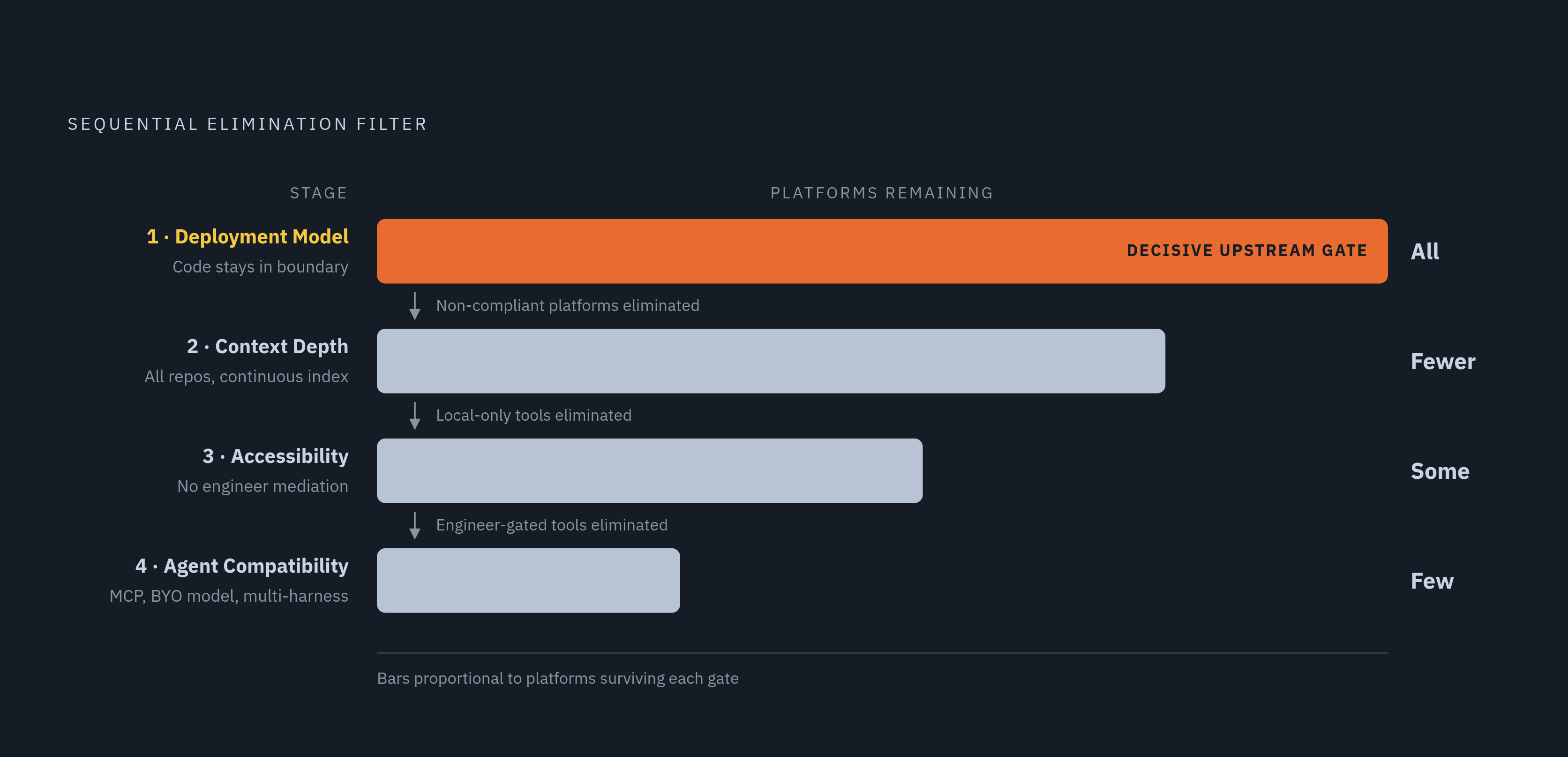
These four dimensions work best as a filter applied in sequence, not a scorecard where strong performance in one area offsets weakness in another. A platform that fails the deployment model test should never reach an agent compatibility evaluation, because no amount of feature depth compensates for a compliance gap that makes the tool unusable.
The sequence that follows from the framework above starts with deployment model because it is the dimension that eliminates options before any other criteria are applied. Accessibility comes third: test whether someone outside engineering, a PM, a support engineer, a new hire, can get a useful answer from the codebase without an engineer mediating the question, which shows whether the platform actually lifts the interrupt load off senior engineers or just repackages it in a friendlier UI. Agent compatibility comes last: confirm MCP support, confirm the platform allows bring-your-own-model flexibility, and confirm it can serve multiple agent harnesses from a single indexed source, since this is the dimension that shows whether the platform can grow alongside the organization's agentic roadmap or will need replacement in eighteen months.
That roadmap matters in the evaluation itself. A platform should be judged against where the organization stands today and where its AI agent usage is clearly heading, at the same time, in the same evaluation. A tool that handles today's human navigation needs well but has no MCP layer at all will need to be replaced the moment agent workflows mature past the experimental stage, and that replacement cost is easier to avoid at evaluation time than to absorb later.
If you want the lowest-risk way to run this entire process, pick platforms with free-tier or self-serve adoption paths, because that lets an engineering team index its own real repositories and test all four dimensions before any procurement conversation starts. Compared against other paths engineering teams weigh, like adding codebase search inside GitHub Copilot or Cursor, standardizing navigation within GitLab or Azure DevOps, running an internal index through OpenGrok, or extending an existing Cody deployment, the same four-dimension test applies evenly: context depth, deployment model, accessibility, and agent compatibility, checked in that order, against the organization's own code.