Self-Serve Codebase Discovery as the Default Onboarding Path for Engineering Teams
New hires explore code themselves instead of asking seniors for every answer.

Engineering onboarding is faster when new hires can explore the codebase themselves instead of taking every question to a senior engineer. Self-serve codebase discovery makes that investigation the default path, supported by automated access, service catalogs, and queryable code context. This leaves seniors more time for product judgment, organizational history, and helping new hires join the team.
Why the standard engineering onboarding model is structurally broken
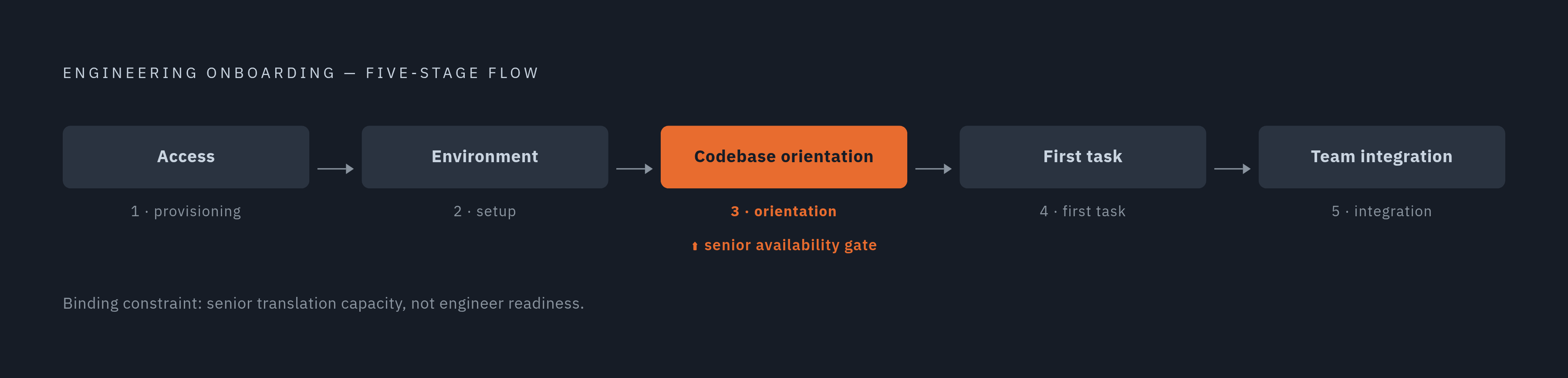
The standard onboarding model makes senior availability a prerequisite for progress. Its five stages are familiar, namely access provisioning, environment setup, codebase orientation, first task, and team integration. But when these stages are done by hand, each new hire brings a series of tickets, messages, and walkthroughs for senior engineers and platform staff. Hiring compounds that load. When teams add engineers aggressively each quarter, the translation work can absorb a full-time equivalent that would otherwise go toward platform work.
Documentation does not remove this dependency when it drifts within weeks of merged PRs. A README or wiki can look authoritative while pointing to a deprecated service or a changed workflow, sending the reader back to someone who knows the current system. When new hires rely on people to guide them, that time includes waiting for walkthroughs as well as reading unfamiliar code. The binding constraint is senior translation capacity.
How queryable codebase discovery changes what the bottleneck is
The deployment mistake is to give an AI coding tool to the senior engineer and leave the new hire dependent on their explanations. Pairing may become faster, but the calendar remains the gate. Giving the investigative interface directly to the new engineer changes the dependency instead. Questions that the repository can answer no longer need to pass through a person before work can proceed.
An agent scans the directory tree, uses search tools such as Grep, Glob, and LSP to locate relevant files, and reads them selectively. It may follow import chains to get enough context to explain how the code fits together. The new hire directs the investigation through questions. This lets them pursue a feature or dependency at the point of need.
Different questions still require different answer surfaces. “Where do I start” needs a map, “how does this flow work” needs a tour, “how do we deploy” needs a runbook, and “who solved this before” needs searchable answers. Queryable discovery covers codebase investigation, while supporting tools supply process and recorded knowledge. Seniors remain necessary for product strategy, organizational history, and decisions that lived in meetings. Their conversations can therefore begin with a specific uncertainty rather than an open-ended request to explain the system.
What a self-serve first week actually looks like in practice
Day one begins with access and a working environment. The new engineer logs into an internal developer platform and provisions an environment from a service catalog without filing a ticket or waiting for the platform team. The setup gives the engineer SSO credentials, source control access, CI/CD visibility, and cloud permissions. Local build and test must pass. An environment that matches production configuration gives the engineer a place to start work as well as a set of accounts.
The software catalog then answers where things live. Service ownership, dependency maps, API documentation, architecture decision records, and coding standards provide an orientation surface without requiring a human guide. Cycloid targets this stage at two to four hours. From that map, the engineer moves into direct codebase queries about how a feature works, which files touch an area, or why a service has two implementations. These are investigations into the current repository.
Setup distribution supports this work but is distinct from it. Anthropic’s Claude Code v2.1.101 ships a built-in /team-onboarding command in April 2026 that generates a teammate ramp-up guide from the running user’s local usage patterns. It makes tooling knowledge available on day one instead of leaving it in a senior engineer’s muscle memory. It does not replace exploration. The guide distributes setup knowledge, while direct queries explain the code the new hire is about to change.
Cycloid targets a first PR merged to main by day one or two as the new hire’s first real task, with code review testing whether access, environment, and workflow function end-to-end. Through the rest of the week, unresolved questions become targeted escalations about product or organizational context. The senior conversation starts after investigation. A first merged PR in week one is the measurable signal that this path is working.
What tools help new engineers and AI agents search an unfamiliar codebase?
The useful comparison is by the question the new hire keeps asking, where the answer appears, and what work keeps it current. Repository-generated knowledge serves a different purpose from an authored tour. A service catalog also leaves a need for a deployment runbook and a record of problems the team has already solved. Fit depends on the missing surface.
Repowise covers repository orientation with a generated wiki for every source file, a dependency graph, ownership from git history, and a risk view. Its onboarding collection includes Getting Started, Key Concepts, How It Works, Active Landscape, and Glossary. This fits the transition from an initial map to focused investigation. Its MCP tools let agents ask for answers grounded in the repository, context, symbols, and code search. Generation from the repository reduces dependence on handwritten explanations, while its October 2026 pricing places two public repositories on hosted Free and private repositories on Pro, with an open-source engine.
Claude Code fits the direct-investigation stage. Anthropic documents an “Understand new codebases” workflow with example prompts that an engineer can use in the first hour. It reads selected files to get context as questions come up. This avoids requiring an authored tour for every investigation. The separate onboarding command distributes local tool setup, so its role should not be confused with a maintained map of the organization’s services.
CodeTour covers a narrower, curated route through a workflow. The free VS Code extension records file-and-line guidance as JSON .tour files in a .tours folder, so tours travel with the repository and can be reviewed in a pull request. It helps new hires find their way through one critical flow early on. Someone still has to author and own it. That maintenance requirement makes it a good fit for small teams with a defined workflow worth explaining explicitly.
Backstage provides the broader service-level map. The open-source developer portal framework from Spotify, a CNCF incubating project, combines a software catalog, project templates, and TechDocs for docs-as-code. It fits the access and orientation stages for organizations running dozens of services that need a unified ownership and dependency view. The software is free, but operation is not effortless. Significant setup and maintenance work accompanies the shared portal.
Confluence and Notion cover process documents, checklists, and runbooks, particularly the question of how deployment works. They help with environment setup and the first real change, when the engineer needs more than the repository’s structure to learn how the team does the work. Their recurring cost is editorial ownership. Unless someone updates them as code ships, instructions drift and restore the need for human translation.
Stack Overflow for Teams / Stack Internal covers private Q&A and validated team knowledge. It fits the point when a new hire needs to discover who solved a similar problem before escalating it. Its value depends on an accumulated body of solved problems. This surface rests on answers that people record and validate, so it complements code search.
Why enterprises with large or sensitive codebases need the self-hosted variant
For regulated or security-conscious enterprises, deployment boundaries narrow the tool choice before features do. The privacy assessment asks what code context leaves the developer’s machine, who can use it for model training, and whether telemetry can be audited or disabled. Local execution is not sufficient. A tool can run locally while sending prompts and code to an external model provider, including when its execution environment is described as self-hosted.
That distinction becomes consequential when an agent reads surrounding context automatically. If that context contains Protected Health Information and is transmitted externally without authorization, a HIPAA-governed organization may have made an unlawful disclosure. The runtime is the security boundary. On a laptop or build server, an assistant may have access to source code, secrets, .env files, credentials, cloud CLIs, SSH keys, and production-like data. The assessment must therefore cover more than the file the engineer meant to discuss.
A fully internal deployment addresses this constraint structurally only when code context stays within the approved environment. Self-hosted code intelligence can give the organization control over repository access and preserve its choice of model or LLM provider through bring-your-own-model flexibility. It is not permission to ignore the destination. The chosen model setup must meet the same boundary requirements as the discovery platform itself.
The comprehension debt objection and what it means for how teams should deploy self-serve discovery
A secure deployment can still produce a learning failure. Comprehension debt builds up when engineers can use a tool to find their way through code but cannot reason about it on their own. Anthropic published a randomized controlled trial in January 2026 on how AI-assisted coding affects the way junior engineers build skills. The concern is directly relevant to onboarding. Shipping in week one does not establish that an engineer can explain the system when the tool is absent or fails.
The objection is strongest for genuinely junior engineers who are learning to reason about code structure for the first time. For experienced engineers joining an unfamiliar repository, the tool more often speeds up finding their way around than learning to understand code. Those are different learning tasks. A deployment model that treats them as interchangeable risks mistaking successful navigation for understanding. Early delivery is therefore a useful operational signal, but not a complete account of learning.
The response is deliberate senior engagement. Seniors can spend their time on why an architecture was chosen, which tradeoffs were accepted, and what decisions never entered the repository. Cultural integration also belongs with people. A codebase tool cannot explain norms, how people work together, or how decisions actually get made. Reports of productivity plateaus after early AI adoption further argue against treating discovery as a set-and-forget intervention.
The division of work is precise.
How engineering leaders can make self-serve discovery the organizational default
Access, SSO, RBAC, the software catalog, and environment provisioning must work without tickets before independent investigation can become the default. Otherwise, the engineer has a discovery tool but remains blocked from using the system. Automating this layer comes first. Cycloid describes setup checklists whose completion time can fall from days to hours with the right platform arrangement.
The next change is to instrument time-to-first-merged-PR as the primary onboarding indicator. Cycloid reports time-to-productivity under a day for automated self-service onboarding, but productive activity and a merged PR are not interchangeable measures. A team needs a consistent endpoint. Measuring the merge establishes whether the new hire has completed a real change through review.
Senior questions provide the companion diagnostic. Leaders should audit whether interruptions concern codebase-answerable details, such as service behavior and configuration locations, or human context, such as architectural intent and roadmap ownership. The former belong in the self-serve layer. The latter justify senior attention, including when an apparently technical question turns out to depend on an undocumented decision. The same distinction can reduce interruptions from PMs, support staff, and other non-engineers using the shared interface.
For enterprise teams, deployment eligibility should precede feature evaluation. A self-hosted platform that indexes all repositories and exposes natural-language search can support the model where external code transmission is prohibited. Teams that can use a free tier can test it on real repositories they are allowed to use before they commit to buying it. The proof belongs in actual onboarding. In the next hiring cycle, leaders should look for a shorter time to first merged PR and fewer codebase-translation interruptions for senior engineers.