Why Wikis and Confluence Pages Fail as Code Knowledge Systems
Static documentation decays faster than code changes, making wikis unreliable for engineering teams.
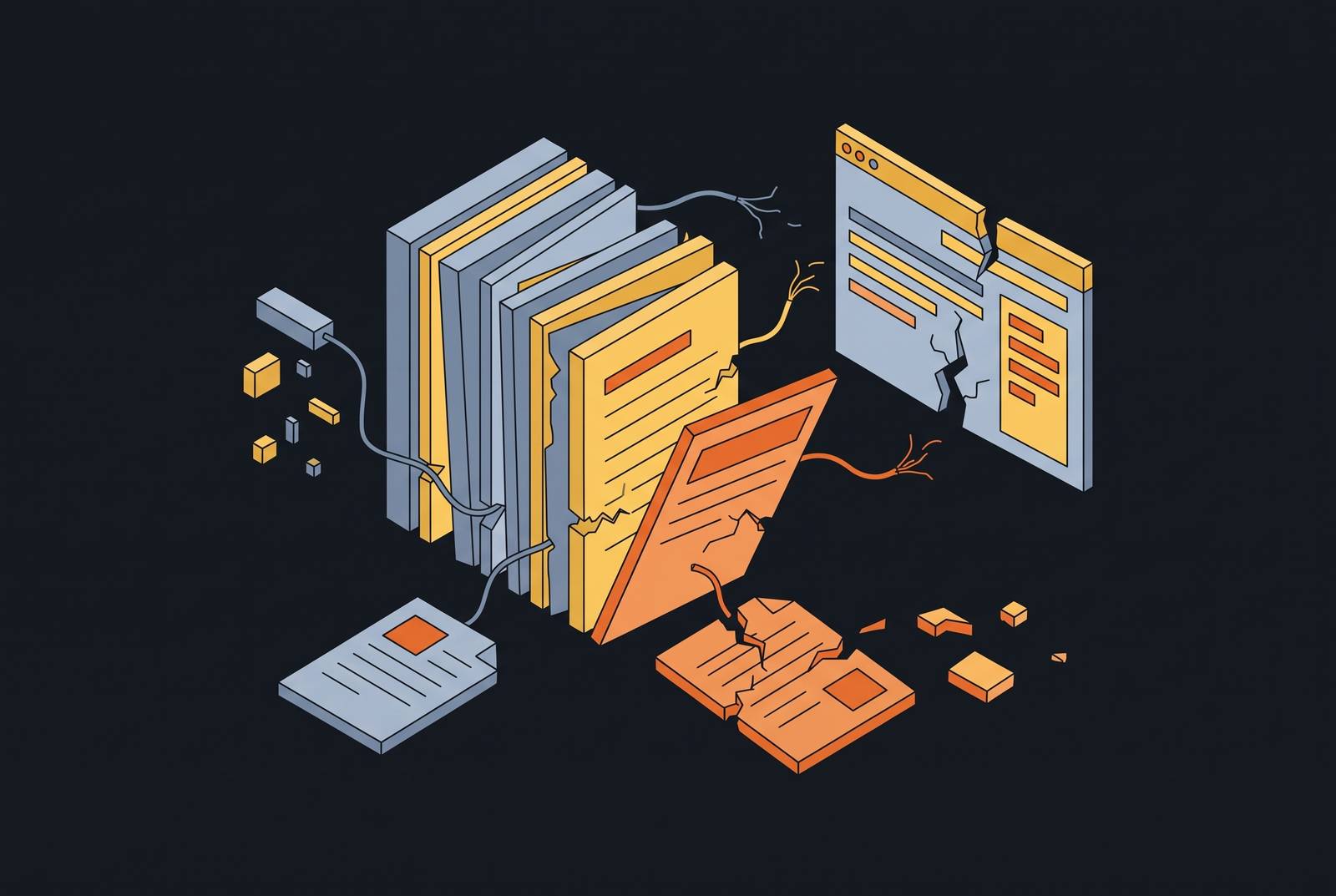
Wikis and Confluence pages fail as code knowledge systems because they capture a moment in time, and the codebase they describe keeps changing underneath them. The mismatch is structural, a matter of the gap that widens with every commit made after the page is published.
Documentation written at a point in time cannot describe a system that keeps changing
A wiki page is a record of what someone understood at the moment they wrote it. That moment is almost always during a feature launch or in the days just after, when the engineer's understanding of the system is at its sharpest and the motivation to write it down is highest. The page gets published, the feature ships, and the engineer moves to the next piece of work. Meanwhile the code does not hold still. A refactor renames a module. An endpoint gets deprecated. A dependency changes behavior in a way that alters what the original page describes. None of these events trigger a revision to the page that described the old state, so the page simply continues to exist, unchanged, while the system it was written to explain moves further away from it with each release. This is the basic nature of a document, not a failure of any particular team's habits: it is static by construction, written once and read many times, while software is dynamic by construction, rewritten continuously and read only in its current state. A knowledge artifact built on the first model cannot stay accurate about a subject that only exists in the second.
Confluence's design choices make the decay problem worse at scale
Confluence is the platform most enterprise engineering organizations use to hold this kind of documentation, and its architecture makes the resulting documentation go stale faster and more thoroughly rather than slowing that decay. The platform has no built-in, out-of-the-box connection to GitHub, GitLab, or the CI/CD pipelines where code actually changes. Wiring that connection up requires third-party Marketplace apps or custom API scripting, and even then, every API change, every refactored module, every deprecated endpoint still requires a human to go find the corresponding page and update it by hand. At scale, across hundreds or thousands of pages, that update simply does not happen with any reliability. Search compounds the problem rather than compensating for it: Confluence's base engine matches keywords across page body, titles, labels, and attachments, which only helps someone who already knows roughly what the answer looks like. Atlassian's Rovo AI now layers intent-aware semantic search on top of that keyword engine, but a developer who does not already know the answer still has no reliable way to find it, because the tool can only search what has been written, not what is currently true. Governance is similarly manual. Confluence offers basic page versioning, but review reminders have to be configured by hand, through the platform's built-in Automation feature or a third-party app, and pruning stale pages is left entirely to the team. The administrative overhead this creates leads directly to what amounts to knowledge rot: pages survive long after they stop being accurate, because nothing in the platform forces anyone to confront them. Past a few thousand pages, search struggles to surface the right document at all, and nothing flags that three different versions of the same setup guide are all still live. Stale and duplicate documentation accumulates faster than any team can prune it.
The organizational posture of a wiki that drives engineers to stop feeding it
Writing documentation requires the person with the most current knowledge of a system to stop doing the work that system was built for, and that trade-off consistently loses to feature work. Documentation tends to get written during the energy of a launch, when the motivation is highest, and then abandoned, because the engineer who could update it has already moved on to the next problem by the time the first update is due. Knowledge fragments further as it spreads across Confluence, Google Docs, Notion, and README files scattered through various repositories. With no single authoritative source among them, trust in any one of them erodes, and the wiki becomes one more place to check rather than the place to check. Once that trust is gone, information retreats into the heads of the senior engineers who actually know how the system behaves today. Retrieval becomes interrupt-driven: "where is X?" on Slack becomes the organization's real knowledge system, and it taxes deep work across the entire team every time someone asks. A fair objection to this account is that disciplined organizations do maintain wikis well, and that is true for process and project knowledge: incident retrospectives, team norms, roadmaps. Those artifacts describe decisions and conversations that happened once and stay true. Code knowledge is different because the thing it describes keeps changing after the page is written, which is precisely the kind of knowledge a wiki is structurally unable to keep pace with.
What happens to new engineers and non-engineers when the wiki cannot be trusted
The people most dependent on documented code knowledge are the people least equipped to notice when that documentation has gone stale. A new engineer following an outdated runbook or an outdated architecture diagram builds a wrong mental model of the system from their very first week, and onboarding time stretches because the information in front of them is actively misleading. A product manager or a support engineer asking how a feature actually works has no direct path into the codebase to check. They either interrupt a senior engineer to ask, or they trust a wiki page that may be months out of date and pass that misunderstanding along to a customer or a roadmap decision. The interrupt load on senior engineers does not disappear in either case. They answer the Slack question directly, and the same question resurfaces later, after the wrong-wiki-page mistake has already surfaced downstream and someone has to untangle what went wrong. It compounds, because more people join, more questions accumulate, and the same small group of senior engineers who could answer them correctly becomes a bottleneck for an ever-larger organization.
How AI coding agents expose the wiki's failure at a second layer
Wikis were already a broken knowledge system for the humans who depended on them, and they are the wrong input for AI coding agents for a related but sharper reason: an agent consuming stale documentation has no way to know it is wrong, and it will not say so. A human reading an outdated page might sense something is off, notice an inconsistency, or ask a colleague to confirm. An agent reasoning from the same outdated page builds its entire output on that incorrect premise and produces something that looks plausible but is subtly wrong, the kind of error that takes longer to debug than writing the code without the agent's help. The infrastructure connecting agents to external tools and data has standardized around the Model Context Protocol, which was donated to the Linux Foundation's Agentic AI Foundation in December 2025. Static wiki pages cannot speak that protocol natively, so any attempt to use a wiki as agent context requires custom integration work, adding the same ongoing maintenance burden that caused the wiki to go stale. An agent that cannot tell a wiki page written months ago from the current state of the repository is a liability that requires a human to check every output before it can be trusted.
The security dimension: why feeding wiki pages into cloud AI agents is a distinct risk
Feeding Confluence pages into a cloud-hosted AI agent as context introduces an uncontrolled data surface into a pipeline hosted entirely outside the organization, one that lacks the audit trail, versioning, and access controls the repository itself already provides. Cloud-based agents send code and surrounding context to provider servers governed by that provider's own privacy policy, a direct concern for any team operating in finance, healthcare, or defense, where the handling of that data is a regulatory matter rather than a preference. Enterprise privacy postures increasingly require that code be processed locally rather than uploaded to a third party, and a wiki-as-context approach violates that requirement by design the moment it is queried through a cloud-hosted model. A wiki page exported as context for an agent sits entirely outside the repository's permission model and its audit trail. It carries no version tag against the code it claims to describe, and the agent consuming it has no way to check its provenance. Self-hosting the agent runtime addresses part of this, but it is not sufficient on its own: the model inference path itself has to be controlled, and the knowledge layer feeding the agent has to be code-native and access-controlled from the start, not bolted on after the fact.
What a Code-Native Knowledge System Must Do
A knowledge system that stays accurate about a codebase has to be indexed against the code itself rather than maintained in a separate document store describing the code from a distance. The codebase is the authoritative source, and any knowledge layer worth trusting derives from it directly rather than summarizing it periodically. That means indexing repositories for semantic and structural search across the actual code, not keyword search across pages written about the code, so the answer to "how does this work?" comes from the code as it exists right now rather than from someone's summary of it written eight months ago. Natural-language query over the codebase gives non-engineers, product managers, support staff, new hires, direct access to ground-truth answers without routing every question through a senior engineer, which breaks the interrupt-driven retrieval pattern the wiki model produces. Context delivered to AI agents has to be code-native and current: repository structure, types, tests, architecture decision records, and recent changes, not an export of a Confluence page. MCP-based connectors that surface project management context from tools like Jira, Linear, or Confluence alongside code search let that knowledge layer stay comprehensive without making the wiki the source of truth for the code itself. Deployment inside the organization's own infrastructure, rather than a cloud service that receives code as input, keeps the knowledge layer from becoming a data exfiltration surface in its own right. A self-hosted platform that deploys as a single Docker container lowers the barrier to building this: teams do not need to construct a bespoke code intelligence stack from scratch to get these properties, and they do not need to accept a cloud vendor's data handling terms to get search that performs at an enterprise standard.
The codebase itself as the new source of truth, with AI as its interface
The shift underway is a move away from documentation as a separate artifact altogether, toward the codebase itself as the knowledge source, with AI serving as the interface that makes that source accessible to everyone in the organization, engineers and non-engineers alike. When any engineer, product manager, or support person can ask a plain question and get an answer derived from the current state of the repositories, the maintenance burden of a parallel documentation system stops mattering, because the need for it as a retrieval mechanism gets replaced by something that cannot go stale in the way a page can. The parallel to platform engineering is instructive here. Kubernetes complexity gave rise to dedicated platform teams who own the infrastructure layer on behalf of everyone else, and AI coding adoption is producing a similar context-engineering layer now: people and systems whose job is to own what agents know, not just what agents are capable of doing. That context layer has to be code-native, access-controlled, queryable, and extensible to the adjacent tools teams already rely on for project management and tracking, properties the wiki never had for code. Teams that build toward this architecture reduce the interrupt-driven retrieval that burns senior engineers' time, shorten onboarding for everyone who comes in behind them, and give their AI agents the full-codebase context that makes an agent's output something a team can trust rather than something it merely hopes is right. The question facing engineering leaders now is not how to get more discipline out of a wiki. It is whether to keep maintaining a model that was never built to track a living system, or to replace it with one that was.
Sources
- Knowledge Activation: AI Skills as the Institutional Knowledge Primitive for Agentic Software Development
- Codified Context: Infrastructure for AI Agents in a Complex Codebase
- Context Rot in AI-Assisted Software Development: Repurposing Documentation Consistency for AI Configuration Artifacts
- content: When AI Coding Agents Read Stale Docs, They Implement Them by frances720 · Pull Request #1102 · Promptless/promptless.ai
- We Are Not There Yet: The Implications of Insufficient Knowledge Management for Organisational Compliance
- Confluence Updates by Atlassian - August 2026 - Releasebot
- Emerging Enterprise Security Risks of AI